
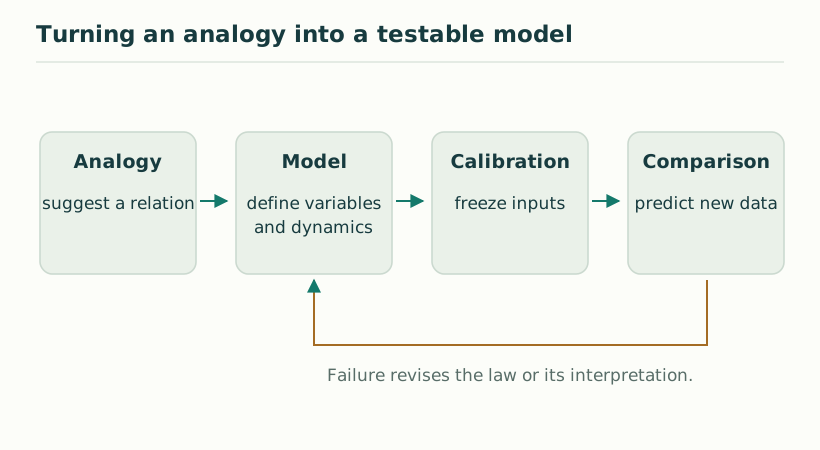
The bridge from SMM/DTT intuition to physics consists of explicit source dynamics, readouts, calibration, and comparisons that could fail.
Choose a question the model can answer
The idea that inner activity can occur before an outer result becomes available is accessible. To make it precise, choose a narrower question: can an intermediate update depend on hidden information while the completed visible update does not?
This asks for a mechanism rather than a picture of everything at once. A successful example would establish possibility under stated assumptions. It would not yet explain space, matter, or a measured time scale. Time Chest supplies motivating questions, while the related mathematical articles help identify which definitions make those questions answerable. Starting with one definite task allows an accessible calculation to carry real explanatory weight.
List the information the model actually keeps
Use two bits a and b, a phase bit c, and a nonnegative integer counter k. The visible bit is a; b is initially hidden. The phase c takes values zero and one and marks the two internal steps. The counter k records completed pairs.
Define one autonomous update: flip a when b=1, leave b unchanged, toggle c, and add the old value of c to k. Starting at c=0, the first step leaves k unchanged and the second increases it by one. The counter is an explicit memory resource. For a finite device it has a maximum value, so the following description applies only before overflow.
Calculate the inner steps and the completed result
Start from (a,b,0,k). After one update the state is (a XOR b,b,1,k). After the next update, XOR with b cancels the first flip and the result is (a,b,0,k+1).
If a=0, the hidden alternatives b=0 and b=1 give different intermediate visible bits. At the two-step boundary they agree again. Define completion as c returning to zero and define the completed record as R=(a,k). Its update is exactly (a,k)↦(a,k+1), independent of b. Thus an inner prefix can reveal a distinction that the completed update cancels.
The calculation makes the observation schedule important. An observer permitted to inspect c=1 can detect the hidden bit; an observer restricted to completed boundaries cannot do so with this readout and these dynamics.
Assign a clock without hiding the calibration
Give each completed pair a positive duration δ and define τ=kδ. The model then predicts that a remains unchanged while the clock advances by δ per completion. The bit counter establishes order; δ supplies the conversion to duration units.
That relation is a stipulated clock interface in this example. To make it physical, one would build a material clock, specify its interaction with the two update phases, and compare its readings with an independently defined reference. A source theory would be stronger if it selected the same conversion that controls another observable, such as signal propagation. Dimensional consistency alone cannot provide the numerical value or universal validity of that conversion.
Relate the example to the nested DTT proposal
This two-step cancellation illustrates the distinction between unfinished inner work and a completed update. It is not a derivation of the six inner roles. In the DTT architecture those roles are nested dependencies, with the seventh outer role making a result available.
A six-role implementation needs its own state, carry structure, retained dependencies, and completion rule. The paired-readout construction in A126 is one explicit example, with successive ranks one, one, two, two, three, three under a supplied pairing. Rank identifies independent readout directions; it does not fix a distance metric, physical clock, or force law. Each additional claimed consequence should be connected to an assumption and a calculation.
Design a failure that the observer can detect
Change the second inner operation so that it does not undo the b-dependent flip. Then a completed record starting at a=0 ends at b. The completed a-only prediction now fails: initially identical visible states can give different later outputs. Retaining b would restore prediction, while keeping only a would require an enlarged model or a changed interface.
This controlled modification identifies what did the explanatory work: cancellation in the completed dynamics, rather than the names inner and outer. A useful test fixes preparations, permitted operations, and readout times before comparison. Agreement at one chosen input is weaker than agreement for all inputs admitted by the stated claim.
Build the next layer only when it has a job
Write a short model ledger: states, update, initial preparation, completion condition, readable quantities, calibration, and predicted comparison. For each new symbol, name the operation that could determine it. For each conclusion, identify whether it was calculated, assumed, or proposed for later testing.
Continue with A21 for autonomous generation, A92 for predictive completion, and A126 for nested readouts. The aim is to retain the conceptual ambition of SMM and DTT while making every link inspectable. A small exact construction is useful because it tells the reader what works, why it works, and which additional relations a more complete account must still explain.
Continue with the articles
- The Cosmic Computer
Develop the cosmic-computer analogy as a way to discuss ordered generation and observable output. Clarify which aspects are metaphorical and which require an explicit computational model.
- The 'Chest' of Time
Introduce the chest of time as a conceptual image linking containment, succession, and manifestation. Build a glossary before connecting the image with later book discussions.
- The Three Hypotheses of the Single Monad Model
A reading guide to the three hypotheses of the original Single Monad presentation. Separate each premise from the consequences later attributed to the combined framework.
- Retained observations versus predictive states
Ask when retained information is sufficient to predict future outputs autonomously. Explain the completion criterion and why keeping observations need not keep every dynamically relevant distinction.
- A protected material clock
Describe the model that realizes resolution-only evolution through protected couplings. Explain which interaction restrictions protect the clock and how a controlled perturbation breaks that protection.
- Six inner stages and one publication interface
Explain the hierarchy of readout ranks 1, 1, 2, 2, 3, 3 followed by completion. These are nested functional roles rather than six independently readable temporal coordinates.
- Why a bare source does not imply spacetime
Introduce the obstruction showing that source order alone lacks enough structure to fix Lorentzian geometry. Use it to explain the role of the reconstruction’s additional assumptions.
- How a protocol can reveal dual-time structure
Outline ways to move beyond the finite prepared linear interface: protocol-dependent access, noncommuting transport, or richer memory. Each route must be defined as an observable procedure.
- Reading Volume IV: Time Chest
A reading guide centered on the volume’s particle–wave and temporal-confinement themes, with questions for a later illustrated expansion.