
Observation creates or accesses correlations under specified operations. A record can be physically meaningful without identifying it with conscious experience or a complete predictive state.
Begin with a detector rather than an external spectator
A thermometer, a camera sensor, and a memory circuit can all participate in observation. They interact with a system and produce distinctions that another operation can later read. Describing this process does not require a person to inspect the display at the moment the interaction occurs.
The conceptual importance for SMM is that observers are among the phenomena whose common origin is being investigated. They cannot stand outside the model and supply its missing clock, memory, or result-selection rule. DTT places the issue at the passage from formation to completed availability: what interaction produces an accessible distinction, and what keeps it useful for a later comparison?
Copy a specified classical alternative
Let s be a classical system bit and m a memory bit initially zero. The reversible operation m↦m XOR s writes s into memory. Reading m then distinguishes the two possible preparations. If the memory starts at one instead, the same operation writes the opposite value, so preparation is part of the protocol.
This elementary example separates the system property, the coupling, the stored value, and the decoder. An incorrectly prepared apparatus can give a stable but misleading result. Reliability consequently requires more than finding a correlation after the fact; the model must state which inputs and settings yield the intended relationship. Calibration is a physical connection between those ingredients.
A coherent input produces a joint state
Now use the quantum controlled operation that agrees with the classical write on basis states. For an input a|0⟩+b|1⟩ and blank memory |0⟩, linearity produces a|0⟩|0⟩+b|1⟩|1⟩. The result is a joint system–memory state, not two separate copies of the unknown input.
If the memory alternatives are orthogonal and the memory is ignored, the reduced system description has no cross term between these alternatives. If marker states overlap, corresponding coherence can remain. This is a precise bridge from a physical record interaction to changes in the predictions available from the system alone. It does not require awareness of the marker, and it does not identify loss of accessible interference with a solution to every interpretation of measurement.
State the whole outcome rule
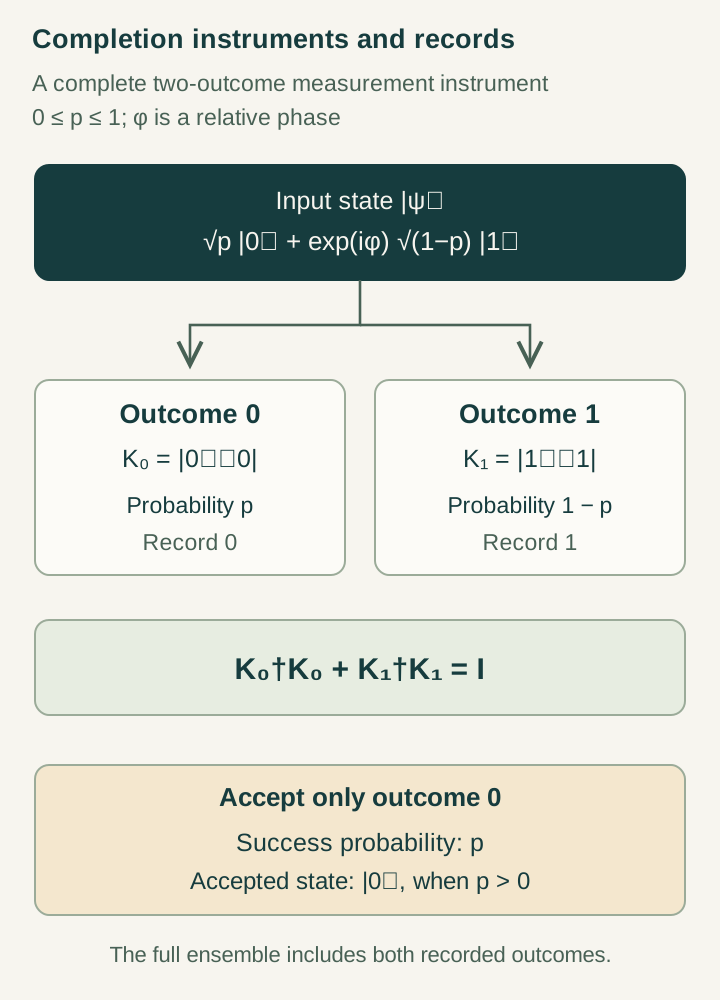
For a normalized input √p|0⟩+eiφ√(1−p)|1⟩, an ideal measurement in the zero–one basis records zero with probability p and one with probability 1−p. Both outcomes belong to the experiment. If a procedure keeps only zero outcomes, its accepted state is |0⟩, provided p is positive, and its success probability is p.
For p=1/4, approximately one quarter of many repetitions enter that accepted sample. Reporting its normalized state without the acceptance rate would conceal a central property of the operation. DTT completion must likewise specify the complete instrument or selection procedure, including failures and the fate of rejected records.
Ask which later tests the record supports
A display can be sufficient for one task and insufficient for another. Suppose internal states (0,+) and (0,−) both display zero. A permitted later operation flips the displayed bit only when the hidden sign is negative. After that operation the displays differ, so present agreement did not imply agreement under all future tests.
One remedy is to retain the sign. Another is to restrict the admissible future operations so that the sign never affects a readout. These choices define different observational descriptions. A source-based account should make the choice explicit before discarding hidden information. The scope of what an observer can distinguish is part of the model, not a property supplied by the word observable.
Let formation and reading have their own requirements
The six inner DTT roles are nested formation dependencies, and the outer seventh role publishes a completed record. The hierarchy does not by itself choose a quantum basis, establish probabilities, or ensure that the record remains stable. Those consequences need explicit interactions and retained-state conditions.
A data bit and completion flag can establish that writing has finished. Protected transport can establish that a later admitted read returns the same label. A predictive-state test can establish that discarded distinctions will not change future allowed observations. These are related achievements with different proofs. Keeping them distinct gives the common-source programme a practical route toward an observer that is fully included in its dynamics.
Keep the operational and experiential questions connected
A physical record describes information that an operation can distinguish. Conscious experience asks further questions about what, if anything, that distinction feels like to an experiencing subject. The record construction supplies a clear physical target without equating a bit, a probability, or a completion flag with experience.
To explore the operational side, write a preparation–interaction–readout procedure and predict both outcomes and repeat-read correlations. Read A76 for the scope of consciousness questions, A77 for coherent states and records, and A120–A121 for registration and durability. The Time Chest connection is an internal observer whose available world and memory arise within the same generative account.
Continue with the articles
- The 'Chest' of Time
Introduce the chest of time as a conceptual image linking containment, succession, and manifestation. Build a glossary before connecting the image with later book discussions.
- Quantum Consciousness and Free Will
Introduce questions about consciousness, quantum descriptions, and free will as distinct problems. Examine the proposed connections while keeping interpretive possibilities separate from experimentally established mechanisms.
- From one source to many observable records
Revisit oneness and multiplicity from the viewpoint of observation. Focus on how many distinguishable records could arise from a shared generative account and what preserves their differences.
- Retained observations versus predictive states
Ask when retained information is sufficient to predict future outputs autonomously. Explain the completion criterion and why keeping observations need not keep every dynamically relevant distinction.
- Completion without biasing an unknown input
Explain the construction of a loaded completion channel with input-independent success probability. Clarify why this condition matters when the matter state is unknown.
- From a continuous pointer to a binary memory
Explain the transfer of a Gaussian pointer response into a binary record with a generated flag. Discuss the threshold approximation and what controls its error.
- Keeping an observed label stable
Study repeated interrogation of a stored label, including selective measurement backaction. Explain the transport assumptions that preserve the label and the errors they allow.
- Six inner stages and one publication interface
Explain the hierarchy of readout ranks 1, 1, 2, 2, 3, 3 followed by completion. These are nested functional roles rather than six independently readable temporal coordinates.
- Reading Volume IV: Time Chest
A reading guide centered on the volume’s particle–wave and temporal-confinement themes, with questions for a later illustrated expansion.