
A sequence becomes an operational history through correlations and access rules. Record order, reversible microscopic dynamics, and thermodynamic entropy require distinct explanations.
Read the past in a present object
A notebook exists now, but its entries can describe yesterday. A footprint is a present pattern related to an earlier passage. In both cases the past event need not still be occurring for information about it to be available.
This makes history a useful challenge for the renewal intuition. If appearances depend on continuing generation, the new appearance must preserve the right relations to earlier ones. A source that independently invents a plausible-looking diary at every step has not yet explained why its contents track what occurred. SMM and DTT need the dynamics that connects an earlier event with a later readable trace.
Write a record with a reversible operation
Take an event bit b and a memory bit m initially zero. Apply the operation (b,m)↦(b,m XOR b). The final memory equals b, while the event bit remains unchanged. If b was zero, the output is (0,0); if b was one, the output is (1,1).
The full transformation is reversible, yet it can produce a useful record from the specified blank preparation. Availability of a record therefore need not mean that the microscopic update has lost information. The preparation, subsequent isolation, and access procedure give the write its historical role. If the initial memory were unknown, the final bit alone would not reliably report b.
Check a sequence rather than one distribution
Compare two devices that each display a fair bit. The first chooses a bit once and retains it; the second chooses a fresh independent fair bit at every reading. Either device has equal probabilities of zero and one on a single reading.
For two readings, however, the retained device produces 00 or 11, each with probability one half. The independent device produces 00, 01, 10, and 11, each with probability one quarter. Repeated-read agreement is certain in the first model and only one half in the second. A history test distinguishes mechanisms that a single-time histogram cannot. In a quantum setting, the reading instruments and their disturbance must be included in the sequential calculation.
An archive supplies one kind of temporal order
Let an archive contain entries E₁, then E₁ and E₂, then E₁, E₂, and E₃. Inclusion orders the available record sets. A later archive in this simple model preserves earlier entries and adds another. The order does not depend on having already assigned a number of seconds between writes.
Independent observers can also hold partially overlapping archives. If one has E₁ and E₂ while another has E₁ and E₃, neither set includes the other. Availability then gives a partial order rather than one universal list. A physical theory must specify communication and access before treating all stored information as equally available to every observer. Ordering records and measuring elapsed duration remain separate tasks.
A completed record must be produced and kept
The six inner DTT roles organize dependent formation processes; the seventh outer role makes a completed result available. A useful completion record can contain both a data value and a flag indicating that its write has finished. A completed zero is then distinguished from blank, unfinished storage.
Retention needs another mechanism. One model writes at a fixed location and moves the completed file outward so later writes do not overwrite it. Subsequent label-preserving reads can recover the same result. This construction has a concrete physical interpretation: ongoing generation and later access to an earlier record can coexist. The guarantee depends on the specified transport, memory preparation, and permitted read operations.
Distinguish record growth from entropy growth
A finite memory has a limited capacity. If an archive keeps every new bit without compression, it eventually needs more space or overwrites an older entry. On a finite transport ring, a file can return to the writer, ending the simple protection argument. These are explicit resource limits on an available history.
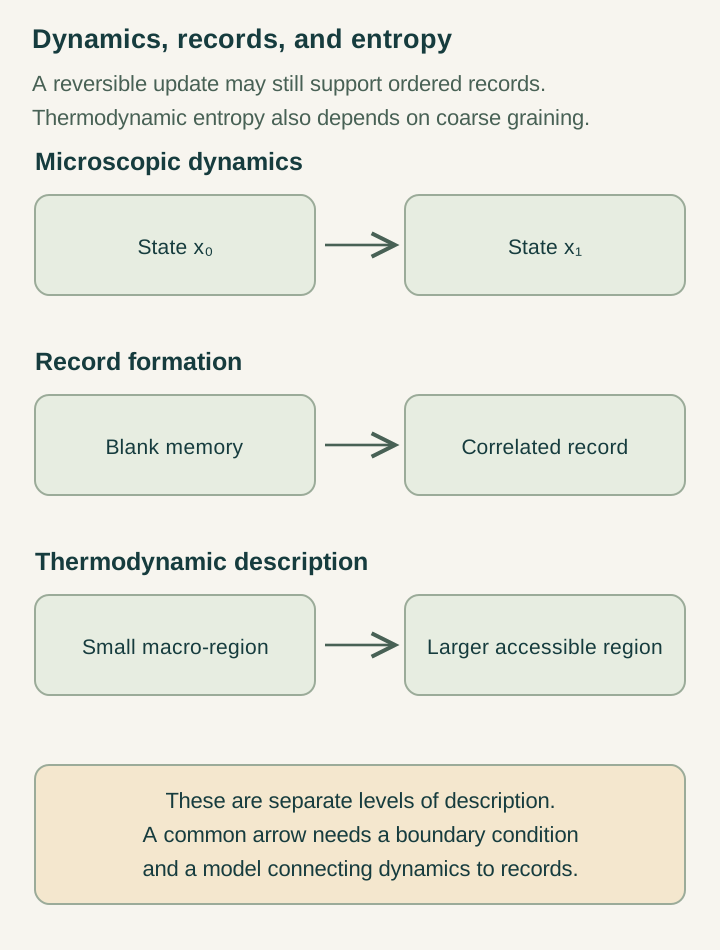
The thermodynamic arrow requires additional ingredients: physical states, an environment or coarse description, and an entropy balance. Growing an observer’s usable archive is not by itself a proof that a chosen entropy increases. A reversible total dynamics may transfer correlations into prepared memory while preserving information elsewhere. Connecting these levels is a valuable source-model task, rather than a consequence of naming the direction of completion.
Build a history test with two preparations
Prepare the event bit as zero in one trial and one in another. Write the record, allow the proposed transport or renewal process to act, and read it twice. Specify in advance which results would count as preservation, loss, or overwriting. Keeping the input alternatives separate prevents a stable-looking output from concealing forgotten information.
Follow A85 for ordered availability and A121 for sequential retention. The Time Chest connection is that an experienced succession needs more than repeated appearances: a present observer must possess lawfully related traces. A successful generative account explains both their availability and the limits under which the same history remains accessible.
Continue with the articles
- The Moment
Explore the moment as the smallest meaningful unit of presence in the historical discussion. Ask how a moment relates to change, observation, and the apparent continuity of experience.
- The Principle of Ever-renewed Creation
Introduce ever-renewed creation as a central motivation of the Single Monad Model. Ask how the idea might be expressed through histories, completed records, and observable persistence.
- From available records to a temporal arrow
Introduce record-positive returns as the steps that preserve or advance accessible records. Explain the conditions under which they define an effective forward action.
- Retained observations versus predictive states
Ask when retained information is sufficient to predict future outputs autonomously. Explain the completion criterion and why keeping observations need not keep every dynamically relevant distinction.
- From a continuous pointer to a binary memory
Explain the transfer of a Gaussian pointer response into a binary record with a generated flag. Discuss the threshold approximation and what controls its error.
- Keeping an observed label stable
Study repeated interrogation of a stored label, including selective measurement backaction. Explain the transport assumptions that preserve the label and the errors they allow.
- Six inner stages and one publication interface
Explain the hierarchy of readout ranks 1, 1, 2, 2, 3, 3 followed by completion. These are nested functional roles rather than six independently readable temporal coordinates.
- Reading Volume IV: Time Chest
A reading guide centered on the volume’s particle–wave and temporal-confinement themes, with questions for a later illustrated expansion.