
Renewal must preserve a lawful relationship between preparations and later records; repeated resemblance or an unchanged probability distribution is weaker.
Ask which continuity matters
A melody remains recognizable when played on another instrument. A flame keeps a recognizable organization while fuel passes through it. A saved message can move between devices. These examples use different standards of identity: a pattern of notes, an organized process, and recoverable information.
The renewal theme in Time Chest and SMM asks how continuing appearance depends on ongoing generation. The examples make that idea understandable without proving that all matter is recreated. A model must identify the particular relationship that persists. Calling two things similar leaves open whether the second continues the first, independently copies it, or merely resembles it by coincidence.
Preserve a relationship while replacing its instances
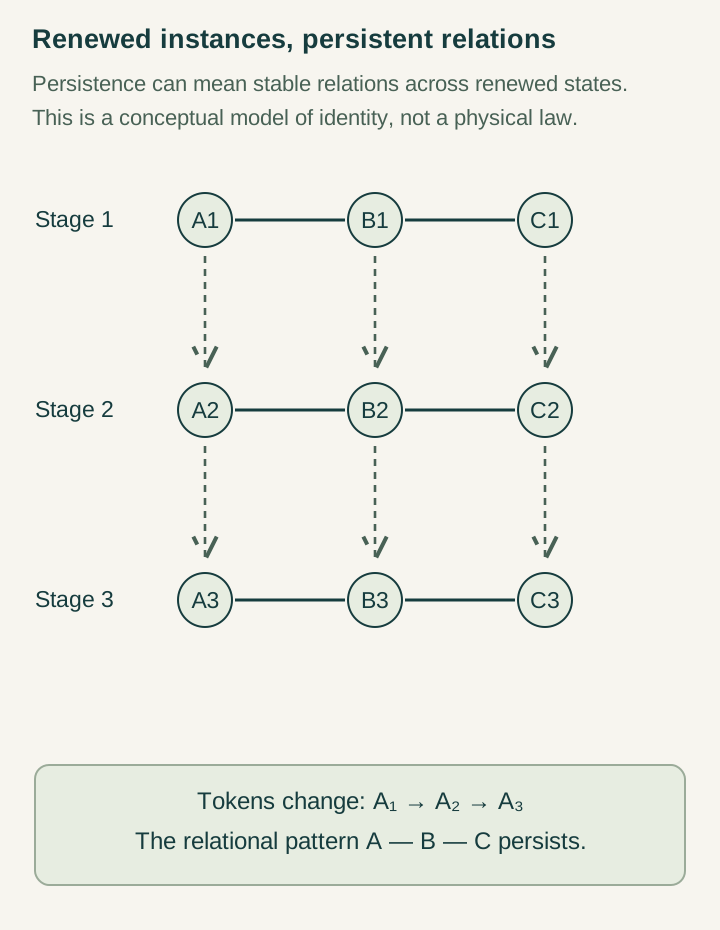
Imagine three named roles A, B, and C arranged in a chain. At each update, new instances occupy the roles, but the connections remain A–B and B–C. The tokens change while the adjacency pattern survives. A correspondence map between stages identifies which new instance continues each role.
The diagram records a chosen invariant: the chain structure. If a later stage instead joins A directly to C, that invariant fails even if the same three labels remain. This provides a concrete test of persistence. It also shows why persistence is always relative to specified properties; preserving a graph does not automatically preserve energy, material composition, or every possible observation.
Recover one message from changing bits
Let a message bit b be either zero or one. At step n store sₙ=b XOR (n modulo two). The stored bit flips at every step. Nevertheless a reader who also retains the parity of n can recover b by applying the same XOR again.
For b=1, the stored sequence is 1,0,1,0. Its changing appearance carries an unchanged message under the declared decoder. Losing the step parity removes the recovery guarantee. The counter, decoder, and access to both are therefore part of the memory resources, not free background knowledge.
Distinguish retention from repeated replacement
Compare that encoding with a device that writes one at every step regardless of its input. The latter looks perfectly stable, but it cannot preserve an unknown initial bit: an initial zero is lost immediately. Testing only the initial value one would hide the failure.
A useful retention test prepares both alternatives and asks whether later decoding recovers each corresponding preparation. A random device that produces zero and one with equal probabilities can keep its one-time distribution unchanged while forgetting every earlier result. Persistence of an actually observed label is a stronger statement about correlations across a sequence of tests, including the effects of those tests on the memory.
Make reliability quantitative
Suppose a classical stored bit independently flips with probability 0.1 during a chosen interval. Three independently protected copies, read by majority vote, fail if exactly two or all three flip. The resulting probability is 3(0.1)²(0.9)+(0.1)³=0.028, compared with 0.1 for one copy.
The improvement uses extra memory and independent errors. If one common disturbance flips all three copies together, majority voting provides no such benefit. This makes the physical mechanism central: the same logical encoding can have different reliability in different environments. The example concerns copying a classical label, not copying an arbitrary unknown quantum state. A quantum record needs its own allowed interactions and readout model.
Retain what later completion will need
DTT places six nested formation roles before outer completion. The source can change internally while preserving information needed for the next completed record. Some of that information may be visible memory; some may be phase or another hidden distinction that future operations can reveal.
A self-contained renewal account must carry observers and their memories along with the patterns they observe. It cannot erase everything and then borrow yesterday’s information from outside the model. The outgoing-record constructions discussed in A121 illustrate a definite route: write a label, move it beyond the writer, and specify later operations that preserve it. Their finite capacity and revisit time delimit how long retention is guaranteed.
Specify one invariant and one failure
Choose a persistent object in an example: a message, a moving pattern, or a chain. State the property you want to recover after an update, the recovery procedure, and the disturbance that would break it. Then prepare two distinct initial cases so that a device which always returns the same answer cannot pass the test.
Read A54 alongside A92 and A121. Together they turn the philosophical intuition of renewal into precise questions about lawful update, predictive memory, and durable records. A successful construction explains why a changing source supports recognizable continuity and how far that guarantee survives the operations available to an observer.
Continue with the articles
- The Principle of Ever-renewed Creation
Introduce ever-renewed creation as a central motivation of the Single Monad Model. Ask how the idea might be expressed through histories, completed records, and observable persistence.
- Creation Scenario: the World as a Movie
Use the world-as-a-movie analogy to introduce repeated generation and apparent persistence. Ask what must link frames for the analogy to describe motion, memory, and coherent interaction.
- Retained observations versus predictive states
Ask when retained information is sufficient to predict future outputs autonomously. Explain the completion criterion and why keeping observations need not keep every dynamically relevant distinction.
- From a continuous pointer to a binary memory
Explain the transfer of a Gaussian pointer response into a binary record with a generated flag. Discuss the threshold approximation and what controls its error.
- Keeping an observed label stable
Study repeated interrogation of a stored label, including selective measurement backaction. Explain the transport assumptions that preserve the label and the errors they allow.
- Six inner stages and one publication interface
Explain the hierarchy of readout ranks 1, 1, 2, 2, 3, 3 followed by completion. These are nested functional roles rather than six independently readable temporal coordinates.
- Reading Volume IV: Time Chest
A reading guide centered on the volume’s particle–wave and temporal-confinement themes, with questions for a later illustrated expansion.