Why a four-pi return is not yet the spin–statistics theorem
A spinor changes sign under a two-pi rotation and returns after four pi. This is an exact representation-theoretic fact with a natural temporal-winding interpretation. Deriving fermionic exchange statistics requires additional structure. A rotation calculation and a two-particle example show what a SMM/DTT spin model must connect.
Temporal winding can give a clear picture of a state that returns only after an extended cycle. In SMM/DTT that idea may help represent how an inner generative process completes to an observable carrier. Spinors provide a precise mathematical example of a sign change under a full spatial rotation.
The explanatory goal is stronger than the picture. A physical fermion also has a transformation law under spacetime symmetries, exchange statistics in multiparticle states and specific dynamical interactions. A source model must connect these properties rather than infer all of them from the length of one drawn loop. [1]
02The spin-half rotation calculation
For a spin-half degree of freedom, rotation by angle θ around a unit direction n is represented by U(θ) = exp[−iθ(n·σ)/2], where σ are Pauli matrices. Since (n·σ)² = I, the exponential is cos(θ/2)I − i sin(θ/2)n·σ.
At θ = 2π the operator is −I; at θ = 4π it is I. Thus every spinor acquires a minus sign after a two-pi rotation. A global sign does not change the probabilities of an isolated state, but relative phases can matter in an interference experiment that compares differently transformed paths. This is a transformation property, not yet a statement about exchanging two particles.
U(θ) = cos(θ/2)I − i sin(θ/2)n·σ
U(2π) = −I, U(4π) = I
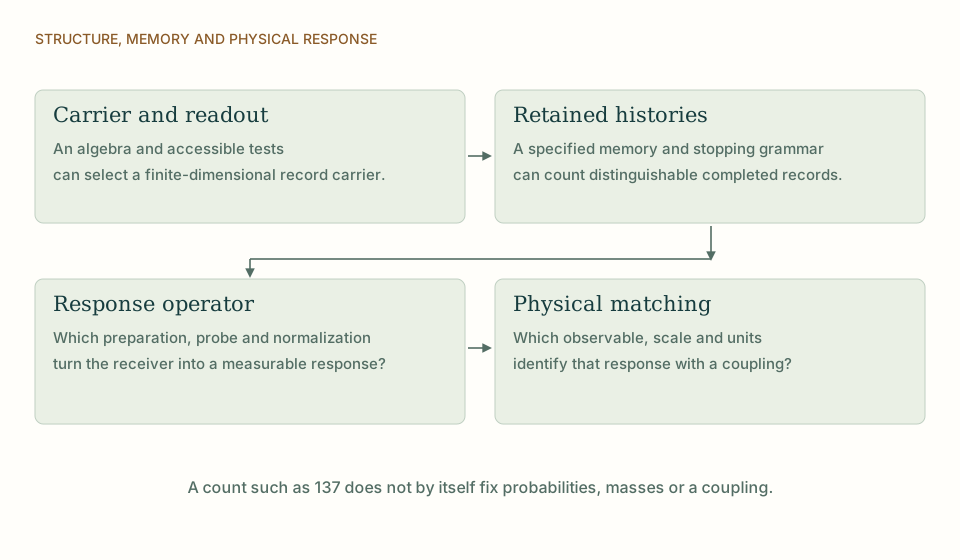
From carrier structure to a measurable response. Representation dimension, a chosen retention grammar, a response operator and physical calibration are separate stages of the constants programme. View full size ↗
03Exchange asks a different question
For two identical particles occupying one-particle states u and v, the symmetric combination u⊗v + v⊗u and the antisymmetric combination u⊗v − v⊗u behave differently under the exchange operator. The first has eigenvalue +1 and the second −1. When u = v, the antisymmetric combination vanishes, giving the familiar exclusion within that state construction.
This calculation requires a multiparticle composition rule and a chosen symmetry sector. The one-particle fact U(2π) = −I does not, by itself, state which exchange sector the full theory admits. Nonrelativistic quantum mechanics can discuss the two ingredients separately; a deeper connection needs the physical assumptions of a field theory or an equivalent reconstruction.
P12(u⊗v ± v⊗u) = ±(u⊗v ± v⊗u)
u⊗u − u⊗u = 0
04What the relativistic theorem adds
The spin–statistics connection links the two properties under relativistic consistency conditions. The relativistic connection depends on covariance, appropriate positivity or stability conditions, and locality. Observable quantities commute at spacelike separation, while field formulations use the appropriate commutation or anticommutation relations. Modern formulations make their own precise assumptions about fields, states and locality.
These conditions matter for a generative programme. If spatial locality and relativistic transformations are supposed to emerge, they cannot be silently imported at the last step and then described as consequences of winding alone. A conditional result can legitimately assume the recovered field structure, but a fundamental source derivation must explain why the necessary structure is present. [2]
05An operational temporal-spin construction
A DTT model could first define a source carrier whose completed transformations realize SU(2), then show how its records compose for multiple excitations. It would need an exchange operation implemented through admissible histories, a rule for coherent amplitudes, and a proof that the resulting physical sector has the required locality and positivity properties.
If antisymmetry emerges from those operations, exclusion follows for identical single-particle states. If an antisymmetric sector is selected independently, it should be identified as a premise. The distinction is useful: it tells the next calculation whether the missing ingredient is one-particle geometry, multiparticle composition or a locality-based selection theorem. [1]
06When a rotation phase becomes an interference signal
A global minus sign on an isolated state leaves its probabilities unchanged. The sign can matter when a controlled rotation acts in only one arm of an interferometer. Before recombination the two path amplitudes may be written as |0⟩|s⟩ + |1⟩U|s⟩. If the controlled operation is a two-pi spin-half rotation, U = −I, and it reverses the relative path phase. A four-pi rotation restores that relative phase.
This thought experiment identifies an operational role for the spinor return structure without treating the sign alone as an observable. It also preserves the distinction from particle exchange: the interferometer compares two controlled histories of a spin state, whereas exchange statistics constrains a multiparticle description. SMM/DTT can aim to generate both from a common source representation, but it must supply the controls and readout for the first and the appropriate multiparticle composition law for the second. Agreement between those constructions would be a substantive unification result.
07The value and limit of the winding picture
The four-pi structure is a legitimate guide to spinor transformations. It is especially helpful when explaining why an inner state can carry distinctions that disappear from a simple vector readout. It does not imply that every fermion must literally travel around a four-pi spatial path, or that bosons must be massless because they return after two pi.
The stronger SMM/DTT opportunity is a joint derivation of carrier geometry, physical exchange and source-generated dynamics. The rotation and exchange calculations supply two independent benchmarks. Connecting them through the same generative law would be more substantial than attaching a familiar statistics label to a loop diagram.
THE SAME QUESTION, DIFFERENT STARTING POINTS
The comparison at a glance
Question
SMM/DTT
Relativistic spin–statistics connection
Rotation
A temporal carrier may realize a spinor return structure.
SU(2) gives a sign at 2π and identity at 4π.
Exchange
Derive composition and exchange from allowed source histories.
Symmetric and antisymmetric multiparticle sectors are separate constructions.
Theorem
Recover the assumptions linking rotation to statistics.
Distinguish spinor structure from spatial readout.
Sources and further reading
References support the comparator and the specific mathematical or interpretive claims indicated. SMM/DTT connections are developed in the analysis above.