A compactification gap and the Yang–Mills mass-gap problem
A compact operator can have a positive spectral gap, and that is a meaningful mathematical result. The four-dimensional Yang–Mills problem asks for substantially more. Comparing a rotor, a compactification spectrum and an interacting gauge theory makes clear how an inner-time model can contribute without confusing different notions of mass and gap.
A spectral gap is a separation between parts of an operator’s spectrum. Its meaning depends on the operator, state space, physical sector and units. A finite matrix, a particle on a circle and an interacting quantum field theory can all have gaps while representing very different physical systems.
For SMM/DTT, inner compactification may provide a useful spectral construction. Its contribution should be stated as a result for that construction. The connection to particle mass or to the Yang–Mills Millennium problem requires an additional physical and limiting argument. This distinction lets a valid regulated-model theorem keep its value without being assigned a stronger conclusion it has not established. [2]
02A rotor with an exact positive gap
For a quantum rotor with angle θ, moment of inertia I and periodic wave functions, take H = −ℏ²∂²θ/(2I). The eigenfunctions exp(inθ) have energies En = ℏ²n²/(2I), with integer n. The n = 0 state is a normalizable ground state and the first excited energy is ℏ²/(2I).
The gap above the ground state is therefore positive even though the zero mode is present. Removing the zero mode is not needed to obtain this particular excitation gap. If I = mR², increasing the circle radius drives the gap to zero as R⁻². The finite-radius gap consequently does not automatically survive an infinite-size limit.
En = ℏ²n²/(2I), n∈Z
ΔE = E₁−E₀ = ℏ²/(2I)
I=mR² ⇒ ΔE=ℏ²/(2mR²) → 0 as R→∞
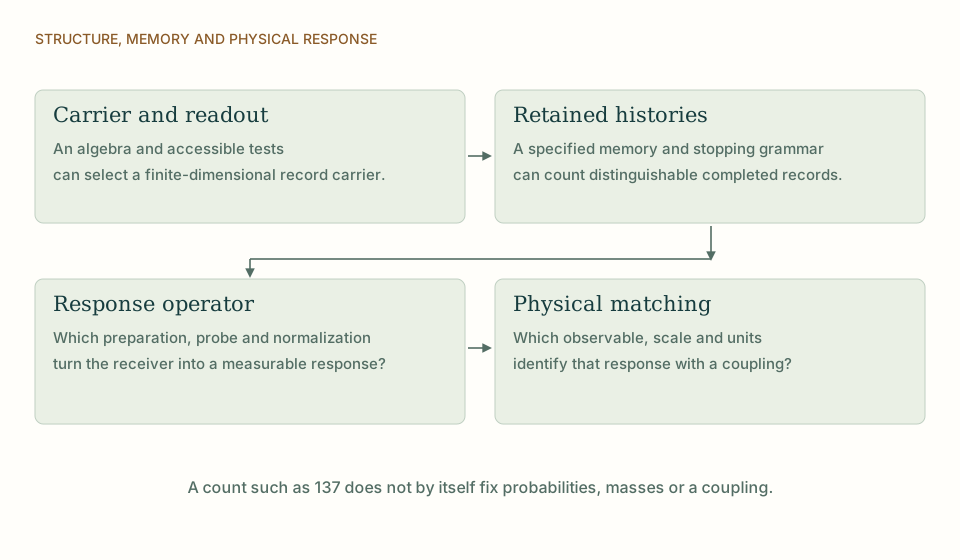
From carrier structure to a measurable response. Representation dimension, a chosen retention grammar, a response operator and physical calibration are separate stages of the constants programme. View full size ↗
03The physical units of a compactification spectrum
A spatial circle of radius R gives momenta pn = nℏ/R. For a massless relativistic field, a corresponding excitation energy scale is ℏc/R. A circle parameterized by an internal phase or a time radius requires its own generator and conversion law. Writing the same symbol R in these different settings does not make the mass formulas interchangeable.
An inner-time source model must specify whether its eigenvalue is a frequency, an inverse length, an energy or a mass parameter. The relation E = ℏω can translate a frequency to energy once the quantum generator and action scale are fixed. That conversion alone does not establish a particle pole or the spectrum of a interacting gauge-invariant quantum field theory.
04What the Yang–Mills problem requires
The Clay problem concerns existence of a nontrivial quantum Yang–Mills theory on four-dimensional space with a positive physical mass gap, under the stated mathematical requirements. A gap in a lattice regulator or a compact auxiliary direction can be a useful intermediate result, but the appropriate continuum and infinite-volume behavior must be controlled.
One needs the correct physical observables and a genuine interacting gauge theory. A positive first eigenvalue of an auxiliary Laplacian is not the same object as the lowest physical excitation above the vacuum in the continuum theory. The distinction is particularly important when the gap scales with a regulator radius that disappears or diverges in the desired limit. [2]
05Why Gauss’s law does not remove every zero mode
Gauss constraints restrict physical states and eliminate gauge redundancy. They do not generically imply that all configurations constant along a compact auxiliary coordinate vanish. A zero Fourier index labels constancy in that coordinate; gauge invariance is a different condition. Gauge-invariant quantities can remain in a zero-mode sector.
If a proposed source model excludes such a sector, the exclusion needs an explicit constraint or boundary condition and a demonstration of physical consistency. It may produce a valid restricted theory, but its relationship to ordinary four-dimensional Yang–Mills theory must then be established. Renaming the excluded sector unphysical is not a substitute for that derivation.
06A finite family is not yet a continuum theory
Suppose a regulator produces a family of Hamiltonians indexed by a resolution scale. At every finite resolution one can calculate an energy difference between the vacuum and an excited state. A continuum claim must show how observables and states approach a physically meaningful limit as the regulator is removed. A positive gap at every finite step can still approach zero; a divergent unrenormalized energy difference can also fail to define a finite physical mass.
For a source model this makes the hierarchy of retained descriptions especially relevant. The nested construction could provide a natural sequence of effective spaces and operators, but it must explain their comparison across scales. A convincing bridge to the Yang–Mills problem would control that sequence, preserve the needed gauge and quantum-field structure, and establish a positive limiting gap in physical units. The finite rotor calculation is valuable as a worked spectral example precisely because its narrower result can be stated completely and then extended through explicit additional constructions.
07A constructive role for inner-time models
A useful result can begin with a well-defined finite or compact model, identify its gauge-invariant Hilbert space, prove a gap, and state how the gap behaves as each physical or regulator scale changes. A lower bound that remains positive in the required limit would be much stronger than a bound proportional to a scale that vanishes.
This gives the SMM/DTT spectral programme a concrete development route: connect inner generation to an interacting, local observable theory and track its physical energy spectrum through the limit. The rotor calculation supplies a simple warning about scale dependence, while the continuum target explains what a genuinely stronger theorem would have to control.
THE SAME QUESTION, DIFFERENT STARTING POINTS
The comparison at a glance
Question
SMM/DTT
Four-dimensional Yang–Mills theory
Finite gap
Inner compactification can define a gapped auxiliary or regulated operator.
The rotor has gap ℏ²/(2I) above a present zero-mode ground state.
Physical mass
A source spectrum needs a calibrated physical energy interpretation.
Yang–Mills mass concerns gauge-invariant continuum excitations.
Limit
Prove the relevant bound survives the intended physical limit.
A gap proportional to R⁻² can disappear as R grows.
KEEP THE CONNECTION
Key ideas
A compactification gap is valuable but depends on the operator and its scale.
Gauss’s law is not a general argument for removing every zero Fourier mode.
A Yang–Mills claim must control an interacting physical theory and the required limits.
Locate the remaining constructive research targets.
Sources and further reading
References support the comparator and the specific mathematical or interpretive claims indicated. SMM/DTT connections are developed in the analysis above.