Gauge fields and parallel transport: SMM/DTT and Standard Model quantum field theory
Can comparing records generated at different stages produce the connection and curvature of an interacting gauge theory? This article compares the source-based construction with Standard Model quantum field theory, identifies their strongest point of contact, and works through a concrete example that separates a valid mathematical result from the further physical relation needed to explain observations.
Gauge theory organizes how local descriptions are compared. A connection transports an internal state between neighboring locations or records; curvature measures the mismatch obtained by transport around a closed loop. The local choice of basis is a redundancy, while suitable loop traces and scattering observables are physical. The gauge group, its representations, and the dynamics of its connection are distinct ingredients.
A temporal-loop picture is therefore closest to gauge theory when it specifies actual transport maps and their composition. A loop in a diagram is not enough: it may carry no nontrivial holonomy, and a nontrivial holonomy does not by itself determine a force law. A physically meaningful construction must also show which carriers respond to the connection and how its fluctuations propagate. [1][2][3]
02The SMM/DTT contribution
SMM/DTT can interpret a connection as the rule for comparing retained distinctions across completed records. The source is nonspatial; spatial gauge transport belongs to the generated relational structure. The six inner levels can organize preparation and comparison, with outer completion preserving a gauge-invariant response.
This perspective offers a concrete bridge because it puts relational consistency before a background coordinate grid. Its main open issue is selection: why should the admissible comparison maps yield the observed internal groups and matter representations? A neutral completion rule may project onto an invariant sector, but deriving a projector is different from deriving the action or the normalization of a gauge coupling.
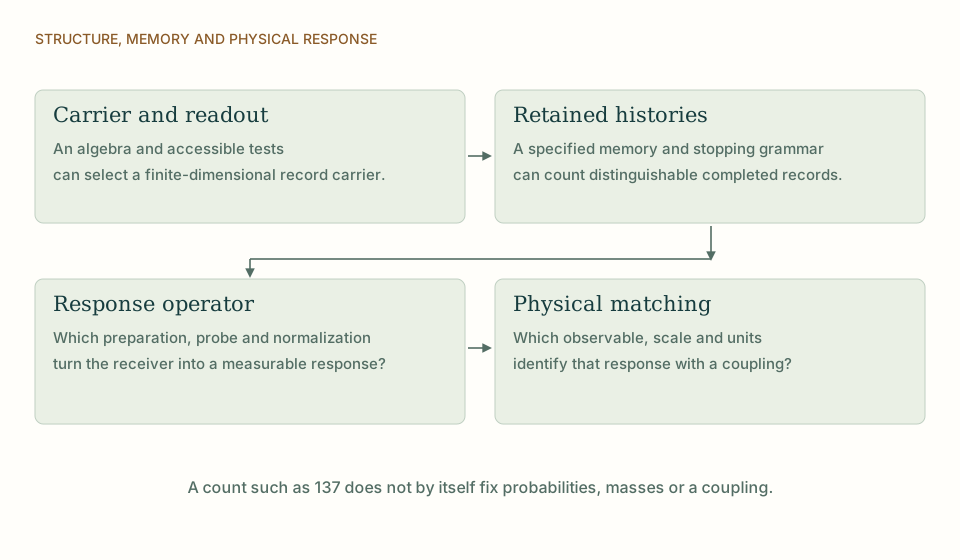
From carrier structure to a measurable response. Representation dimension, a chosen retention grammar, a response operator and physical calibration are separate stages of the constants programme. View full size ↗
03How Standard Model quantum field theory frames the problem
The Standard Model describes matter and nongravitational interactions with quantum fields, internal gauge symmetry and a Higgs sector. Particle representations, coupling constants and several mass parameters are inputs constrained by experiment. Its success makes it the immediate low-energy benchmark for any proposed source theory of matter, while leaving important questions about the origin of those inputs open.
A DTT comparison should therefore distinguish explanation of a parameter from reproduction of a formula that already contains it. A source-derived carrier or completion law would be useful if it restricts representations, couplings or relations among observables. It must still reproduce the field-theoretic meaning of charge, spin, locality and radiative corrections. [1][4]
04Where the mechanisms agree and differ
The Standard Model identifies gauge fields through local internal transformations and their interactions with charged matter. DTT's comparison-based account could explain why a connection is needed when independently generated records use different internal frames. That is a real structural overlap: physical transport must be consistent even when local descriptions vary.
The difference is that gauge covariance fixes the form of some couplings without fixing the gauge group, the charge spectrum or the coupling strength. A temporal loop that yields a phase therefore supplies only part of electromagnetism. Six nested inner levels may organize the transport and neutral completion of a carrier, but they do not establish the full non-Abelian interaction sector by counting stages. The holonomy calculation below shows the precise piece that can be reproduced: a relative phase or matrix mismatch around a closed path. A stronger DTT law would also determine the energy associated with that mismatch and how the connection propagates. Matching those quantities to the effective gauge action would convert a relational interpretation into a constrained microscopic model. The key is to derive transport and response together, rather than attach a known field-theory action to an otherwise arbitrary temporal phase. [1][4]
05Worked example: assumptions, calculation and result
For a U(1) connection, a particle transported around a loop acquires phase exp(iqΦ/ħ), where Φ is the enclosed magnetic flux. If qΦ/ħ=π, the phase is −1; if it is 2π, the phase is +1. An interference experiment compares that phase with a reference path, so the observable effect depends on relative transport rather than a locally assigned absolute phase.
In a matrix-valued theory, small-link transports U₁ and U₂ need not commute. With U₁≈1+iaA and U₂≈1+iaB, their loop product differs from the identity at order a² through the commutator [A,B], along with derivative terms for spatially varying fields. This is the algebraic origin of a curvature-like mismatch. The calculation identifies a mechanism that a temporal comparison model can reproduce explicitly. [1][2][3]
Uloop=exp(iqΦ/ħ) for U(1); noncommuting transports generate an order-a² commutator contribution.
Φ is magnetic flux, q charge, and qΦ/ħ is dimensionless. The compact matrix example absorbs coupling constants into A and B.
06An independent operational check
A basis change at the starting point conjugates a non-Abelian loop operator, Uloop→gUloopg⁻¹. Its matrix entries change, but its trace and eigenvalues do not. These are natural candidates for completed observables. A temporal model can therefore retain a physical loop response while discarding arbitrary local frame information. The discarded information is a redundancy, not necessarily a hidden physical field. This distinction helps separate the source ontology from gauge bookkeeping. The important dynamical question remains how the invariant response changes the energy or transition probability of an actual carrier, because that is what turns parallel transport into a measurable interaction.
07What follows from the comparison
A strong result would derive both the allowed holonomies and their energetic response from source dynamics. It would explain which phases survive outer completion and which are invisible because they act only in inaccessible sectors. That is a more precise use of temporal winding than identifying every closed inner process with an electromagnetic interaction.
THE SAME QUESTION, DIFFERENT STARTING POINTS
The comparison at a glance
Question
SMM/DTT
Standard Model quantum field theory
Starting physical structure
One nonspatial source; six nested inner functional levels produce records accessible through outer completion.
Complex quantum fields in gauge representations, with a Higgs sector and measured parameters.
The central mechanism in this topic
Record comparisons should generate both transport maps and their energetic response.
Gauge connections and matter representations define interactions through a local action.
How the claim is made operational
A source-to-record map must define geometry, material response and physical clocks with shared inputs.
A local action, quantum amplitudes, renormalization and comparison with measured observables.
Meaning of agreement
Agreement is a compatibility result; a source-selected relation or fixed residual would add explanatory content.
The stated framework provides a benchmark within its own assumptions and established domain.
KEEP THE CONNECTION
Key ideas
Holonomy is the correct interface, but a force law also requires dynamical and normalization data.
The worked example establishes only the result stated under its explicit assumptions.
Six nested inner levels describe one generative organization; outer time orders accessible completion.
Develops the source construction or operational distinction used in this comparison.
Sources and further reading
References support the comparator and the specific mathematical or interpretive claims indicated. SMM/DTT connections are developed in the analysis above.