Matter–antimatter asymmetry: SMM/DTT and Spectral geometry and Kaluza–Klein models
Can an oriented process of temporal completion produce a quantitative excess of baryons over antibaryons? This article compares the source-based construction with Spectral geometry and Kaluza–Klein models, identifies their strongest point of contact, and works through a concrete example that separates a valid mathematical result from the further physical relation needed to explain observations.
Matter–antimatter asymmetry concerns a number imbalance, not merely the presence of an arrow of time. An expanding universe with irreversible processes can still contain equal baryon and antibaryon abundances. Under conventional local quantum-field-theory assumptions, a dynamical explanation uses baryon-number violation, C and CP violation, and a departure from thermal equilibrium. Alternative assumptions can change this logic, but they must be explicit.
A temporal orientation may help specify initial conditions or nonequilibrium dynamics. It does not automatically distinguish a charged process from its charge-conjugate process. The central quantitative object is a difference of transition probabilities combined with production, dilution and washout. This is where a source-based account must connect ontology to a particle-physics calculation. [1][2][3]
02The SMM/DTT contribution
DTT distinguishes inner generation from outer retained order, and therefore supplies a natural setting for irreversible completion. The Single Monad is not itself a particle carrying baryon number; matter and antimatter must appear as distinguishable excitations or records within the model. Six nested inner levels do not, by their mere ordering, establish CP violation.
A useful constructive possibility is an orientation-sensitive completion amplitude whose transformation under charge conjugation and parity is calculable. If interference between amplitudes produces a nonzero asymmetry, the same rule must also define the allowed number-changing channels and their reverse processes. This would connect the temporal arrow to an actual source term rather than simply renaming the observed matter excess.
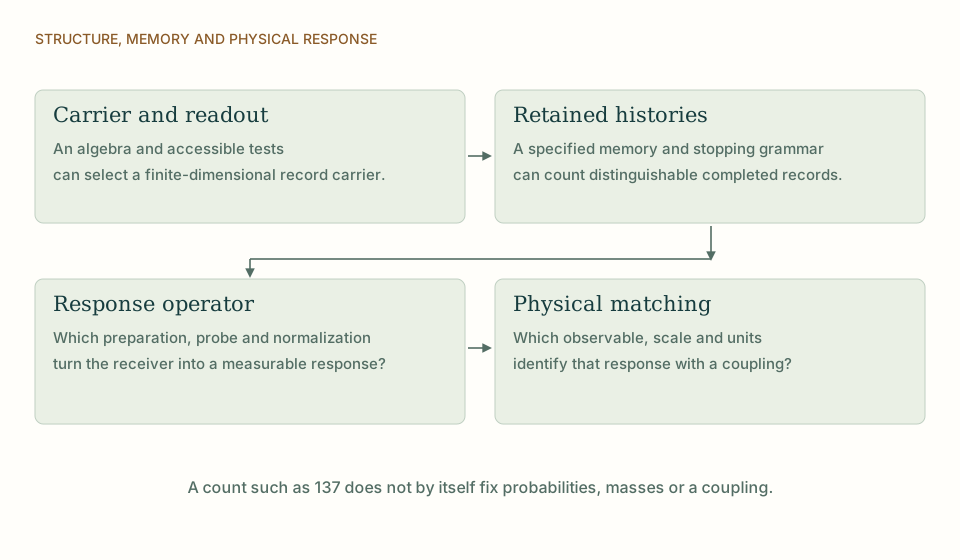
From carrier structure to a measurable response. Representation dimension, a chosen retention grammar, a response operator and physical calibration are separate stages of the constants programme. View full size ↗
03How Spectral geometry and Kaluza–Klein models frames the problem
Kaluza–Klein models relate lower-dimensional fields to a higher-dimensional geometry, often with compact internal directions. Fourier or spectral modes on the compact factor generate towers of effective excitations. Spectral geometry similarly relates operators and their spectra to geometric information, though it need not use a literal extra coordinate.
For DTT the useful comparison is the interpretation of an inner compact cycle. A compact time parameter is not automatically a harmless spatial extra dimension: its signature, operator domain and physical evolution must be stated. Six nested functional levels are not six compact coordinates. The shared mathematics of modes becomes a physical correspondence only when energy, charge and geometry are mapped consistently. [4][5]
04Where the mechanisms agree and differ
Compact internal geometry can affect chirality, zero modes and effective couplings, so Kaluza–Klein and spectral models offer possible ingredients for matter–antimatter asymmetry. However, a surplus of one type of mode is not automatically the cosmological excess of particles over antiparticles. The latter is a statement about occupied states and their dynamical evolution.
DTT's compact inner cycle may similarly select spectral sectors without producing an abundance imbalance. A six-level functional hierarchy is not a collection of extra coordinates, and an oriented cycle does not define CP violation until the action on physical carriers is specified. A useful comparison would derive the effective chiral spectrum and its phases from a temporal operator, then calculate whether those ingredients support a number-generating process. The yield below illustrates the separate role of population and washout. A source-selected boundary condition could be a meaningful first result if it removes an otherwise arbitrary spectral choice. It would not yet explain baryogenesis. The strongest programme joins the spectral selection to autonomous nonequilibrium completion, so that the same inner dynamics controls both the available states and the way their populations become asymmetric. [4][5]
05Worked example: assumptions, calculation and result
Let a heavy unstable species X decay into channels that produce opposite baryon numbers, and define ε=[Γ(X→B)−Γ(X→anti-B)]/Γtotal in a simplified normalized model. If the initial abundance relative to entropy is YX=10⁻³, the asymmetry per decay is ε=10⁻⁶, and an efficiency factor κ=0.1 accounts for incomplete production and washout, then YB≈εκYX=10⁻¹⁰.
The arithmetic shows how a small microscopic bias can become a small final abundance. None of the three inputs has been predicted here. A real model must compute ε from amplitudes, κ from kinetic evolution, and YX from its cosmological state. Setting ε to obtain the desired final result is a fit, not an explanation of matter–antimatter asymmetry. [1][2][3]
YB≈ε κ YX; (10⁻⁶)(0.1)(10⁻³)=10⁻¹⁰.
YB and YX are number densities divided by entropy density in consistent natural units; ε and κ are dimensionless. This is a toy yield estimate.
06An independent operational check
A simple symmetry test can already be decisive. If every allowed history H has a charge-conjugate history H̄ with the same probability and opposite baryon number, then their contributions cancel in the ensemble average. Summing over pairs gives zero net baryon number regardless of whether the histories are temporally irreversible. A nonzero result therefore requires the model to alter the pairing, its weights or its initial ensemble. This is an original diagnostic that can be applied before solving a full cosmology. It identifies exactly why temporal direction and matter excess are different claims, while leaving a clear route for a source-based asymmetric completion mechanism.
07What follows from the comparison
The immediate theoretical gain is to ask which of these inputs an autonomous temporal source actually fixes. Even a proof that a class of completion rules enforces ε=0 would be informative: it would identify a symmetry that any successful extension must alter. An oriented inner process becomes relevant to baryogenesis only through its transformation properties and quantitative couplings.
THE SAME QUESTION, DIFFERENT STARTING POINTS
The comparison at a glance
Question
SMM/DTT
Spectral geometry and Kaluza–Klein models
Starting physical structure
One nonspatial source; six nested inner functional levels produce records accessible through outer completion.
A specified internal geometry or operator whose modes appear as effective fields.
The central mechanism in this topic
A temporal spectrum and its occupation dynamics must be derived together.
Internal geometry can organize chiral modes and couplings but not automatically their populations.
How the claim is made operational
A source-to-record map must define geometry, material response and physical clocks with shared inputs.
Dimensional reduction, spectral decomposition, normalization and mode matching.
Meaning of agreement
Agreement is a compatibility result; a source-selected relation or fixed residual would add explanatory content.
The stated framework provides a benchmark within its own assumptions and established domain.
KEEP THE CONNECTION
Key ideas
Spectral asymmetry becomes cosmological matter asymmetry only through a specified dynamical process.
The worked example establishes only the result stated under its explicit assumptions.
Six nested inner levels describe one generative organization; outer time orders accessible completion.
Develops the source construction or operational distinction used in this comparison.
Sources and further reading
References support the comparator and the specific mathematical or interpretive claims indicated. SMM/DTT connections are developed in the analysis above.