A Lorentzian cone and a theory of physical observers
A cone of admissible displacements can possess Lorentzian symmetry before a model explains actual moving clocks and rulers. A boost calculation and a scale transformation show what cone preservation fixes and what it leaves free. This sharpens the SMM/DTT path from temporal generation to a physical relativity principle.
A model may produce a set of allowed displacement–delay pairs bounded by a cone. This is a meaningful kinematic structure. To identify its automorphisms with transformations between physical observers, the model must also show that clocks, rulers, matter and signal procedures realize those transformations.
SMM/DTT’s quantum-relativity programme therefore has two connected tasks: generate an appropriate causal structure and recover the operational equivalence of inertial descriptions. The first is not a substitute for the second. An emergent lattice can exhibit a propagation bound while a physical preferred frame remains detectable through dispersion or clock behavior. [1]
02The elementary boost calculation
In one spatial dimension set x⁰ = ct and use the quadratic form q = (x⁰)² − x². A boost with rapidity η maps x⁰ to coshη x⁰ − sinhη x and x to −sinhη x⁰ + coshη x. Substituting these expressions and using cosh²η−sinh²η = 1 gives q′ = q.
The calculation proves preservation of the interval in this chosen representation. Its physical interpretation requires x⁰ to be calibrated by a clock, x by an operational length and c by the relevant common signal law. The hyperbolic functions do not independently derive those identifications.
x⁰′ = coshη x⁰ − sinhη x
x′ = −sinhη x⁰ + coshη x
(x⁰′)²−(x′)² = (x⁰)²−x²
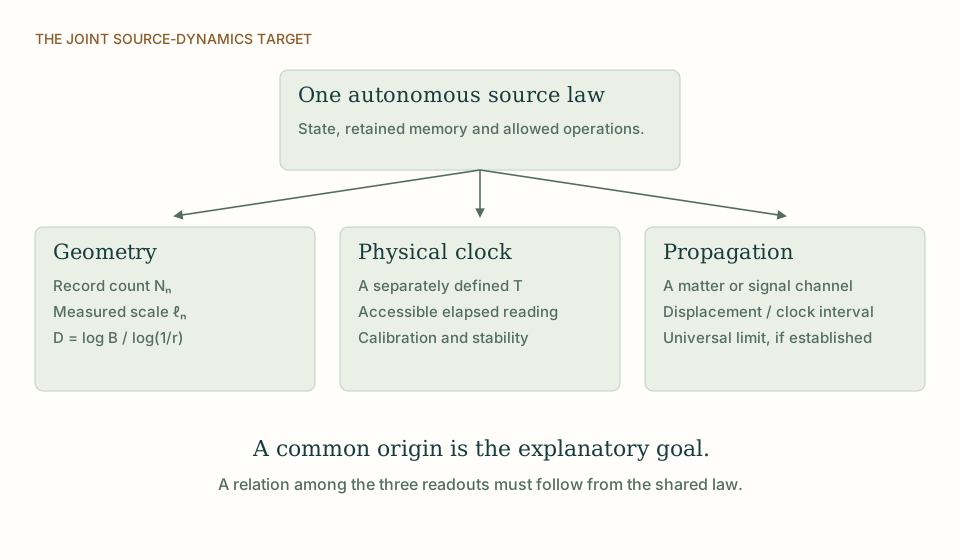
Geometry, clocks and propagation as independent readouts. A single source model should explain the relation between separately defined measurements. Sharing a diagram does not impose that relation. View full size ↗
03The cone leaves a scale freedom
Multiply every transformed coordinate by a positive factor λ. The resulting transformation preserves the sign of q and maps the null cone to itself, but it gives q′ = λ²q. Thus preserving the cone alone does not select the interval’s absolute normalization.
A universal λ may represent a change of units. A physical clock theory must nevertheless establish how units are shared between observers and species. If relative clock or ruler scales depend on uncontrolled source variables, cone geometry can coexist with different operational predictions. Recovering a Lorentz group with calibrated intervals needs more than a picture of hyperbolic orthogonality.
x′ = λΛx, λ>0, Λ Lorentz
q(x′) = λ²q(x)
The causal cone is preserved even when interval scale changes.
04The role of accessible operations
A mathematical automorphism is not necessarily a physical change of reference frame. The source may admit only a subset of transformations, or its preparation rules may privilege particular states. A physical relativity principle concerns what observers can prepare, compare and measure using actual material devices.
This motivates the website’s distinction between geometric symmetry and frame richness. A stronger DTT result would show that allowed source operations produce sufficiently many observer configurations, and that their readout transformations agree with the geometry. Checking one material clock or one excitation species is weaker than establishing the universal correspondence. [1]
05Why mass–energy and gravity require more
Once a relativistic momentum representation and its invariant mass are given, the energy–momentum relation can support the familiar rest-energy identification. But the physical meaning of the generator, normalization of action and relation between source excitations and measured inertial mass still need specification in an emergent model.
Gravitational equivalence adds another question: why should every relevant matter sector couple to the same effective geometry with the required universal structure? Neither a Lorentzian cone nor an invariant dispersion relation by itself supplies field equations or universal gravitational coupling. The source programme becomes more informative when it links these additional laws rather than appends them independently.
06A timelike record pair in two coordinate systems
In units with the limiting speed equal to one, take two events separated by t = 10 and x = 6. Their squared interval is 100−36 = 64. A Lorentz boost with velocity parameter 0.6 has factor 1.25 and gives x′ = 1.25(6−0.6×10) = 0 and t′ = 1.25(10−0.6×6) = 8. The interval remains 64, and an ideal inertial clock following that timelike separation records proper duration eight in these units.
The calculation provides an exact target for a reconstruction of physical observers. A source-generated clock carried along the corresponding trajectory should reproduce the proper-time reading within the model’s stated regime; a transported rod and signal protocol should implement the associated spatial comparison. Merely assigning the transformed numbers to record labels does not establish that material devices behave this way. A stronger model derives their agreement from the same source law and identifies the limits of the approximation.
07A useful hierarchy of results
A constructive sequence can establish a composition-stable influence bound, a calibrated clock–ruler dictionary, an accessible observer transformation group, universal matter propagation and finally a common gravitational coupling. Each step has its own possible counterexamples and can remove a specific independent freedom.
This is a demanding but focused route for SMM/DTT. The six nested inner roles may organize how the records are generated, while outer completion determines accessible observations. The physical significance comes from proving that different observers of those records recover the same laws, not merely from recognizing a Lorentz-like matrix in the internal algebra.
THE SAME QUESTION, DIFFERENT STARTING POINTS
The comparison at a glance
Question
SMM/DTT
Lorentz transformations
Cone
A source may constrain allowed displacement and delay.
Cone preservation fixes causal structure but allows positive rescaling.
Boost
Generated clocks and rulers should realize geometric transformations.
Lorentz matrices preserve a specified interval form.
Universality
Recover shared matter and observer behavior from the source.
One symmetric equation is weaker than a physical relativity principle.
KEEP THE CONNECTION
Key ideas
A Lorentz boost preserves a chosen interval; its clock and length interpretation is separate.
Cone preservation leaves a positive scaling freedom.
References support the comparator and the specific mathematical or interpretive claims indicated. SMM/DTT connections are developed in the analysis above.