Compact inner time and the problem of closed timelike curves
A cyclic internal phase and a compact physical time coordinate can have radically different causal consequences. An explicit circle example explains why SMM/DTT must identify which kind of compactification it uses. The comparison preserves inner recurrence while making the physical requirements for causality and clock evolution clear.
An internal phase can return to the same value while a clock continues to advance. A physical time coordinate identified modulo a period can instead close a timelike path. Both may be drawn as circles, yet only the second necessarily concerns closed timelike curves in the spacetime metric.
SMM/DTT frequently uses cyclic language for inner generation and a distinct outer completion order. The physical question is whether the inner circle is an internal phase space, a bookkeeping cycle, a gauge direction, or a genuinely timelike dimension. Its mathematical role must be fixed before spectral formulas or causality claims can be interpreted. [1]
02A compact timelike coordinate
Consider a flat metric ds² = −c²dt² + dx² with the identification t ≡ t+T. The curve at fixed x that increases t from zero to T returns to the same spacetime point. Its tangent is timelike throughout, so the quotient contains a closed timelike curve.
The conclusion follows from the metric and identification alone. It is not avoided by saying that T is extremely small, because shrinking the period does not change the sign of the tangent norm. A theory may impose additional constraints or change what counts as a physical trajectory, but those restrictions must be part of its definition.
t ∼ t+T, x = constant
ds² = −c²dt² < 0
(0,x) and (T,x) are the same event on the quotient
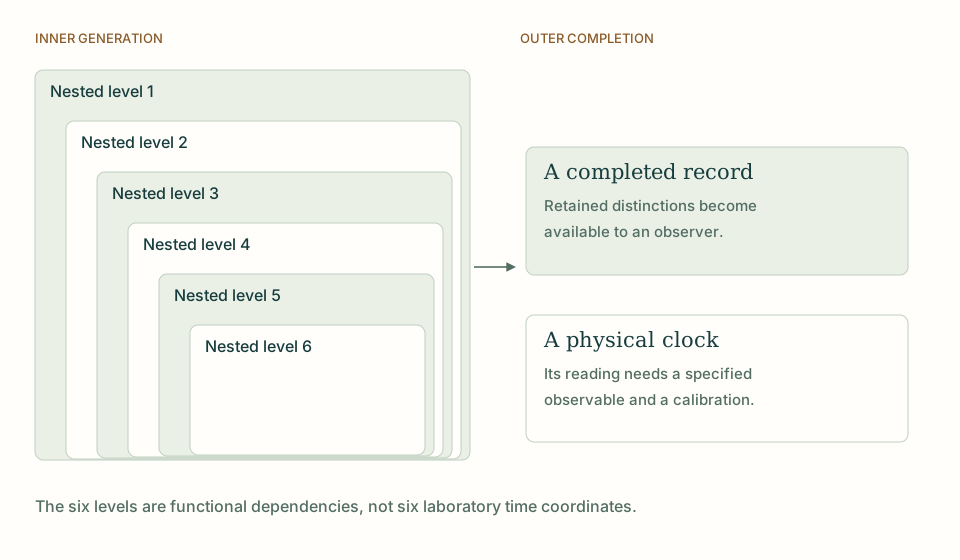
Six nested inner levels and outer completion. The nesting indicates functional dependence in the SMM/DTT proposal. Outer completion makes a retained result available; it does not turn the six levels into six independently measured clocks. View full size ↗
03An internal phase with an unbounded clock
Now take a system with internal phase θ on S¹ and a separate clock coordinate τ on the real line. Let θ(τ) = ωτ modulo 2π. After one period the phase returns to its initial value, but τ has increased. The full physical state need not return, because a memory register or other degrees of freedom can retain the elapsed completion.
This is an ordinary cyclic internal degree of freedom. A periodic phase spectrum does not make the observer’s worldline a closed timelike curve. It is closer to the role that inner recurrence can play in an operational DTT construction, provided the outer records, clock and retained memory are explicitly represented.
θ(τ+2π/ω) = θ(τ)
τ+2π/ω ≠ τ
Equality of one internal observable is not equality of the complete physical event.
04Spectral gaps do not settle the causal question
For a circle of length 2πR, the operator −∂²/∂θ² with a suitable scale has eigenvalues n²/R². Whether R represents a length, a time, or an internal dimensionless radius determines how energy units enter. A spatial compactification commonly produces Kaluza–Klein momentum levels; a time-periodic boundary condition has a different physical interpretation.
Neither the discreteness of n nor the existence of a nonzero first mode explains why the zero mode is absent in a physical sector. Boundary conditions, constraints and state selection must be specified. Causality and a spectral gap therefore require distinct checks even when both are described using the same compact circle.
05What chronology protection contributes
Hawking’s chronology-protection conjecture concerns the physical obstruction to forming closed timelike curves. It is a research argument about spacetime dynamics and quantum effects, not a blanket theorem that licenses every proposed temporal compactification. Its role here is to identify a genuine causal issue when a compact coordinate is treated as physical timelike geometry.
Conversely, a DTT model with only an internal periodic phase should not be criticized as if it had already postulated a compact spacetime time axis. Its own challenge is to derive a well-defined outer evolution with stable probabilities, memory and admissible signalling. Clear ontology determines which mathematical consistency test actually applies. [2]
06A cyclic phase does not count completed cycles
A phase variable taking values on a circle can distinguish positions within a cycle while failing to distinguish the first return from the thousandth. An observer who measures only that variable obtains the same answer after each full turn. To measure elapsed time across many turns, a device needs a retained cycle count, another nonperiodic record, or correlations with a larger environment. The phase variable and the memory together define the useful clock.
For DTT this suggests a precise division of labour: a cyclic inner operation may generate a repeatable standard, while outer retained records distinguish successive completions. This construction is compatible with an ordinary ordered history and does not itself identify later spacetime events with earlier ones. A literal compact timelike coordinate would require a different global identification of events and must be assessed through its spacetime causal structure. Keeping the two constructions explicit allows cyclic generation to be developed without importing the causal assumptions of a timelike quotient.
07A useful formulation for future work
A source model can state its configuration space as an internal cycle coupled to observable records and then specify the physical metric only on the reconstructed outer description. It should explain whether inner winding affects observable phases or masses and how the required conversion scale is fixed. It should also show that all admitted physical trajectories respect the claimed causal structure.
This gives a stronger temporal comparison than treating Wick rotation, compactification and renewal as interchangeable operations. Cyclic generation remains a meaningful idea, while its link to spacetime is exposed to concrete mathematical scrutiny. The result is a clear separation of the internal recurrence mechanism from the causal geometry it is meant to generate.
THE SAME QUESTION, DIFFERENT STARTING POINTS
The comparison at a glance
Question
SMM/DTT
Chronology protection
Circle
Inner recurrence may be an internal or generative cycle.
A physically timelike periodic identification creates causal loops.
Clock
Outer records must distinguish successive completed cycles when required.
A periodic phase can coexist with an unbounded proper-time reading.
Spectrum
The source must specify units, operator and physical sector.
Discrete circle modes alone establish neither causality nor an interacting mass gap.
KEEP THE CONNECTION
Key ideas
A compact internal phase is not automatically a compact spacetime time coordinate.
Identifying physical timelike events periodically produces closed timelike curves in the elementary model.
Spectral formulas need their operator, units and physical interpretation stated.
Follow the causal and physical-clock requirements.
Sources and further reading
References support the comparator and the specific mathematical or interpretive claims indicated. SMM/DTT connections are developed in the analysis above.