
In this article
- The question behind the comparison
- The single-source and nested-time proposal
- The comparator’s explanatory structure
- The precise agreement and difference
- Worked example: what follows and what does not
- What this comparison contributes


McTaggart’s A/B distinction is not a distinction between real and imaginary components of a number. Tense and earlier/later relations are logical or ontological features of events; i and j specify multiplication laws. The comparison develops this distinction through a worked example and explains its implications for SMM/DTT’s nested generation, completed records and account of the observable world.
The expression imaginary time can refer to different mathematical constructions. Ordinary complex numbers use i² = −1. Split-complex numbers use j² = +1 and have a quadratic form with indefinite sign. A substitution t = −iτ in an analytic expression is another operation again: it can turn oscillatory evolution into exponential damping under suitable assumptions. These distinctions matter for SMM/DTT because its terminology connects inner and outer time with complex geometry. The interpretation becomes clearer when the algebra, bilinear form and physical observables are stated separately.
An ordinary complex coordinate z = a + ib has squared modulus a² + b². A split-complex coordinate z = a + jb has product with its conjugate a² − b². The second expression can vanish for a nonzero element and can be negative; its square root is therefore not a norm on the whole algebra in the usual positive-definite sense. Hyperbolic rotations preserve this indefinite form. This is a precise mathematical affinity with Lorentzian geometry, but it does not establish that a pair of temporal roles constitutes two physical timelike dimensions.
The nested interpretation helps here. Inner generation and outer completion can be represented using different algebraic components without becoming independently traversable axes. A model still needs a rule connecting its components with clocks and records. If ordinary quantum phase also appears, a compatible complex structure with square −1 must be distinguished from the split unit with square +1. Treating the two symbols as interchangeable would change the multiplication law and invalidate the inference. DTT can gain precision by using each structure only for the function it actually performs.
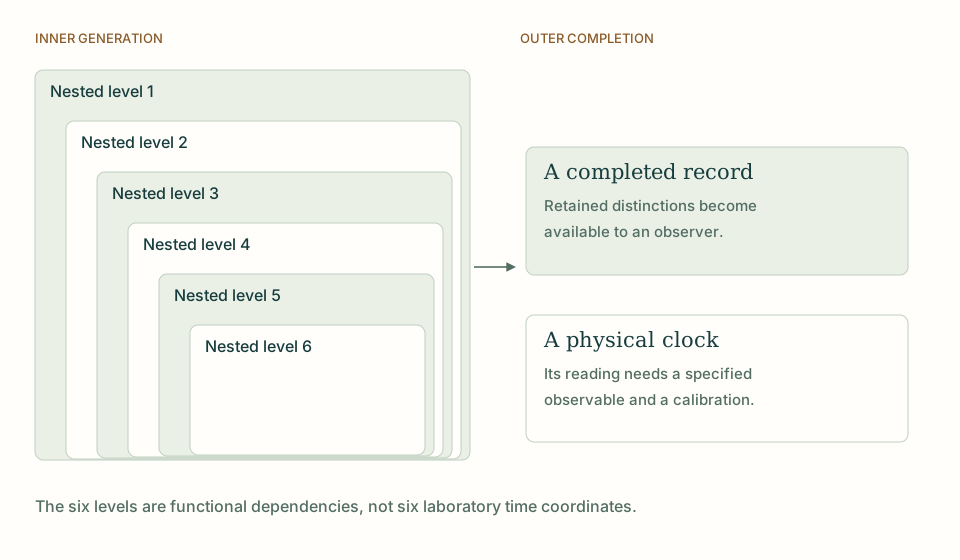
SMM begins with one nonspatial generative source. DTT distinguishes its inner production from the outer order in which completed results become accessible. The six inner levels are nested functional dependencies within that production; the seventh denotes outer completion. They are not six independent clocks, six spatial directions, or six simultaneously occupied temporal axes. This distinction makes the framework more specific than a general claim that everything changes: it asks how a world of persistent relations can be generated before its spatial representation is taken for granted. [2]
McTaggart distinguished tensed positions—past, present and future—from the relations earlier than and later than. His argument challenges the coherence of taking passage as a changing possession of incompatible temporal properties. For the comparison here, the distinction is a tool for asking what DTT’s completion adds to an ordered history. A sequence can be fully ordered without specifying which member is now present.
Consider a list of event labels A, B and C. The facts A precedes B and B precedes C do not change when a reader moves down the list. What changes is the reader’s relation to a particular entry. If a completion theory adds an objective change in actuality, it needs to say whether that change is another event, an irreducible feature of events, or a change in a meta-time. These alternatives expose the regress question without assuming that McTaggart’s conclusion is correct. His analysis is philosophical; it supplies no Hamiltonian, physical clock or information-processing mechanism. [1]
McTaggart’s A/B distinction is not a distinction between real and imaginary components of a number. Tense and earlier/later relations are logical or ontological features of events; i and j specify multiplication laws. Representing two temporal roles by an ordered pair can be useful bookkeeping, but choosing complex or split-complex multiplication adds mathematical structure not supplied by the philosophical distinction.
The proper DTT question is what that added structure explains. A split-complex form may encode an indefinite invariant, while an ordinary complex structure may encode phase. Neither operation automatically represents the becoming of an event from future to present to past. If a model associates completion with one component and inner generation with another, it should define the readout and show why transformations preserve observable relations. McTaggart’s argument then remains a separate challenge to the interpretation of passage. The comparison is useful precisely because it prevents a visually attractive plane from being mistaken for a solution to a problem about temporal predicates and actualization. [1]
For z = a + jb, multiply by exp(jη) = cosh η + j sinh η. The new components are a′ = a cosh η + b sinh η and b′ = a sinh η + b cosh η. Direct expansion gives a′² − b′² = a² − b². In contrast, multiplying a + ib by exp(iθ) preserves a² + b². Thus a quarter-turn in the ordinary complex plane and a finite hyperbolic boost have different invariants. No real rapidity η produces the circular operation i. The calculation locates the exact algebraic similarity to relativity and prevents a picturesque rotation from being mistaken for a derivation of physical evolution.
The positive research question is which operational distinction selects a particular algebra. If completion singles out a compatible ordinary complex structure while a separate indefinite bilinear form organizes clock comparisons, the two roles can coexist coherently. If the distinction is merely a notation chosen for convenience, it cannot determine the observed signature or the probability rule. Clarifying this issue makes comparisons with philosophical theories of time more illuminating, because those theories concern existence and ordering rather than an unexplained multiplication table.
THE SAME QUESTION, DIFFERENT STARTING POINTS
| Question | SMM/DTT | McTaggart’s A-series and B-series |
|---|---|---|
| Explanatory starting point | DTT’s proposed inner–outer relation requires explicit algebraic maps, with ordinary complex and split-complex operations kept distinct. | Tensed positions and fixed earlier/later relations classify events without specifying their physical production. |
| Key distinction | Split-complex boosts preserve a²−b², whereas ordinary complex rotations preserve a²+b²; neither identity alone supplies source dynamics. | McTaggart’s A/B distinction is not a distinction between real and imaginary components of a number. |
KEEP THE CONNECTION
Connects this comparison with the author’s discussion of temporal algebra.
Connects this comparison with the author’s discussion of temporal algebra.
Connects this comparison with the author’s discussion of temporal algebra.
Connects this comparison with the author’s discussion of temporal algebra.
Connects this comparison with the author’s discussion of temporal algebra.
References support the comparator and the specific mathematical or interpretive claims indicated. SMM/DTT connections are developed in the analysis above.
How these comparisons distinguish premises, results and physical claims