Two frameworks can use the language of two times while assigning it very different mathematical meanings. Bars’s constrained higher-dimensional formulation and DTT’s generation–completion distinction provide a useful example. Comparing their state spaces, gauge constraints and observables clarifies what a substantive correspondence would require.
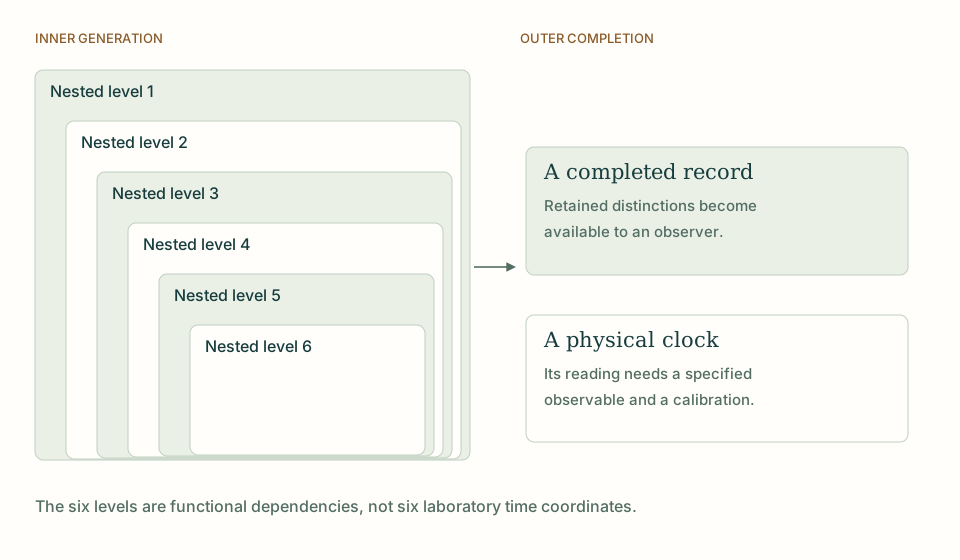
DTT distinguishes the inner activity that produces a configuration from the outer completion through which an observable record becomes available. Its six inner levels are nested functional dependencies within that account. Calling this a duality of time does not automatically specify a spacetime with two independent timelike metric directions.
Bars’s Two-Time Physics uses a different starting point: an enlarged phase space with gauge constraints. Its proposed relationship among different one-time systems is obtained through gauge choices in that framework. The shared phrase is therefore the beginning of a question, not evidence that the two theories have the same state space or physical content. [1][2]
02A constrained phase-space benchmark
In the elementary worldline formulation, coordinates X and momenta P form an Sp(2)-related pair. Constraints of the form X² = 0, P² = 0 and X·P = 0 organize the gauge description in a space with two timelike directions. Gauge fixing can yield different one-time dynamical descriptions. The constraints are essential to the proposal: the extra signature is not permission for unrestricted negative-norm physical states.
This mathematical structure is far more specific than a distinction between an inner process and its output. A proposed DTT connection would have to identify actual constraints and gauge orbits in the source model, and then show how its completed observables correspond to a gauge-fixed physical system. [2]
X² = 0, P² = 0, X·P = 0
The displayed constraints summarize the elementary constrained model; their quantization and ordering require the original formalism.
Six nested inner levels and outer completion. The nesting indicates functional dependence in the SMM/DTT proposal. Outer completion makes a retained result available; it does not turn the six levels into six independently measured clocks. View full size ↗
03Counting physical degrees of freedom
A phase space with d+2 configuration coordinates has dimension 2(d+2). In a regular region where the three constraints are independent and first class, imposing them removes three dimensions and quotienting their gauge flows removes three more. The reduced phase-space dimension is therefore 2(d+2) − 6 = 2d − 2.
This is the same degree count as a massless particle in d-dimensional one-time spacetime after its reparameterization constraint and gauge identification. Equal dimension is a consistency check, not a proof that every reduced Hamiltonian or quantum theory is identical. Singular constraint surfaces and global gauge choices can require separate care.
dim Γreduced = 2(d+2) − 2×3 = 2d−2
Independent first-class constraints, regular reduction, and no unaccounted boundary or global sectors.
04Hidden operations are not automatically gauge
In a DTT source model, two inner histories may produce the same immediate record. That does not imply they are gauge-equivalent. They could retain different memory that affects a later experiment. Gauge equivalence is stronger: differences along a gauge orbit do not change any physical observable in the specified theory.
The distinction gives a useful test. If a source difference can be detected through an allowed future intervention, it belongs to physical predictive structure, even when the present output conceals it. If no permitted experiment can distinguish it, a quotient description may be justified. The quotient must be defined by the full accessible operation set rather than by one selected measurement.
05What the comparison contributes
Bars’s construction highlights the role of constraints in removing apparently excessive degrees of freedom. DTT highlights the role of completion in determining what a receiver can observe. These ideas could meet in a model where source constraints generate equivalence classes of internal histories and the outer record algebra is well defined on those classes.
That would be a precise research bridge. It would need to preserve probability, identify physical evolution, and show that the same class predicts the same future record statistics under admitted controls. Simply replacing the word gauge with inner time would leave these tasks unresolved. The positive opportunity is an explicit reduced description derived from source operations. [1]
06Gauge-related descriptions and observable agreement
A simple way to recognize gauge freedom is to ask whether changing an internal label changes any admitted physical observation. If every observable is constant along a family of transformed states, those states represent one physical possibility within that model. Choosing one representative makes a calculation shorter without adding a new measured degree of freedom. In a constrained Hamiltonian theory this statement must be implemented by the constraint algebra and the definition of observables.
The comparison suggests a useful question for DTT: do different inner descriptions sometimes complete to exactly the same retained world? If so, their equivalence should be expressed through the full admitted readout, not just through one convenient detector. That can reveal a redundancy in description. It still does not make the particular Sp(2) symmetry of Two-Time Physics a consequence of nested temporal roles; a proposed correspondence must exhibit its actual generators and constraints.
07A clear way to state the outcome
At the current level of this comparison, the approaches share an interest in a deeper structure behind ordinary one-time observation. Their mechanisms differ: constrained phase-space geometry in one case, and generative activity with completed records in the other. No equivalence of the two frameworks is established here.
The worked reduction explains what would count as a nontrivial connection: a matching constraint algebra, a map between reduced observables and compatible dynamics. It also prevents a mistaken criticism of DTT based solely on ordinary multi-time pathologies, because the number of functional temporal roles is not itself a metric signature. The relevant consistency questions depend on the model actually proposed.
THE SAME QUESTION, DIFFERENT STARTING POINTS
The comparison at a glance
Question
SMM/DTT
Bars Two-Time Physics
Two-time meaning
Inner generation and outer completion are different temporal roles.
Two-time signature appears in a constrained enlarged phase space.
Redundancy
Observational equivalence must include future admissible tests.
Gauge equivalence is generated by a specified constraint algebra.
Possible bridge
Construct completed observables on source equivalence classes.
Compare reduced phase spaces, observables and dynamics explicitly.
KEEP THE CONNECTION
Key ideas
Two temporal roles and two timelike coordinates are different mathematical claims.
The Sp(2) constraints are essential to the Two-Time Physics construction.
A useful bridge would compare constraints and physical observables, not terminology alone.
Follow physical clocks and spacetime reconstruction.
Sources and further reading
References support the comparator and the specific mathematical or interpretive claims indicated. SMM/DTT connections are developed in the analysis above.