
In this article
- What rank three actually says
- A distance from allowed transitions
- A small worked example
- Several different dimensions
- The role of frame transport
- Distances and transport can be tested separately
- A stronger spatial-emergence result


A three-dimensional local carrier is a promising building block for spatial emergence. It does not yet determine how separate records are near or far from one another. This guide constructs a graph metric, compares independent notions of dimension, and identifies the additional relationships a SMM/DTT source must generate.
Suppose the source’s accessible tests select a quotient W isomorphic to the imaginary quaternions. Then W has three real linear directions. Within the assumed algebra and detector rules, this can explain why a local difference record has three independent components. It is a result about what a receiver can distinguish at one location in the construction.
A space contains relations between many such records. Which records are adjacent, how readout frames are transported, how lengths are compared, and whether neighborhoods approximate R³ are additional questions. The quaternionic readout is valuable precisely because it supplies a candidate local carrier for that larger construction rather than answering every geometric question at once. [2]
Let completed records form the vertices of a connected undirected graph. Assign each edge a strictly positive length. Define the distance between two vertices as the smallest total edge length along a path joining them. Reversing a path proves symmetry. Concatenating two paths proves the triangle inequality. Positive edge lengths give a positive distance between distinct vertices in a finite graph.
This is an explicit metric construction. It also reveals its inputs: adjacency and edge lengths were supplied. If a temporal source is to generate this metric, its admitted transitions must determine the graph and its operational clock or ruler comparisons must determine the lengths. Declaring vertices to be events does not derive those relations.
Finite connected graph; undirected edges; strictly positive edge lengths.
Take three vertices A, B and C with edge lengths AB = 1, BC = 1 and AC = 3. The shortest A-to-C route goes through B and has length two. Hence d(A,C) = 2 despite the direct edge being longer. If the direct edge is shortened to one half, the distance becomes one half without changing the local internal carrier attached to any vertex.
The example separates internal readout rank from relational distance. Every vertex could carry an identical R³-valued record while the graph is a line, a tree, a complete graph or a cubic lattice. The number of components at a vertex cannot select which of these geometries is physically realized.
A volume-growth exponent counts how many records lie in a ball of radius R. A spectral dimension describes the short- or intermediate-time return probability of a specified diffusion. A tangent-space dimension describes local smooth coordinate structure. These quantities can agree in ordinary Euclidean geometry, but their agreement is a result of that geometry and dynamics.
For a large regular three-dimensional lattice, a suitable continuum regime gives approximately cubic volume growth and ordinary diffusion. For a graph with shortcuts or hierarchical weights, the same local record variables can yield different scaling. Recovering a three-dimensional world therefore means connecting the readout, transition structure and large-scale probes, not choosing one convenient dimension and silently applying it to all of them.
The volume and diffusion probes require independently specified metrics, measures and generators.
Even after assigning a three-dimensional carrier at every record, vectors at different records cannot be compared without a transport rule. A connection specifies how a local frame changes along transitions. Products of transport maps around a loop can retain holonomy, which is sensitive to the path and may represent curvature or gauge structure in an appropriate limit.
The construction must say which part of the transport is spatial frame geometry and which part acts on internal matter degrees of freedom. Equating both merely because quaternionic rotations are available hides a physical identification. A common source could constrain the two, but that connection has to be expressed through its operations and observable tests. [2]
Suppose a source graph admits a shortest-path metric. A second operational question asks how a retained excitation moves along that graph. Two models can have exactly the same edges and edge lengths while assigning very different waiting times to a traversal. Their geometry agrees under the chosen distance convention, but their travel-time measurements disagree. Conversely, identical travel times can result from compensating changes in lengths and waiting times.
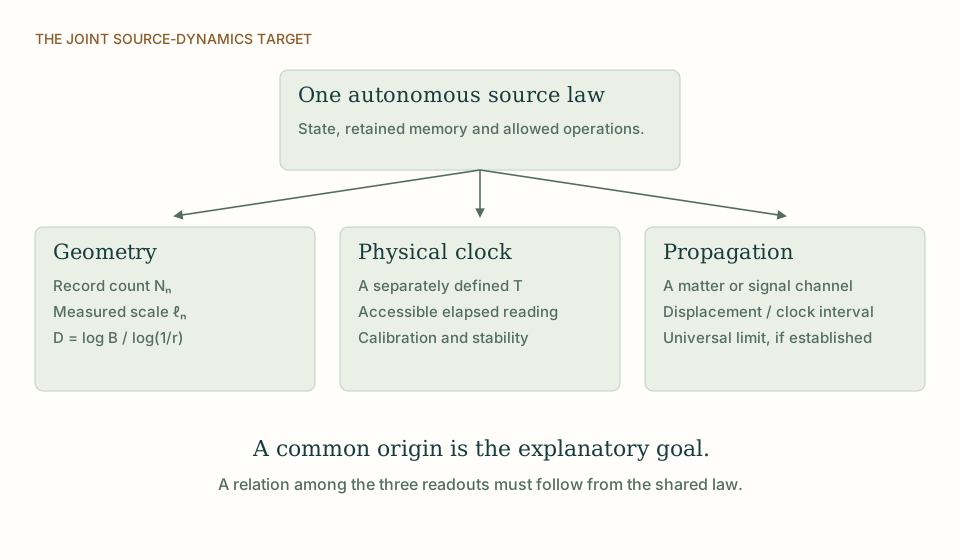
A source construction can use this freedom productively by defining both a geometric distance and a transport-derived distance, then proving when they coincide. Agreement over a range of preparations would connect source organization with actual measurement. Failure can reveal an anisotropic medium, a clock dependence or a scale at which the effective metric ceases to work. The central result would therefore be a compatibility theorem for separately defined observations, supported by the nested generation of the records used in each.
The next useful theorem would begin with a source state and allowed operations that do not presuppose the desired spatial lattice. It would derive a stable adjacency relation between completed records, a metric or operational distance, a compatible measure, and a continuum or controlled finite-scale geometric regime. Robustness under small source perturbations would matter as much as one exactly arranged example.
The six nested inner roles can organize this process by supplying phase distinctions, directional readout, retained relations and completion. Their physical value increases when the hierarchy constrains which networks and transports are possible. That is the route from a local algebraic result to a geometry that can carry matter and clocks.
THE SAME QUESTION, DIFFERENT STARTING POINTS
| Question | SMM/DTT | Metric reconstruction |
|---|---|---|
| Local carrier | A quaternionic construction can select three readable components. | Vector-space rank describes one local linear task. |
| Distance | Generate adjacency and length from source operations and readouts. | Shortest-path distance is a metric once weighted transitions are given. |
| Global geometry | Establish compatible neighborhoods, measure and propagation. | Volume, spectral and tangent dimensions need not agree automatically. |
KEEP THE CONNECTION
Follow the local rank-three readout.
Separate spectral dimension from metric reconstruction.
Read how record counts can enter a volume probe.
Explore the complete geometry sequence.
References support the comparator and the specific mathematical or interpretive claims indicated. SMM/DTT connections are developed in the analysis above.
How these comparisons distinguish premises, results and physical claims