Three spatial readout directions can be assembled from three pairs of opposite channels. Under explicit restrictions this requires six primitive channels. The important next question is whether the channel bound also selects six nested generative levels. A worked rank calculation separates the valid theorem from that additional physical claim.
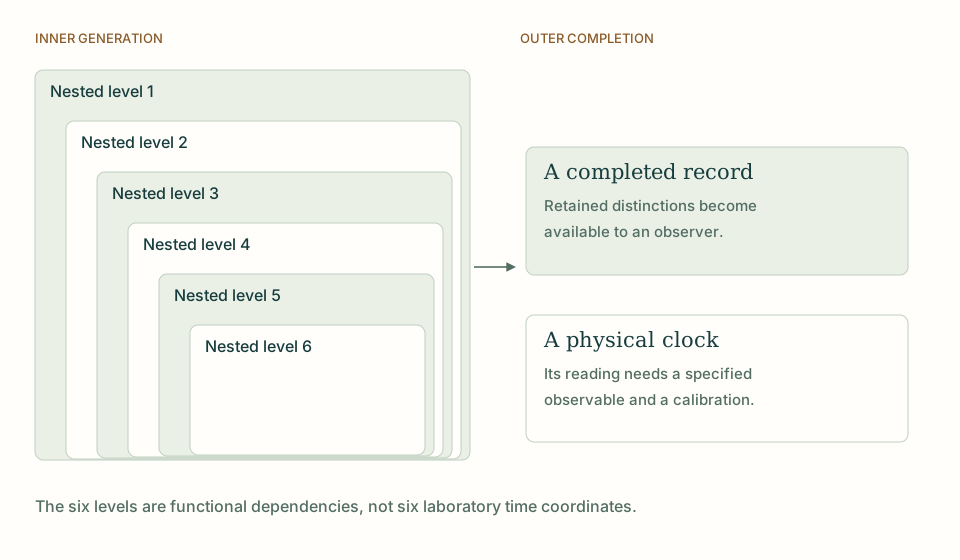
The DTT picture organizes spatial generation through six nested inner levels followed by outer completion. A successful physical reconstruction should explain both what the levels do and why fewer levels cannot accomplish the same admitted task. Drawing six boxes or naming three pairs does not by itself supply that necessity argument.
A restricted lower bound can nevertheless be meaningful. It identifies a model class in which a three-directional odd readout requires three exchanged pairs of primitive nonnegative channels. The value of this result lies in its hypotheses: they tell us exactly what source properties a deeper construction would need to justify. [1]
02Three pairs yield three odd directions
Let e₁⁺, e₁⁻, e₂⁺, e₂⁻, e₃⁺, e₃⁻ be six independent channel labels. An involution exchanges the plus and minus member of every pair. A linear readout is odd under this exchange if swapping all partners reverses its sign. Such a readout depends only on the differences eᵢ⁺ − eᵢ⁻.
Each pair contributes at most one independent odd direction, so p pairs contribute odd rank at most p. Three independent odd readout directions therefore require p ≥ 3, or at least six primitive channels. Equality is attained by mapping the three differences to the coordinate basis of R³. This proves a minimal count for this specified channel task.
J eᵢ⁺ = eᵢ⁻, J eᵢ⁻ = eᵢ⁺
QJ = −Q ⇒ rank(Q) ≤ number of exchanged pairs
rank(Q) = 3 ⇒ at least 3 pairs = 6 channels
The readout is linear and odd, and the primitive channels occur in separately exchanged pairs.
Six nested inner levels and outer completion. The nesting indicates functional dependence in the SMM/DTT proposal. Outer completion makes a retained result available; it does not turn the six levels into six independently measured clocks. View full size ↗
03An explicit finite readout
For nonnegative intensities pᵢ⁺ and pᵢ⁻, define xᵢ = pᵢ⁺ − pᵢ⁻. Choosing channel intensities (3,1), (1,4) and (2,2) gives the readout vector (2,−3,0). The sums pᵢ⁺ + pᵢ⁻ remain independent information about total channel activity, even when the odd readout is fixed.
For example, replacing (3,1) by (4,2) leaves x₁ = 2 unchanged. An observer who only accesses x cannot infer that extra common-mode activity. This elementary example connects directional readout with observational equivalence and retained memory: which channel distinctions survive depends on the admitted detector tests, not simply on the number of primitive inputs.
If three signed coordinates are allowed as primitive channels, they already span R³. They do not obey the preceding restriction to individually exchanged nonnegative partners, so they are not a counterexample to the stated theorem. They are a counterexample to an unrestricted claim that three-dimensional readout always requires six primitive variables.
There are other choices: generators need not be organized into identifiable pairs, and nonlinear detector maps can have different counting properties. A necessity claim must therefore explain why the source admits precisely the restricted kind of preparation, exchange and readout. That explanation may come from positivity, physical controls or a source representation, but cannot be supplied by the desired answer.
05From six channels to six nested levels
A channel is an input to a readout. A level is a position in a hierarchy of generative dependence. Converting the channel lower bound into a level lower bound requires a further rule, such as one primitive channel being supplied per level, together with a demonstration that no level can supply two independent channels.
It also requires nesting to matter dynamically. If all six inputs can be prepared simultaneously without changing the admitted task, a six-step schedule is a choice of implementation. A genuine temporal selection result would show why completing each enclosing operation requires the prior internal result, why the required memory cannot be compressed, and why the receiver’s rank rises in the stated sequence. [1][2]
06What an additional invariant channel contributes
The exchange condition also clarifies the role of a channel that remains fixed under the involution. If Jf = f and the readout is odd, then Qf = QJf = −Qf, so Qf = 0 over the real or complex numbers. Such a channel can retain total activity or completion information while contributing no new odd direction. The six directional channels can therefore coexist with an invariant record variable without turning that variable into a fourth spatial coordinate.
This is an illustrative architectural possibility. It does not identify the invariant channel with the outer temporal role by definition. That identification would need a source operation which actually completes and preserves the relevant record. The calculation nevertheless makes the proposed distinction between internal directional production and outward availability mathematically discussable: separate symmetries can characterize what is generated and what is retained.
07What the stronger result would explain
The channel theorem gives a concrete target for SMM/DTT: derive the positivity and exchange structure from the source, derive the one-channel-per-level restriction, and establish the resulting hierarchy under the full set of allowed operations. The three-direction readout could then be shown to depend on six nested completions rather than merely be representable with six labels.
Even that result would concern local readable directions. Spatial distances, neighboring records, a continuum manifold and relativistic propagation still require their own jointly compatible construction. Treating these as successive explicit achievements preserves the distinctive generative claim while making its physical content progressively stronger.
THE SAME QUESTION, DIFFERENT STARTING POINTS
The comparison at a glance
Question
SMM/DTT
Positive channels and odd readouts
Valid lower bound
A paired positive-channel architecture can implement three odd directions.
Odd rank is at most one per exchanged pair.
Selection question
Explain why source operations require six nested levels.
A count of channels alone does not determine hierarchy or schedule.
Spatial interpretation
Generate metric relations and propagation from the same construction.
Rank three describes local linear readout before a manifold exists.
KEEP THE CONNECTION
Key ideas
Six channels are minimal only within the stated paired, nonnegative, odd-readout class.
The channel-to-level correspondence is an additional claim requiring a mechanism.
A rank-three readout remains distinct from an emergent three-dimensional space.
Continue with locality, distances and spatial reconstruction.
Sources and further reading
References support the comparator and the specific mathematical or interpretive claims indicated. SMM/DTT connections are developed in the analysis above.