
In this article
- The explanatory ambition
- A complete six-stage model
- An independence test
- What a shared constraint can establish
- The six nested roles in a physical construction
- A useful next result


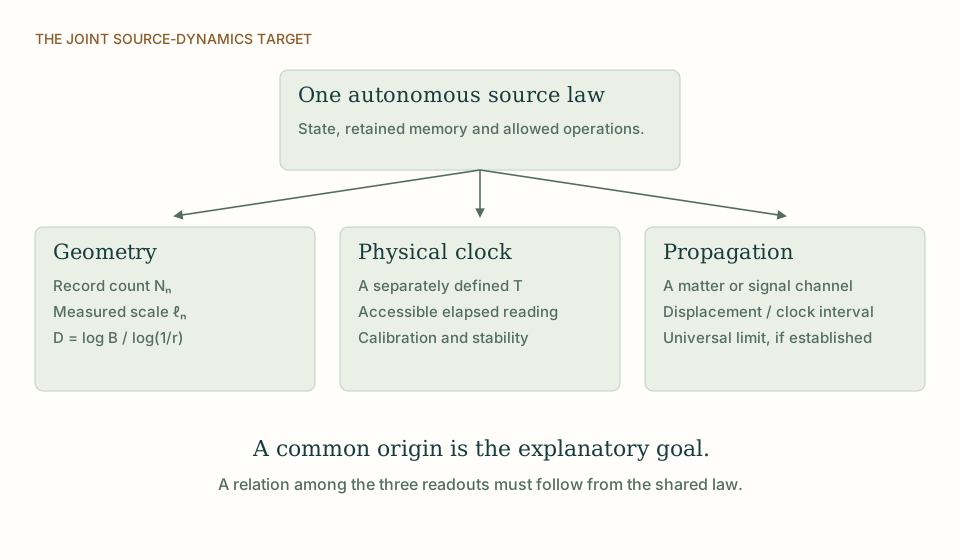
A single controller can coordinate separately chosen clocks, matter rules and spatial readouts. The stronger SMM/DTT goal is to explain why those rules agree. An explicit six-stage counter model and a conserved-constraint example make the difference precise and identify what a shared dynamical explanation would accomplish.
SMM begins from a common generative source rather than a collection of independently existing spatial things. Its physical development therefore has an unusually demanding target: the same process should account for observable relations, clock readings and matter propagation. It is possible to implement all three in one computer program. That achievement does not yet explain why their laws are compatible.
The distinction matters whenever “one source” is used in an argument. Numerical unity says how many underlying systems there are. Dynamical unity says how their measurable structures are constrained. A source carrying three freely adjustable subroutines remains a model with three independent choices, even when it has only one name and one update command. [1]
Consider a state (q,m,x), where q takes six internal values, m counts completed returns, and x is an integer position register. Each step advances q. When q wraps from 5 to 0, the same step increases m by one and increases x by one. Completion is the section q = 0. A receiver reads X = ax and T = τ₀m, with positive constants a and τ₀.
After k completed cycles the receiver has Xₖ = X₀ + ka and Tₖ = T₀ + kτ₀. Hence its velocity is a/τ₀. This is an exact consequence of the displayed update and readouts. The model contains six internal stages, but it has neither derived their necessity nor constructed three spatial dimensions. The position register and its step size were supplied as inputs.
This illustrative counter is deterministic. The registers must be bounded or assigned an explicit resource policy in a finite realization.
Replace the clock by T′ = λτ₀m while leaving the update, position register and completion section unchanged. The observed velocity becomes a/(λτ₀). All source trajectories and stage counts are identical. Consequently the mere existence of the common controller does not select its clock-to-motion ratio. If λ is only a universal change of units, nothing physical changes; if one species or one operational clock changes relative to another, it is a physically different model.
The useful test therefore holds units and independently calibrated comparisons fixed. Can an allowed modification alter one channel’s reading without changing the others? A positive answer locates an independent freedom. It prevents a definition of time from being mistaken for a law relating measurements.
A stronger model may possess source quantities Q₁ and Q₂ and an invariant constraint C = Q₁ − γQ₂. In a quantum formulation, suppose the admitted initial states lie in the kernel of C and the autonomous Hamiltonian preserves that kernel. Then the relation is maintained throughout evolution. Commutation [H,C] = 0 is one sufficient condition, subject to the appropriate operator domains.
This supplies a real mechanism of protection: the equality survives because departures are excluded by the invariant sector. It does not determine γ from nothing. The value of γ, the preparation of the sector and the choice of the two observables still need justification. Removing one freedom while naming the remaining ones is a constructive advance, even before a universal physical theorem is available.
For the elementary argument H and C may be finite matrices. Unbounded operators require a common invariant domain.
The six-stage counter is a convenient operational example, not a literal derivation of DTT’s six nested levels. Nesting concerns dependence: a later completion may require coherent results from earlier internal operations. A physical account should show which information each operation supplies, what is retained through the enclosing level, and why collapsing or duplicating a level changes the accessible task.
This directs attention to the source interaction rather than a diagram’s labels. The same interaction could constrain a branch encoder, stabilize a material clock and transport an excitation. Demonstrating such a link would make the ontology do explanatory work. The comparison with autonomous systems gives a precise standard for that demonstration. [1]
The most informative result would specify one family of source updates, independently define its geometry, clock and propagation observables, and prove an invariant relation over a nontrivial range of settings. A protected equality in one specially prepared state is weaker than a law stable under admitted controls and changes of preparation.
Conversely, a counterexample family is useful evidence about the assumptions: it identifies what the source principles do not yet force. SMM/DTT becomes stronger when the next model eliminates that freedom through a common physical mechanism. A successful explanation then earns its unity through the relation it derives, while the six nested generative roles organize how the observable result is completed.
THE SAME QUESTION, DIFFERENT STARTING POINTS
| Question | SMM/DTT | Autonomous dynamical systems |
|---|---|---|
| Meaning of one source | A common generative foundation should constrain all physical readouts. | A single autonomous update may still contain independent subrules. |
| Exact result | A proposed source law can protect relations through an invariant sector. | The six-stage example gives a/τ₀ because its readouts were selected. |
| Selection question | Explain the clock, geometry and propagation dictionary together. | Changing a freely supplied clock factor changes the measured ratio. |
KEEP THE CONNECTION
Read the minimum specification of a source model.
Connect autonomous dynamics with generation and completion.
See the distinction between one clock realization and a universal clock law.
Follow the nested readout construction.
References support the comparator and the specific mathematical or interpretive claims indicated. SMM/DTT connections are developed in the analysis above.
How these comparisons distinguish premises, results and physical claims