Finite source memory, recurrent dynamics and the cost of a lasting past
A lasting sequence of completed records needs somewhere to retain its distinctions. Finite-state recurrence and a simple counting bound show what an autonomous SMM/DTT source can and cannot preserve. The comparison with information thermodynamics clarifies when storage, compression, overwriting and physical reset enter the account.
Continuous renewal is not the same as complete erasure. An observer who can remember an earlier event already carries a relation between successive completions. In a physical version of SMM/DTT, that relation must be represented by retained source information, an emitted record, a stable environment, or another specified memory mechanism.
This is why memory belongs in the state space of an autonomous source model. A law can generate a new configuration at every internal step while a finite receiver eventually forgets the distinctions needed to recognize its history. The source’s current state and the observer’s accessible past are related but distinct resources. [1]
02A finite deterministic recurrence bound
Take a deterministic update on a set of K states. Among the first K+1 states visited, two must coincide. From that coincidence onward the future repeats, because the next state depends only on the present state. There can be a transient segment, followed by a cycle with length at most K. If the update is bijective, the trajectory starts on a cycle immediately.
An autonomous counter that keeps adding an exactly new integer forever therefore cannot be implemented on a fixed finite state set. A toy model using an unbounded integer register is mathematically coherent, but its unbounded storage is an assumption. This does not prohibit finite devices from working reliably for finite durations; it sets the correct resource scale for their claims.
X has K states, U:X→X
∃ 0 ≤ i < j ≤ K with Uⁱ(x₀) = Uʲ(x₀)
Uⁱ⁺ᵐ(x₀) = Uʲ⁺ᵐ(x₀) for every m ≥ 0
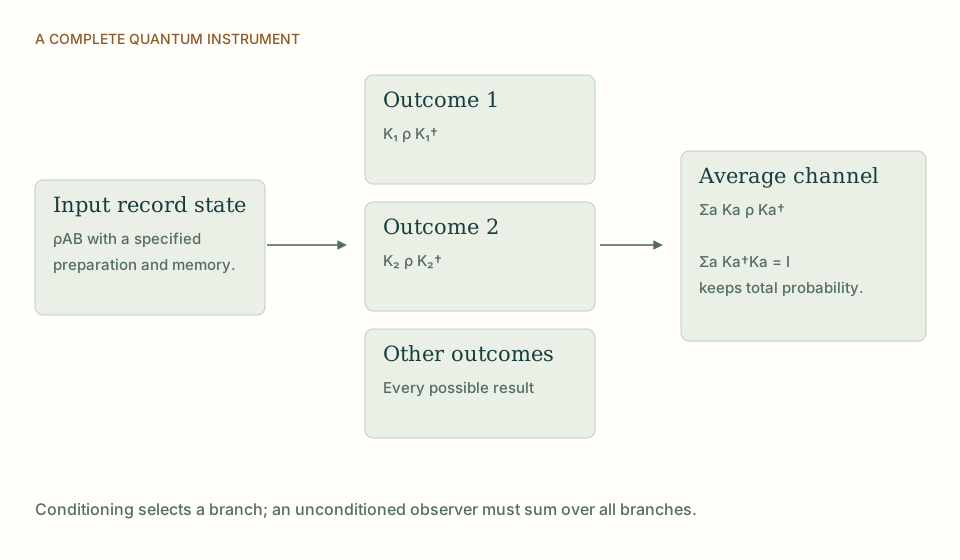
From a source process to a complete record instrument. Outcome probabilities, retained conditional states, and the outcome-averaged channel belong to the same instrument. Keeping every outcome prevents postselection from being mistaken for a signal. View full size ↗
03How much space is needed for an exact history?
Suppose each of n completed events can contain one of M independent labels and the receiver must distinguish every possible full history without error. There are Mⁿ histories. A classical register needs at least that many distinct states, or n log₂M bits. A quantum receiver that distinguishes the same histories perfectly in one readout needs at least Mⁿ mutually orthogonal record states.
For binary outcomes and n = 100, the full history requires at least 100 bits. This is a requirement on the task, not a claim that every observer stores every microscopic event. A device can retain only a running count or an expectation value, but it then solves a smaller task. Compression is possible when the histories are restricted or when errors and loss are allowed; its assumptions must be named.
Number of exact histories = Mⁿ
log₂(memory states) ≥ n log₂M
Perfectly distinguishable quantum records: dim Hrecord ≥ Mⁿ
04Quantum recurrence is not the same pigeonhole argument
A finite-dimensional quantum state space contains continuously many pure states. It is therefore incorrect to apply the finite-set recurrence bound K directly to every unitary quantum trajectory. Exact periodicity depends on commensurate energy differences; approximate recurrence has a different formulation.
The orthogonal-record bound remains applicable to perfect distinguishability. A fixed d-dimensional register cannot encode more than d mutually orthogonal alternatives in one use. The distinction prevents an apparent escape through infinitely many nonorthogonal states: their mathematical number is not their capacity for error-free classical records. A realistic model can instead distribute records across an expanding environment or accept finite resolution.
05Where thermodynamics enters
Landauer’s argument concerns logically irreversible reset under physical conditions, not an automatic heat payment for every bit that exists. For an ideal isothermal erasure of an initially unbiased classical bit with suitable memory states, the familiar minimal dissipated heat is kBT ln 2 in the reversible limit. Biased memories, correlations, available side information and nonequilibrium resources change the accounting.
A source model that overwrites its register must state whether it preserves the displaced information elsewhere and where the reset resources come from. If records flow into an environment, the enlarged system may preserve information while the local observer loses access. This connects DTT’s outer record order with a physical resource ledger without turning an information-theoretic formula into a derivation of cosmic thermodynamics. [2]
Ideal unbiased-bit reset: Q ≥ kBT ln 2
This benchmark assumes the stated isothermal reset task and an appropriate thermodynamic memory model.
06A small memory task with a different answer
Consider ten binary completions. Remembering their exact ordered sequence requires 1024 distinguishable records. Remembering only how many outcomes were one requires eleven records, corresponding to counts zero through ten. Remembering only whether that count is even or odd requires two. All three receivers observe the same source events, yet their memory bounds differ because they preserve different questions about the past.
This example gives a precise meaning to selective retention. A temporal arrow can depend on records useful for prediction or comparison without demanding an archive of every microscopic distinction. It also clarifies how a receiver dimension should enter the SMM/DTT programme: the dimension follows from a specified family of admissible questions and an error criterion. A stronger source theory would explain why those questions become physically available, and why other distinctions cease to influence future completed observations.
07The constructive lesson for SMM/DTT
A useful source construction states its memory capacity and the observation horizon together. It can then prove, for example, that n completions preserve a chosen set of distinctions with a given error bound. A model of perpetual renewal needs a further rule for an unlimited record history, a growing environment, finite accessible memory, or recurrence.
These alternatives are physically different. Choosing among them affects temporal arrows, predictive states, entropy and what an observer can infer about earlier inner activity. The distinctive SMM/DTT opportunity is to generate the record capacity and its clock costs from the same nested source dynamics that produces the observable world.
THE SAME QUESTION, DIFFERENT STARTING POINTS
The comparison at a glance
Question
SMM/DTT
Information thermodynamics
Persistence
A completed world includes relations retained across renewal.
Memory capacity is fixed by which histories must remain distinguishable.
Autonomy
The source model must include its controller and record resources.
A finite deterministic state set eventually cycles.
Reset
Overwrite and environmental records need a stated physical mechanism.
Landauer’s bound applies to specified irreversible reset tasks.
KEEP THE CONNECTION
Key ideas
A finite deterministic source cannot produce an unlimited exact counter without added resources.
Perfectly distinguishing Mⁿ histories requires at least Mⁿ orthogonal record states.
Erasure, storage and inaccessible environmental information have different thermodynamic roles.
Follow quantum states, records and open-system dynamics.
Sources and further reading
References support the comparator and the specific mathematical or interpretive claims indicated. SMM/DTT connections are developed in the analysis above.