
In this article
- Memory has an operational definition
- The source and its two temporal roles
- Worked revival from a single memory qubit
- One witness is not every memory test
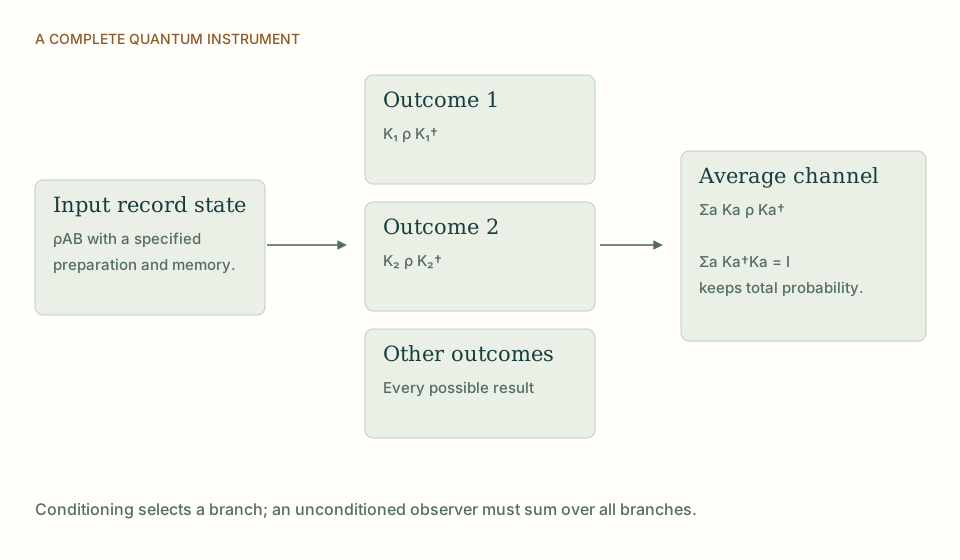
- What the completed record retains
- A source-specific result


Information that disappears from a local state can later return through a retained memory. This comparison calculates a qubit coherence revival, explains the difference between information-backflow witnesses and full intervention-based memory tests, and identifies how DTT can add a constrained source mechanism to standard open-system dynamics.
A process has memory when earlier interventions can affect later statistics in ways not captured by the chosen present-state description. Open-system quantum theory studies this through environments, memory kernels and multi-time processes. DTT’s inner source is a natural candidate for retained variables, but hidden variables are physically meaningful here only through their effect on accessible tests.
A non-Markovian signal is not automatically a discovery of a second physical time. One ordinary time parameter and a finite environment can already produce memory. The source programme’s distinctive task is to explain why the memory has a selected structure and how its retention is tied to completion. [2] [3]
The Single Monad Model begins with one nonspatial generative source. The Duality of Time Theory distinguishes the source’s inner production from the outer order in which completed records become accessible. Its six inner levels are nested functional roles of one process: a higher role organizes lower-level work. The seventh is the completion or observation interface. They are neither six independent clocks nor six additional time coordinates.
This distinction supplies a useful research question: which features of an observed world can follow from the way a source produces, retains and releases information? A concrete answer needs a state space, an autonomous update, retained memory and a rule connecting completion to an accessible measurement. In the constructions discussed here, those mathematical ingredients are stated explicitly. A successful finite example establishes what its specified mechanism can do; further arguments connect it to physical particles, spacetime or universal laws. [1]
Let a system qubit interact with a memory qubit through H=ℏg ZS⊗ZM/2, with the memory initially in |+x⟩. Tracing out the memory multiplies the system’s off-diagonal entry by γ(t)=cos(gt). Prepare the two possible system inputs |+x⟩ and |−x⟩. Their trace distance at time t is D(t)=|cos(gt)|.
The states begin perfectly distinguishable, become identical in the reduced description at gt=π/2, and become perfectly distinguishable again at gt=π. Information has returned through the coherent memory. No irreversible collapse was introduced. The revival witnesses non-Markovian behaviour for this family under the information-backflow criterion, while the joint system–memory evolution remains unitary and has one physical time variable. [3] [2]
g is an angular-frequency scale. The trace distance is one half the trace norm of the difference of the two density operators.
A rise in trace distance is a useful witness of information backflow, but different definitions of quantum Markovianity answer different operational questions. Full multi-time interventions can reveal memory even when a chosen pair of states shows no obvious revival. Conversely, a poor state reconstruction or uncontrolled preparation drift can imitate an apparent change in distinguishability.
The process-tensor approach asks what happens after a causal break that discards and reprepares the visible system. Dependence on earlier interventions can then diagnose retained memory outside that system. DTT benefits from this distinction because it should predict a complete family of responses rather than equate any oscillating curve with inner time. [2] [3]
Start with (|0⟩+|1⟩)|e⟩/√2 and let an interaction correlate the alternatives with normalized environment states |e₀⟩ and |e₁⟩. The reduced system state has diagonal entries 1/2 and off-diagonal entries γ/2, where γ=⟨e₁|e₀⟩. Its eigenvalues are (1±|γ|)/2 and its purity is [1+|γ|²]/2.
If |γ|=0.6, the purity is 0.68. If the environmental alternatives become orthogonal, purity falls to 1/2 and the system looks maximally mixed. A controlled reversal of the joint interaction can nevertheless restore the original pure state when all relevant degrees of freedom remain coherent. This is why a completed local archive cannot be identified with the full microscopic state. The entropy of its reduced description measures inaccessible correlations under a chosen partition; it is not, by itself, evidence that information has been fundamentally destroyed. [2] [4]
γ is the environment overlap. The total state in this example remains pure and evolves unitarily.
A finite source architecture could constrain the frequencies, amplitudes or correlations of revivals and relate them to completion accuracy. Such a constraint would be a concrete additional result. An arbitrary hidden bath with freely chosen couplings is too flexible to establish why one observed memory law occurs.
The six nested functions can organize different retained operations without being six independent reservoirs or clocks. Their physical significance appears when the common update fixes a multi-time relation across those functions. A useful DTT model would also identify when memory becomes safely compressible into a single-time state, because ordinary Markovian approximations work well in many regimes. The comparison therefore supports both a positive mechanism for hidden retention and a precise account of its observational limits. [2] [3]
THE SAME QUESTION, DIFFERENT STARTING POINTS
| Question | SMM/DTT | Open quantum systems |
|---|---|---|
| Inner retention | A source memory can restore information absent from a completed local state. | A finite quantum environment already produces coherence revivals. |
| Operational test | DTT should predict responses to interventions that distinguish genuine retained memory. | Trace-distance backflow is a witness, while process tensors describe broader multi-time dependence. |
| Additional constraint | A selected source architecture should relate its memory and completion parameters. | An unconstrained environment can realize many effective laws. |
KEEP THE CONNECTION
Connects this comparison with the author’s underlying construction.
Connects this comparison with the author’s underlying construction.
Connects this comparison with the author’s underlying construction.
Connects this comparison with the author’s underlying construction.
Connects the comparison to the programme’s current statement of results and assumptions.
References support the comparator and the specific mathematical or interpretive claims indicated. SMM/DTT connections are developed in the analysis above.
How these comparisons distinguish premises, results and physical claims