
In this article
- Stationarity need not mean no observable change
- The source and its two temporal roles
- Worked conditional evolution
- A finite clock has a limited reading language
- Where the two programmes differ
- What the comparison contributes


A globally stationary quantum state can contain evolving correlations relative to a clock subsystem. This article derives the conditional Schrödinger equation in the ideal clock model, explains the limits of a finite clock, and compares relational time with DTT’s distinct task of producing and releasing completed physical records.
The Page–Wootters mechanism describes dynamics through correlations between a clock and the rest of a quantum system, even when the combined state satisfies a stationary constraint. An observer who conditions on a clock reading can recover an evolving system state. This is a concrete account of a temporal role emerging inside a larger quantum description.
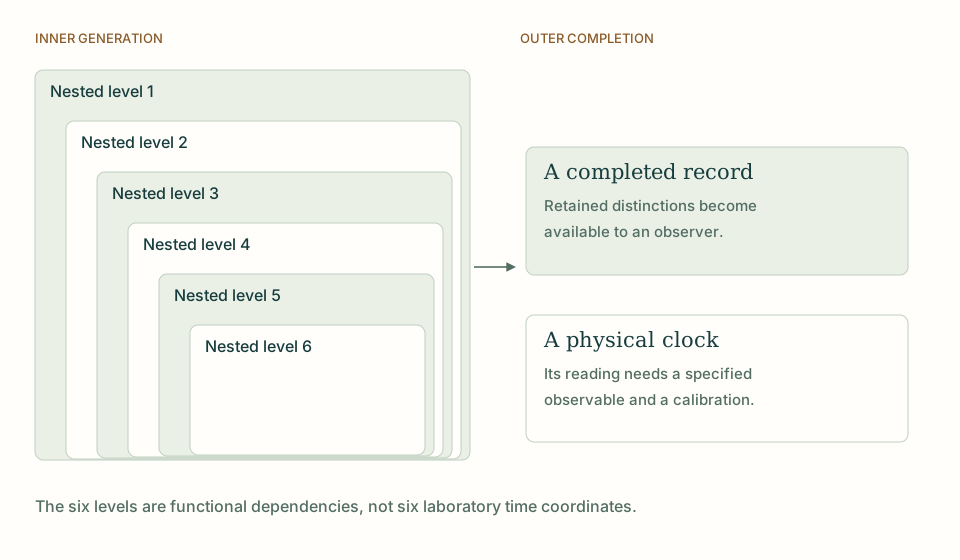
DTT also distinguishes the organization of a source from the time visible in completed observations. The resemblance is important, but the two frameworks begin with different data. The ideal Page–Wootters construction supplies a clock subsystem, a Hamiltonian split and a suitable correlated state. DTT’s stronger ambition is to explain how a physical clock and the observed system arise from the same source. [2]
The Single Monad Model begins with one nonspatial generative source. The Duality of Time Theory distinguishes the source’s inner production from the outer order in which completed records become accessible. Its six inner levels are nested functional roles of one process: a higher role organizes lower-level work. The seventh is the completion or observation interface. They are neither six independent clocks nor six additional time coordinates.
This distinction supplies a useful research question: which features of an observed world can follow from the way a source produces, retains and releases information? A concrete answer needs a state space, an autonomous update, retained memory and a rule connecting completion to an accessible measurement. In the constructions discussed here, those mathematical ingredients are stated explicitly. A successful finite example establishes what its specified mechanism can do; further arguments connect it to physical particles, spacetime or universal laws. [1]
In natural units ℏ=1, impose (HC+HS)|Ψ⟩=0 with no interaction term in the ideal model. Let the clock states satisfy |t⟩=e^{−iHCt}|0⟩, and define the unnormalized conditional system state |ψ(t)⟩=⟨t|Ψ⟩. Differentiating the bra gives ∂t⟨t|=i⟨t|HC. Therefore i∂t|ψ(t)⟩=−⟨t|HC|Ψ⟩=HS|ψ(t)⟩.
The ordinary Schrödinger equation follows for the conditional state. The derivation is exact within the stated ideal assumptions. It does not manufacture a clock spectrum from nothing, and the physical normalization of clock-conditioned states needs care when the clock is finite or imperfect. The parameter t labels a clock orbit; what a real observer can resolve depends on the distinguishability of its states and the measurement used to read them. [2]
Ideal noninteracting clock–system split and ℏ=1. A physical clock requires an observable and finite-resolution analysis beyond this algebraic identity.
For a two-level clock with an energy gap ℏω, phase states repeat after 2π/ω and are not mutually orthogonal at every pair of nearby times. Such a clock can encode a periodic phase, not an unlimited sequence of perfectly distinguishable time labels. More levels or additional memory can extend its useful range, with corresponding resource costs.
This limitation is directly relevant to DTT’s outer records. A clock phase and a retained count of completed episodes are different observables. The phase may recur while the archive distinguishes successive cycles. A source model that claims an irreversible outer order must therefore include the memory that separates repeated clock readings, or explain why the permitted observation language does not require it. Periodicity alone does not select a future direction. [2] [3]
Page–Wootters explains conditional change inside a stationary state; DTT seeks an autonomous production process whose completion makes a world accessible. Neither is automatically a theory of two independent physical times. A useful correspondence could identify the source’s retained clock degree of freedom with the relational clock and the completed record with a conditional state.
The stronger DTT claim would then be to derive the clock Hamiltonian, the system Hamiltonian and their correlation from one constrained update. If those are independently selected to reproduce a desired relation, the construction has imported the Page–Wootters ingredients rather than explained their agreement. The same caution applies to geometry: a relational clock does not by itself generate three spatial dimensions or a universal propagation cone. [2] [1]
The ideal derivation is a valuable benchmark because it shows how a familiar dynamical equation can arise from a correlation constraint with transparent assumptions. DTT can adopt that standard of clarity while pursuing a different source origin. Finite clock accuracy, interaction-induced corrections and the cost of retaining cycle records are natural quantitative quantities to calculate.
A physical advance would be a relation among those quantities that follows from source dynamics and survives changes of the clock implementation. A philosophical advance would be a coherent account of why generative priority and observed temporal order are different. The two forms of progress can support each other, but a conditional clock theorem should not be announced as a complete derivation of spacetime or all material time from a bare nonspatial source. [2] [3]
THE SAME QUESTION, DIFFERENT STARTING POINTS
| Question | SMM/DTT | Page–Wootters mechanism |
|---|---|---|
| Clock role | A DTT clock must be an independently defined source-generated observable. | The ideal mechanism supplies a clock subsystem and conditions on its states. |
| Outer records | Retained memory can distinguish cycles that share the same clock phase. | Finite clocks have periodicity and resolution limits. |
| Derived equation | A source theory can aim to derive the ingredients of the conditional evolution jointly. | The Schrödinger equation follows under the stationary constraint and clock assumptions. |
KEEP THE CONNECTION
Connects this comparison with the author’s underlying construction.
Connects this comparison with the author’s underlying construction.
Connects this comparison with the author’s underlying construction.
Connects this comparison with the author’s underlying construction.
Connects the comparison to the programme’s current statement of results and assumptions.
References support the comparator and the specific mathematical or interpretive claims indicated. SMM/DTT connections are developed in the analysis above.
How these comparisons distinguish premises, results and physical claims
SMONAD
Share this page, or keep a clear reference to the work you are reading.
Use this reference for the explanation on this page. “n.d.” means its first publication date is not specified; the update date is recorded separately.