
In this article
- A history is more than a time-labelled state
- The source and its two temporal roles
- Chain operators connect history to dynamics
- Worked interference between two histories
- What source unity can explain
- A sharp result worth pursuing


A quantum history contains ordered alternatives and the operations connecting them. This comparison explains how history amplitudes differ from a classical list of past events, works through the failure of naive probability addition, and identifies the source-memory structure DTT would need to make temporal entanglement a precise physical claim.
Entangled-history approaches organize quantum alternatives across several times into a history-state language. Their novelty is not the addition of independent time axes, but a richer representation of correlations and coherent alternatives associated with a sequence. The physical meaning depends on which interventions and final tests define that sequence.
For DTT this is a close conceptual comparison. Inner work can retain phase relations among possible record histories before an outer archive becomes accessible. The important question is whether the source supplies a coherent amplitude for an entire history, how that amplitude is measured, and when alternative histories can be treated as exclusive classical records. [2] [3]
The Single Monad Model begins with one nonspatial generative source. The Duality of Time Theory distinguishes the source’s inner production from the outer order in which completed records become accessible. Its six inner levels are nested functional roles of one process: a higher role organizes lower-level work. The seventh is the completion or observation interface. They are neither six independent clocks nor six additional time coordinates.
This distinction supplies a useful research question: which features of an observed world can follow from the way a source produces, retains and releases information? A concrete answer needs a state space, an autonomous update, retained memory and a rule connecting completion to an accessible measurement. In the constructions discussed here, those mathematical ingredients are stated explicitly. A successful finite example establishes what its specified mechanism can do; further arguments connect it to physical particles, spacetime or universal laws. [1]
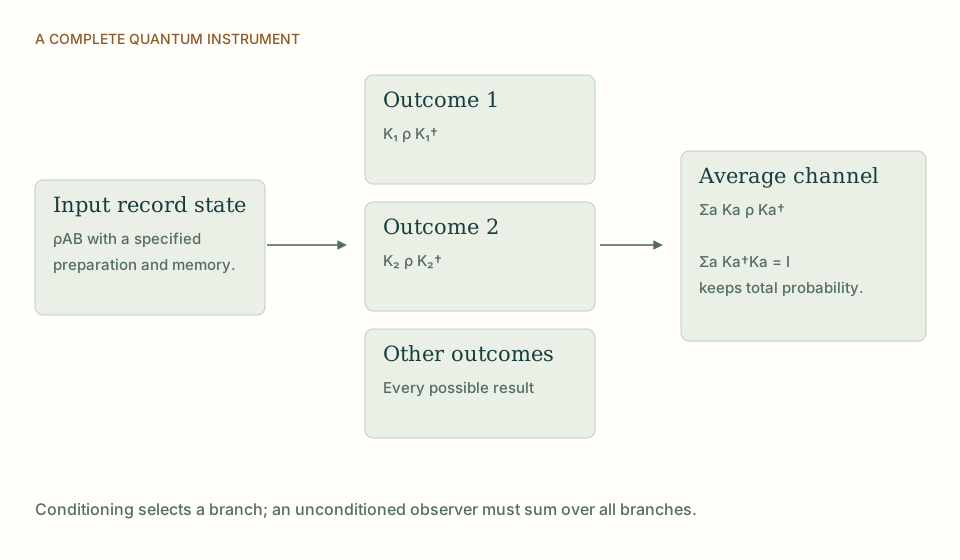
For a sequence of alternatives represented by projectors P at specified stages, a chain operator is the ordered product of those projectors and the unitary evolutions between them. Given an initial density operator, the decoherence functional D(α,β)=Tr(CαρCβ†) measures both weights and interference between histories. Its diagonal entries alone are not automatically a classical probability distribution for arbitrary coarse-grainings.
If the off-diagonal terms relevant to a coarse-graining vanish, the corresponding alternatives can obey the usual additive rule. If they do not, combining histories includes interference. This is the precise distinction that the phrase temporal entanglement should preserve. A tensor product of time labels is a representation choice; its operational interpretation still needs the chain dynamics and allowed measurements. [2] [3]
Suppose two coherent alternatives contribute amplitudes a₀=a₁=1/2 to one selected final outcome. Keeping the alternatives unmeasured gives probability |a₀+a₁|²=1. Treating them as exclusive classical alternatives would give |a₀|²+|a₁|²=1/2. The missing half is the interference term 2Re(a₀a₁*)=1/2.
Now attach orthogonal durable marker states to the alternatives and ignore the markers. Their cross term vanishes in the reduced probability, restoring the value 1/2. This is not a contradiction between two descriptions of one unchanged experiment: the marker interaction changes the process. A DTT source that says it has already completed a path record must specify whether that record is a coherent internal correlation or an irreversible accessible marker. The distinction determines which probability calculation is appropriate. [4] [2]
Amplitudes refer to the same chosen final event. The simple numbers illustrate a balanced interference process, not probabilities for every possible final outcome.
A single generative process is a natural place to store the relative phase linking different possible histories. It can explain why separate-looking records need a common multi-time state rather than independent single-time assignments. Yet the unity of the source does not itself produce quantum interference: a classical source can generate correlated but noninterfering histories as well.
The additional ingredient is a source composition rule that preserves amplitudes and makes their relative phase accessible to a defined completion test. A finite model can display this explicitly, and a resource theorem can identify the memory required. The six inner levels may organize the process, but they are nested functional stages rather than six factors representing separate physical time directions. A valid history reconstruction must also avoid confusing a private source traversal with a physically observed trajectory. [2] [5] [1]
The most useful comparison distinguishes three achievements: representing temporal correlations, constructing a source that produces them and deriving restrictions on which correlations are physically possible. Entangled histories supplies tools for the first. DTT seeks the latter two.
A concrete source result would identify a family of interventions for which a classical retained register is insufficient but a specified coherent memory succeeds, and then connect that memory to the completion mechanism. An experimentally different result would require a further restriction beyond ordinary quantum history calculus. The source ontology can remain a coherent interpretation when the probabilities coincide; it becomes additional physics when its architecture constrains an accessible multi-time quantity that the comparator leaves free. [2] [5]
THE SAME QUESTION, DIFFERENT STARTING POINTS
| Question | SMM/DTT | Entangled histories |
|---|---|---|
| History structure | DTT can retain coherent relations among alternative record histories. | Entangled-history formalisms represent temporal quantum alternatives with a specified history algebra. |
| Probability addition | A completion rule must explain when history interference survives or disappears. | Classical additivity requires the relevant decoherence-functional cross terms to vanish. |
| New prediction | Source memory must impose an extra operational restriction to distinguish the mechanism. | A history representation alone does not introduce another physical time dimension. |
KEEP THE CONNECTION
Connects this comparison with the author’s underlying construction.
Connects this comparison with the author’s underlying construction.
Connects this comparison with the author’s underlying construction.
Connects this comparison with the author’s underlying construction.
Connects the comparison to the programme’s current statement of results and assumptions.
References support the comparator and the specific mathematical or interpretive claims indicated. SMM/DTT connections are developed in the analysis above.
How these comparisons distinguish premises, results and physical claims
SMONAD
Share this page, or keep a clear reference to the work you are reading.
Use this reference for the explanation on this page. “n.d.” means its first publication date is not specified; the update date is recorded separately.