Tensor networks show how an organization of quantum correlations can support geometric interpretations. This comparison derives the bond-cut entropy bound, distinguishes a chosen network graph from an emergent physical metric, and asks how DTT’s source hierarchy could select locality and accessible space through one constrained construction.
A tensor network represents a many-body quantum state by contracting smaller tensors along shared indices. The connectivity and bond dimensions constrain the correlations the representation can support. In holographic and entanglement-renormalization settings, the network can suggest geometric relations among regions and scales.
SMM/DTT likewise seeks to make visible spatial multiplicity arise from a deeper organization of relations. The useful comparison is the encoding of observables: an inner architecture can determine what a completed region can distinguish. The difference is that a tensor network normally begins with a chosen graph and tensors, while the source programme wants to explain why the observed geometry is selected at all. [2][3]
02The source and its two temporal roles
The Single Monad Model begins with one nonspatial generative source. The Duality of Time Theory distinguishes the source’s inner production from the outer order in which completed records become accessible. Its six inner levels are nested functional roles of one process: a higher role organizes lower-level work. The seventh is the completion or observation interface. They are neither six independent clocks nor six additional time coordinates.
This distinction supplies a useful research question: which features of an observed world can follow from the way a source produces, retains and releases information? A concrete answer needs a state space, an autonomous update, retained memory and a rule connecting completion to an accessible measurement. In the constructions discussed here, those mathematical ingredients are stated explicitly. A successful finite example establishes what its specified mechanism can do; further arguments connect it to physical particles, spacetime or universal laws. [1]
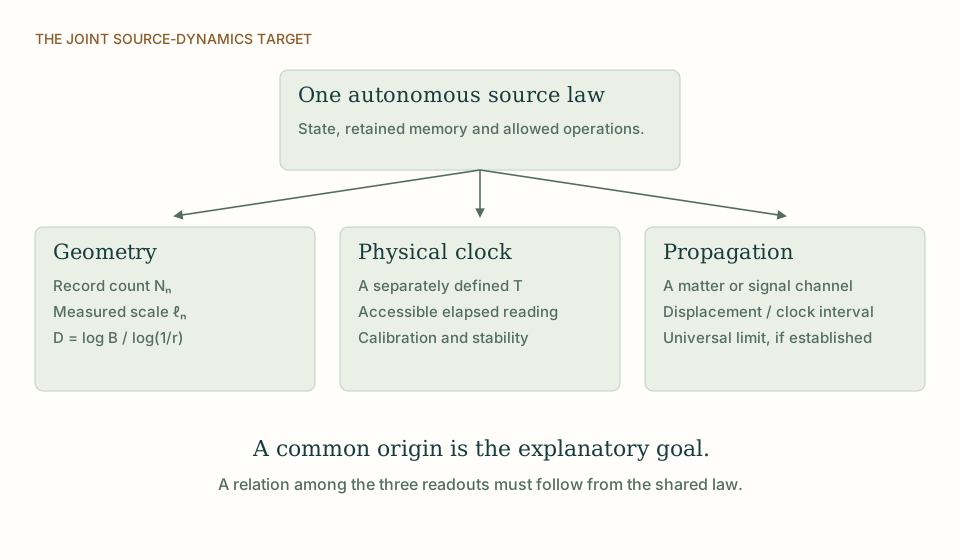
Geometry, clocks and propagation as independent readouts. A single source model should explain the relation between separately defined measurements. Sharing a diagram does not impose that relation. View full size ↗
03Worked information bound across a cut
Suppose a partition of a tensor network is crossed by n bonds, each of dimension χ. Contracting all tensors on either side writes the state as a sum of at most χⁿ product terms across the partition. Its Schmidt rank is therefore no greater than χⁿ, and the von Neumann entropy satisfies S≤n lnχ in natural logarithmic units.
For a block inside a one-dimensional matrix-product state with two boundary cuts and bond dimension χ=4, the bound is S≤2 ln4=ln16, or four bits. The bound does not mean the state actually saturates it; the tensors may give much less entanglement. It also does not say that every network bond is a physical length or a unit of gravitational area. Those interpretations require an additional dictionary. [2][4]
Schmidt rank≤χⁿ ⇒ S≤n lnχ; for n=2 and χ=4, S≤4 bits
Finite pure-state bipartition. Bond dimensions are representation resources; saturation and geometric interpretation are separate assumptions.
04Why rank three is not yet physical space
A rank-three readout or a three-component algebraic variable can organize directions, but a physical space also requires neighbourhoods, distances, volume and propagation. A tensor network makes the same distinction visible: its graph distance, correlation length and any reconstructed bulk metric need not be identical.
DTT’s quaternionic or paired-readout constructions can therefore be compared with networks at the level of an interface, not simply declared proofs of a three-dimensional manifold. A source may generate a graph, but a selection principle must explain why local, approximately isotropic graphs are preferred over arbitrary relational structures. The entropy bound is useful because it provides one calculable relation between graph structure and information. It does not by itself establish the metric or the dimension measured by diffusion and signal propagation. [2][3][1]
05The temporal hierarchy can organize an encoding
Nested inner functions can be interpreted as stages that assemble, coarse-grain or protect correlations before a record becomes accessible. This resembles the way a multiscale network organizes information, but the hierarchy’s order is not automatically physical time. A renormalization layer, an algorithmic contraction order and a material clock are different quantities.
A stronger source model would derive a family of tensors or update maps from one law and show why their completion produces an effective geometry. Its memory budget could constrain bond dimensions, while its observable tests define which network transformations preserve the same world. This would make the comparison constructive. Freely choosing a network to draw a desired space demonstrates representational capacity rather than spontaneous emergence. [2][5]
06What would make the result physically distinctive
The valuable target is a joint relation among accessible entanglement, local transport and calibrated distance. If a source theorem linked these quantities under a controlled refinement, it would remove freedoms that an arbitrary tensor network leaves independent. A deviation in correlation decay or transport could then become an observable prediction when tied to physical scales.
Holographic examples show that entanglement can be deeply connected with geometry in restricted settings. They do not establish that every entangled state defines a smooth spacetime. DTT can use those examples as motivation and as tests of a concrete dictionary, while its own source-origin claim remains responsible for selecting the state, graph and clock. The resulting programme is ambitious precisely because it seeks their common explanation. [2][3]
THE SAME QUESTION, DIFFERENT STARTING POINTS
The comparison at a glance
Question
SMM/DTT
Tensor networks
Encoding
A DTT hierarchy can constrain how source correlations become accessible spatial records.
A tensor network encodes states through chosen tensors and bonds.
Geometry
A readout rank or graph must be connected independently to physical distance and propagation.
Graph connectivity and entropy bounds do not automatically define a spacetime metric.
Resource bound
A physical source budget could constrain the available encoding.
A cut through n bonds gives S≤n lnχ.
KEEP THE CONNECTION
Key ideas
A DTT hierarchy can constrain how source correlations become accessible spatial records.
A readout rank or graph must be connected independently to physical distance and propagation.
The source interpretation becomes additional physics when it constrains an independently measurable process.
Connects the comparison to the programme’s current statement of results and assumptions.
Sources and further reading
References support the comparator and the specific mathematical or interpretive claims indicated. SMM/DTT connections are developed in the analysis above.