
In this article
- The conjecture has a specific setting
- The source and its two temporal roles
- Worked example: the pattern matters
- Entanglement alone is not a metric
- Connectivity does not imply signalling
- A meaningful source-to-space result


Entanglement can encode geometric connectivity in particular gravitational theories, but a correlated pair is not automatically a traversable wormhole. This comparison calculates how different pairings change accessible entanglement, explains the scope of ER=EPR, and identifies the source-to-geometry dictionary required by SMM/DTT.
ER=EPR proposes a deep relation between entanglement and Einstein–Rosen bridge descriptions in appropriate gravitational settings. Its clearest examples involve entangled black holes and holographic quantum theories. The proposal does not imply that every laboratory Bell pair supplies a classical tunnel that can transmit messages.
SMM/DTT similarly treats apparent spatial separation as something that may arise from a deeper unity of relations. That is a useful conceptual connection, but a common source is not yet a wormhole metric. A source-based geometry needs an encoding map that identifies which correlations correspond to connectivity, distance and causal access. [2] [3]
The Single Monad Model begins with one nonspatial generative source. The Duality of Time Theory distinguishes the source’s inner production from the outer order in which completed records become accessible. Its six inner levels are nested functional roles of one process: a higher role organizes lower-level work. The seventh is the completion or observation interface. They are neither six independent clocks nor six additional time coordinates.
This distinction supplies a useful research question: which features of an observed world can follow from the way a source produces, retains and releases information? A concrete answer needs a state space, an autonomous update, retained memory and a rule connecting completion to an accessible measurement. In the constructions discussed here, those mathematical ingredients are stated explicitly. A successful finite example establishes what its specified mechanism can do; further arguments connect it to physical particles, spacetime or universal laws. [1]
Take four qubits. In state A, qubits 1 and 2 form a Bell pair and qubits 3 and 4 form another. In state B, the Bell pairs are 1–3 and 2–4. Every individual qubit is maximally mixed in both states, so all single-qubit density operators are identical.
Across the partition {1,2}|{3,4}, however, state A is a product and has zero entanglement entropy, while state B has two Bell pairs crossing the partition and entropy 2 ln2, or two bits. The number of qubits and each local state therefore fail to determine the global correlation structure. A DTT model that counts records without retaining the relevant relations cannot reconstruct even this simple connectivity information. [3] [5]
Four-qubit pure-state example. The calculation illustrates relational information, not a claim that these states literally contain classical spacetime bridges.
The example shows why correlations can carry information missing from local components, but many states with the same entropies still have different phases, dynamics or physical interpretations. A scalar entropy is not a complete specification of a metric. Holographic geometric reconstruction relies on a much richer operator dictionary and state structure.
DTT can make a constructive contribution by generating that richer structure from a constrained source. The six nested roles may organize relations before spatial readout, but their existence does not select which entangled states admit a smooth geometry. A rank-three algebraic readout supplies directional data only under its assumptions; distances and a propagation law remain additional parts of the reconstruction. [2] [3] [1]
Entanglement permits nonclassical joint correlations while local reduced states remain insensitive to a remote unconditioned operation. The same caution applies to a geometric bridge interpretation: the ordinary Einstein–Rosen bridge is not a freely traversable communication channel. Traversable constructions require additional conditions and interactions, which are separate physical ingredients.
A DTT source that coordinates distant records must therefore prove its observable no-signalling property. Saying that the source is nonspatial does not make arbitrary communication effects compatible with relativity. The positive opportunity is to explain why an underlying nonseparable structure yields a causal outer interface. That explanation would connect the programme’s source unity to the precise limits on accessible influence. [2] [6] [7]
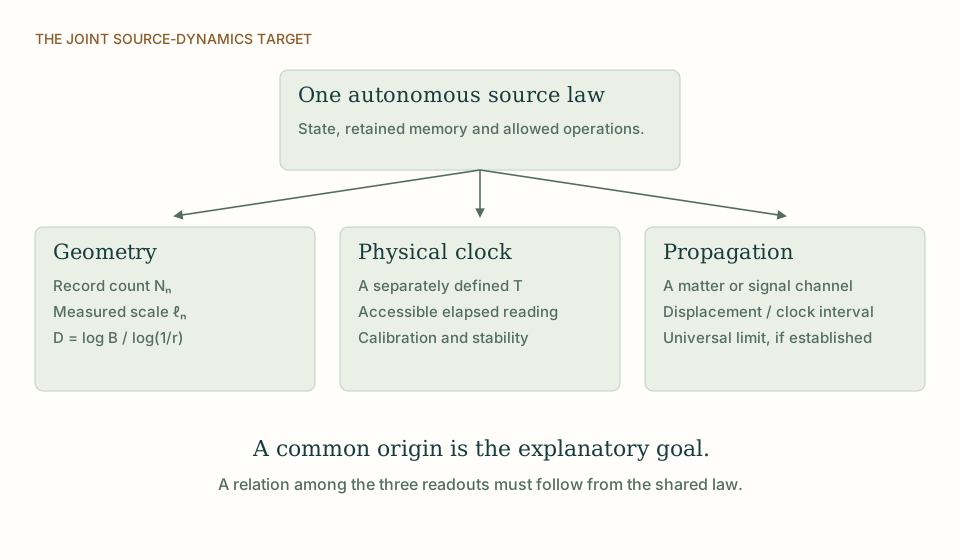
The strongest DTT model would specify a family of source states, define accessible regional observables and derive a geometric relation from their correlations. It should show why the resulting geometry has stable locality and how physical clocks and matter propagate within it. A finite tensor-network example can demonstrate part of this programme without claiming a universal spacetime theorem.
ER=EPR provides motivation and controlled analogies for such work, while the source ontology remains responsible for its own dictionary. A qualitative resemblance between unity and entanglement does not establish that dictionary. A derived relation among correlation, distance and causal response would be the substantive result that makes the comparison more than an attractive image of connectedness. [2] [4] [3]
THE SAME QUESTION, DIFFERENT STARTING POINTS
| Question | SMM/DTT | ER=EPR conjecture |
|---|---|---|
| Correlation structure | DTT needs relational source data beyond local record counts. | Different Bell pairings have identical one-qubit states but different regional entanglement. |
| Geometry | A source-to-metric dictionary must select states that support a geometric interpretation. | ER=EPR is a conjectural relation with controlled gravitational examples. |
| Causality | Underlying source unity must preserve the observable limits on communication. | Entanglement and an ordinary Einstein–Rosen bridge do not provide arbitrary signalling. |
KEEP THE CONNECTION
Connects this comparison with the author’s underlying construction.
Connects this comparison with the author’s underlying construction.
Connects this comparison with the author’s underlying construction.
Connects this comparison with the author’s underlying construction.
Connects the comparison to the programme’s current statement of results and assumptions.
References support the comparator and the specific mathematical or interpretive claims indicated. SMM/DTT connections are developed in the analysis above.
How these comparisons distinguish premises, results and physical claims
SMONAD
Share this page, or keep a clear reference to the work you are reading.
Use this reference for the explanation on this page. “n.d.” means its first publication date is not specified; the update date is recorded separately.