Black-hole information: retained source records and the island formula
Island calculations explain how fine-grained radiation entropy can change when the correct gravitational reconstruction is included. This comparison develops a transparent two-branch entropy example and asks what DTT’s retained source memory must actually do to reproduce a unitary radiation channel rather than merely hide information elsewhere.
01The information problem concerns an observable channel
Hawking’s semiclassical calculation yields radiation with thermal low-order properties. If a pure initial state evolved into a completely mixed final radiation state with nothing else remaining, the resulting channel would not be unitary. Retaining information in an inaccessible description is therefore not enough: a proposed resolution must say what the final physical state is and how its correlations encode the initial information.
Island methods calculate radiation entropy in controlled gravitational settings using quantum extremal surfaces. Their success is a major theoretical result within those settings, not an experimental verification of every microscopic picture of black holes. DTT can compare its source archive with that calculation only after defining the radiation subsystem and its encoding. [2][3]
02The source and its two temporal roles
The Single Monad Model begins with one nonspatial generative source. The Duality of Time Theory distinguishes the source’s inner production from the outer order in which completed records become accessible. Its six inner levels are nested functional roles of one process: a higher role organizes lower-level work. The seventh is the completion or observation interface. They are neither six independent clocks nor six additional time coordinates.
This distinction supplies a useful research question: which features of an observed world can follow from the way a source produces, retains and releases information? A concrete answer needs a state space, an autonomous update, retained memory and a rule connecting completion to an accessible measurement. In the constructions discussed here, those mathematical ingredients are stated explicitly. A successful finite example establishes what its specified mechanism can do; further arguments connect it to physical particles, spacetime or universal laws. [1]
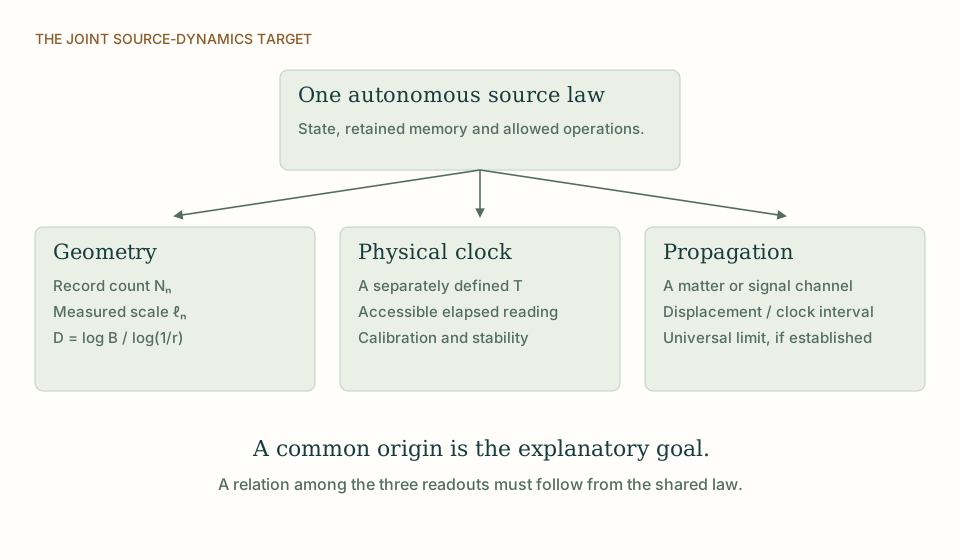
Geometry, clocks and propagation as independent readouts. A single source model should explain the relation between separately defined measurements. Sharing a diagram does not impose that relation. View full size ↗
03The generalized entropy prescription
In the applicable semiclassical setting, a candidate island I contributes a generalized entropy consisting of a geometric area term and the bulk entropy of I together with the radiation region R. One extremizes over allowed island boundaries and compares the relevant extrema, including the no-island candidate. The selected value can change as evaporation proceeds.
This is not an instruction to subtract an arbitrary amount of hidden information from a radiation entropy. The geometry, quantum state and extremization conditions are essential. An SMM/DTT model that labels an internal memory as an island has not established the formula. It needs a physical or mathematical encoding that explains why those source degrees of freedom are included in the reconstruction of the radiation region. [2][3]
S(R)=min extI [Area(∂I)/(4Gℏ)+Sbulk(R∪I)]
Units c=kB=1 are used schematically. The formula applies within the gravitational models and semiclassical assumptions for which the prescription is justified.
04Worked toy competition between entropy branches
To display the mechanism without pretending to model a real black hole, let a no-island branch grow as S₀(t)=s t and an island branch decrease as S₁(t)=Sinit−κt, with positive s and κ. The selected toy entropy is the smaller branch. They cross at t*=Sinit/(s+κ). Before that time the result grows; afterwards it falls until the toy approximation reaches its endpoint.
For dimensionless illustrative values Sinit=100, s=2 and κ=1, the crossing occurs at t*=100/3 and entropy 200/3. The shape resembles a Page curve, but these numbers contain no black-hole dynamics. Many unrelated two-branch models could draw the same curve. A DTT claim requires the source state, its unitary update and the actual radiation entropy, not merely a plotted rise and fall. [2]
Stoy(t)=min(st,Sinit−κt); t*=Sinit/(s+κ)
The toy branches are schematic entropies and must be used only over their nonnegative, intended domain. They are not a derived evaporation law.
05What the source archive would have to explain
DTT can usefully distinguish a limited exterior record from a larger coherent source state. Information can be inaccessible locally while remaining encoded in correlations of the total system. The decisive next step is a map showing how that information becomes represented in final radiation, or in another explicitly retained physical subsystem if the model has one.
If the archive never couples back to radiation, it may preserve information in a larger ontology while leaving the radiation channel mixed. That is a different answer from unitary evaporation into radiation. A finite source model can make the distinction exact by tracking the state of source, interior and emitted registers. Its entropy should be calculated from that state, with the geometry and area term supplied only when their relation has been established. [2][4]
06A useful level of achievement
A source model with exact unitary information transfer and a controlled thermal-looking early output would be a meaningful constructive result. Matching the area law, exterior temperature and gravitational reconstruction would be further achievements. The six nested roles may organize the internal process, but they do not by themselves give a horizon Hilbert space or an extremal-surface formula.
The comparison therefore offers a disciplined route to a stronger DTT account: first an explicit channel and entropy calculation, then a derived connection to geometry. Island research supplies a demanding target for that connection. It should be cited for its actual controlled results, while the claim that a Single Monad implements them remains a separate proposal to establish. [2][3]
THE SAME QUESTION, DIFFERENT STARTING POINTS
The comparison at a glance
Question
SMM/DTT
Island formula
Hidden information
A source archive must specify its coupling to the final observable radiation.
Island reconstruction changes which bulk degrees of freedom enter the radiation entropy.
Entropy curve
A DTT Page curve should be computed from its actual state and dynamics.
A two-branch minimum can illustrate a transition without being a microscopic evaporation theory.
Geometric link
Area and source-state counting need a derived dictionary.
The island formula uses generalized entropy and extremal-surface conditions.
KEEP THE CONNECTION
Key ideas
A source archive must specify its coupling to the final observable radiation.
A DTT Page curve should be computed from its actual state and dynamics.
The source interpretation becomes additional physics when it constrains an independently measurable process.
Connects the comparison to the programme’s current statement of results and assumptions.
Sources and further reading
References support the comparator and the specific mathematical or interpretive claims indicated. SMM/DTT connections are developed in the analysis above.