Relativity and quantum measurement: completion on spacelike hypersurfaces
Relativistic quantum evolution can be organized by spacelike hypersurfaces instead of one preferred laboratory clock. This article explains the integrability condition, proves order independence for two separated local operations, and asks how DTT can distinguish private generation order from the causal order of accessible completed records.
01A state need not be tied to one global clock slice
The Tomonaga–Schwinger formalism assigns a quantum state to a spacelike hypersurface and describes how it changes when the surface is deformed locally. This is useful in relativistic field theory because different observers can use different foliations of the same spacetime. A physical prediction should not depend on the arbitrary order in which spacelike-separated surface elements are advanced.
DTT’s source may have an internal production order, but its completed observations must still be compared with relativistic measurements. The key question is whether that hidden order affects accessible joint statistics. The formalism supplies a precise benchmark: a source description can have private bookkeeping while the observable theory remains independent of an arbitrary spacelike ordering. [2][3]
02The source and its two temporal roles
The Single Monad Model begins with one nonspatial generative source. The Duality of Time Theory distinguishes the source’s inner production from the outer order in which completed records become accessible. Its six inner levels are nested functional roles of one process: a higher role organizes lower-level work. The seventh is the completion or observation interface. They are neither six independent clocks nor six additional time coordinates.
This distinction supplies a useful research question: which features of an observed world can follow from the way a source produces, retains and releases information? A concrete answer needs a state space, an autonomous update, retained memory and a rule connecting completion to an accessible measurement. In the constructions discussed here, those mathematical ingredients are stated explicitly. A successful finite example establishes what its specified mechanism can do; further arguments connect it to physical particles, spacetime or universal laws. [1]
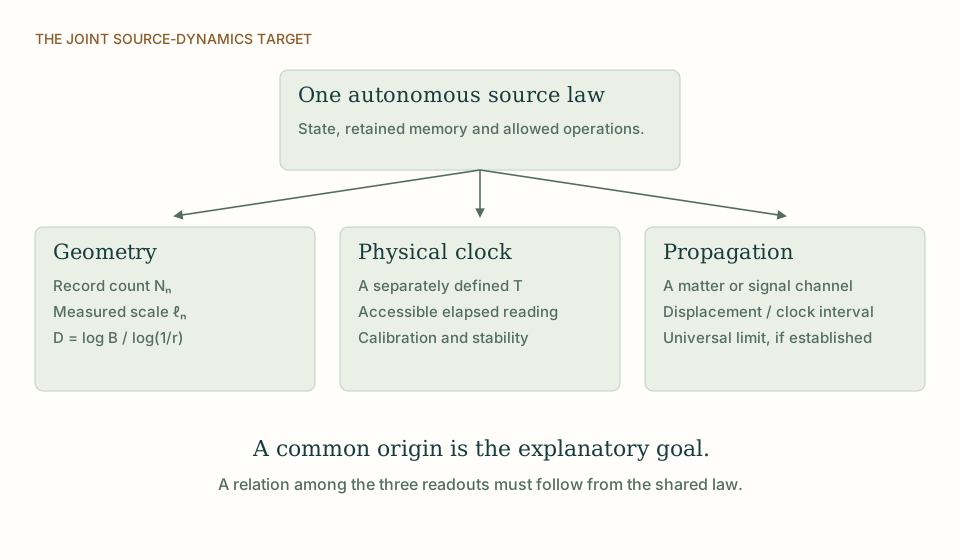
Geometry, clocks and propagation as independent readouts. A single source model should explain the relation between separately defined measurements. Sharing a diagram does not impose that relation. View full size ↗
03The integrability requirement
Schematically, the interaction-picture equation is iℏ δ|Ψ[Σ]⟩/δΣ(x)=HI(x)|Ψ[Σ]⟩. Local deformations at separated spacelike points must give the same final state regardless of their order. In the appropriate local formulation, commutativity of the interaction densities at spacelike separation supplies the central integrability condition.
The equation does not introduce a separate physical time at each point. It expresses one relativistic dynamics in a covariant organization. Nor does the formal use of many possible surfaces prove that a hidden source has a preferred global present. If DTT asserts such a present, the assertion needs a rule showing why its observables respect the same foliation-independent interface, or a specified deviation that can be tested. [2][3]
04Worked finite example with two laboratories
Take two local unitaries UA acting on subsystem A and UB acting on B. On the combined Hilbert space their extensions are UA⊗I and I⊗UB. Multiplication in either order gives UA⊗UB. Therefore their commutator vanishes, and the final state is the same for either ordering, even if the initial state is entangled.
For local instruments with Kraus operators acting on separate factors, the unnormalized joint outcome state has the same order independence. This does not imply that the outcomes are statistically independent: entanglement can correlate them. It means that swapping the formal order of the separated operations does not change their joint probability. A DTT update can use this structure to keep an inner scheduling choice inaccessible, but it has to derive the locality of the observable operations rather than merely label them spacelike. [4][2]
[UA⊗I,I⊗UB]=0; (UA⊗I)(I⊗UB)=UA⊗UB
The tensor factors represent separated operations in the finite benchmark. In field theory the corresponding condition is locality of the observable algebras.
05Generation order and physical influence
A source scan that visits one address before another is a computational order. Physical influence is defined by what an intervention can change in a later accessible record. These orders need not be identical. DTT’s distinction is valuable if the source builds a nonlocal representation while its readout obeys a local causal algebra.
The challenge is stronger when geometry itself emerges. Then the theory must show that the same readout which labels two operations spacelike also makes their physical actions commute or otherwise produces the required causal consistency. Assigning a Minkowski metric after choosing commuting operators gives a conditional model; it does not explain why the metric and dynamics agree. A joint source theorem would derive both from a common structure and identify the range in which the equivalence holds. [3][1]
06What a completion model can claim
An autonomous completion instrument can be embedded in a relativistic interface when its local operations and records satisfy the relevant covariance and causal constraints. That would be a useful consistency result for DTT. It would not establish a universal metric or prove that every possible source implementation has the same limiting speed.
A stronger physical claim would fix the clock calibration, propagation algebra and completion law together. If the source predicts a measurable preferred-frame effect, its dependence on observable settings must be stated explicitly. If it predicts none, the invariance should be proved for the allowed measurement class. The Tomonaga–Schwinger comparison is valuable because it turns an ambiguous debate about simultaneity into an exact question about whether different allowed descriptions yield the same records. [2][3]
THE SAME QUESTION, DIFFERENT STARTING POINTS
The comparison at a glance
Question
SMM/DTT
Tomonaga–Schwinger formalism
Inner order
A source may have private scheduling without making it an observable simultaneity relation.
Hypersurface evolution permits different foliations of one relativistic process.
Causal consistency
DTT must derive the order independence of operations called spacelike by its readout.
Commuting local operations yield the same joint statistics in either ordering.
Physical scope
A compatible finite interface is a step toward a joint clock–geometry theory.
The formalism presupposes the relevant relativistic field structure.
KEEP THE CONNECTION
Key ideas
A source may have private scheduling without making it an observable simultaneity relation.
DTT must derive the order independence of operations called spacelike by its readout.
The source interpretation becomes additional physics when it constrains an independently measurable process.
Connects the comparison to the programme’s current statement of results and assumptions.
Sources and further reading
References support the comparator and the specific mathematical or interpretive claims indicated. SMM/DTT connections are developed in the analysis above.