
In this article
- The question behind this comparison
- The SMM/DTT starting point
- How the comparator works
- The decisive comparison
- Worked benchmark
- What follows for the source programme


Information hidden behind a horizon is not automatically returned by a theory that retains an unseen archive. Comparing DTT with quantum field theory vacuum, this article checks black-hole radius, temperature and entropy scalings, then identifies the source-to-radiation map required for temporal completion to become a physical account of interior information.
Black-hole interiors test whether a theory can connect local physics, causal horizons and global information consistently. Classical general relativity describes a horizon and, in simple solutions, an interior singularity. Quantum field theory on that background predicts Hawking radiation in an appropriate state. A complete microscopic account would explain the quantum degrees of freedom and their evolution beyond the regime of the semiclassical approximation.
DTT’s retained-source picture offers a way to distinguish inaccessible information from destroyed information. An exterior completed archive may omit relations still present in the full source. That distinction is useful, but it does not itself solve the information problem: the theory must show how the final accessible state is related to the initial state and how its entropy evolves. A hidden archive that never influences observable radiation is not automatically a unitary evaporation mechanism. [2] [3] [4]
The Single Monad Model begins with one nonspatial generative source. The Duality of Time Theory distinguishes the source’s inner production from the outer order in which completed records become accessible. Its six inner levels are nested functional roles of one process: a higher role organizes lower-level work. The seventh is the completion or observation interface. They are neither six independent clocks nor six additional time coordinates.
This distinction supplies a useful research question: which features of an observed world can follow from the way a source produces, retains and releases information? A concrete answer needs a state space, an autonomous update, retained memory and a rule connecting completion to an accessible measurement. In the constructions discussed here, those mathematical ingredients are stated explicitly. A successful finite example establishes what its specified mechanism can do; further arguments connect it to physical particles, spacetime or universal laws. [1]
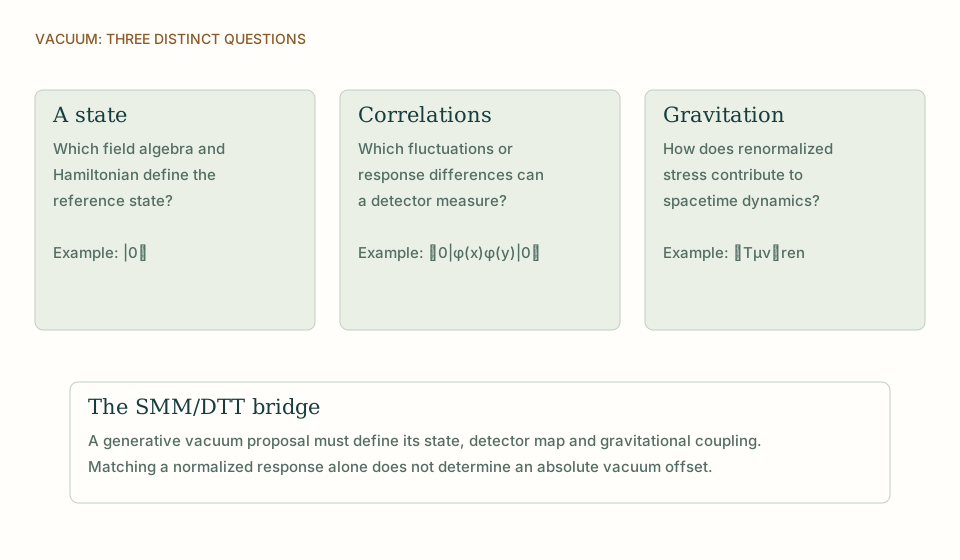
In quantum field theory a vacuum is a state associated with the field algebra and a choice of dynamics. In stationary settings it is often characterized as a lowest-energy or positive-frequency state. In curved or time-dependent spacetime, different physically motivated notions of particles need not select one universal vacuum. Correlation functions, detector responses and renormalized stress-energy are the quantities that connect this language with observations.
The SMM proposal goes one explanatory level deeper by treating the vacuum as an outcome of generative activity rather than as an already specified field state on an already specified geometry. That ambition is distinct from a standard vacuum calculation, but a proposed replacement must recover its operational content. A constant shift of the nongravitational Hamiltonian changes only an overall phase; a gravitational vacuum term requires a separate coupling and renormalization discussion. The word fluctuation refers to statistical properties of observables, not automatically to short-lived particles literally borrowing energy from nothing. [2]
QFT on a black-hole background predicts Hawking radiation through the field state and geometry, while leaving the fully quantum interior and complete evaporation problem outside its controlled scope. DTT’s source memory could supply degrees of freedom beyond that approximation, but retaining hidden information is not yet a mechanism for returning it to accessible radiation.
The temperature scaling is a necessary exterior benchmark. A proposed completion-based emission law should recover the inverse-mass temperature and appropriate correlations in the regime where semiclassical field theory applies. If it modifies the high-frequency state or horizon behaviour, those changes must be propagated into detector observables rather than inferred from a picture of discrete creation. The critical difference concerns the full map from initial matter to final radiation. A source archive disconnected from the output may preserve information ontologically while leaving the observable channel nonunitary. DTT’s strongest contribution would show how inner retention and outer release together yield a unitary channel with the correct semiclassical low-order statistics. That is a concrete dynamical problem beyond identifying the horizon with an information boundary. [2] [3] [4]
For a nonrotating, uncharged black hole, the Schwarzschild radius is rs=2GM/c² and the Hawking temperature is TH=ℏc³/(8πGMkB). Doubling the mass doubles the radius and halves the temperature. Its Bekenstein–Hawking entropy scales as M², so doubling the mass multiplies the entropy by four. These different scalings constrain any proposed source capacity and release law simultaneously.
For an illustrative solar-mass black hole, rs is about 2.95 kilometres and TH about 6.2×10⁻⁸ kelvin. These are semiclassical predictions for the stated idealized system, not direct laboratory measurements of its radiation. A DTT model that uses completion events as radiation emissions must recover the thermal low-order spectrum in this regime while also specifying the correlations needed for unitary information recovery. A curve that reproduces only the temperature does not decide whether the radiation’s fine-grained entropy ultimately decreases. [2] [3] [4]
Schwarzschild solution; rotation, charge, accretion and quantum-gravity corrections are omitted. The solar-mass values are illustrative.
The strongest source-based contribution would be a finite model with a controlled exterior limit, an explicit internal memory and a demonstrably unitary transfer of information into radiation. Island calculations provide a separate benchmark for entropy in certain controlled gravitational models. Reproducing their qualitative Page-curve shape is insufficient by itself; the microphysical map and its domain of validity remain central to the explanatory claim. [2] [3] [4]
THE SAME QUESTION, DIFFERENT STARTING POINTS
| Question | SMM/DTT | quantum field theory vacuum |
|---|---|---|
| Starting structure | One nonspatial source, retained memory and six nested inner functions with an outer completion interface. | Field algebra, state and dynamics; geometry is usually supplied. |
| Observable connection | The source update and readout must generate the measured records and their calibrated relations. | Correlation functions and detector or material response. |
| Black hole interiors and temporal completion | The temperature scaling is a necessary exterior benchmark. | QFT on a black-hole background predicts Hawking radiation through the field state and geometry, while leaving the fully quantum interior and complete evaporation problem outside its controlled scope. |
| Status of the claim | A constructive research programme; a specified finite model establishes only its stated conditional results. | Field-theoretic vacuum concepts vary with state and spacetime. |
KEEP THE CONNECTION
Connects this comparison with the author’s underlying construction.
Connects this comparison with the author’s underlying construction.
Connects this comparison with the author’s underlying construction.
Connects this comparison with the author’s underlying construction.
Places the comparison alongside the programme’s published results, assumptions and open targets.
References support the comparator and the specific mathematical or interpretive claims indicated. SMM/DTT connections are developed in the analysis above.
How these comparisons distinguish premises, results and physical claims