DESI and evolving dark energy: a dated benchmark for DTT
The published DESI DR2 analysis offers a concrete test of evolving-dark-energy models, with significance that depends on the data combination. Reviewed on 17 October 2026, this guide explains that named 2025 result, works through the usual equation-of-state parameterization, and identifies what a DTT source law must predict before comparison.
The DESI DR2 cosmological-constraints paper, published in 2025, analyzes baryon acoustic oscillation measurements and combinations with CMB and supernova data. In its w₀wa model, DESI plus CMB gives a 3.1σ preference over ΛCDM. Adding Pantheon+, Union3 or DESY5 supernova samples gives reported preferences of 2.8σ, 3.8σ and 4.2σ respectively. These are different, partly overlapping data combinations, not independent discoveries to average together.
This guide uses that identifiable published analysis as a dated benchmark, reviewed on 17 October 2026. It does not present the numbers as a new 2026 release or a definitive identification of dark energy’s microphysics. The collaboration discusses statistical and systematic alternatives. A preference for an evolving phenomenological model is not confirmation of DTT or of one particular scalar-field mechanism. [2][3]
02The source and its two temporal roles
The Single Monad Model begins with one nonspatial generative source. The Duality of Time Theory distinguishes the source’s inner production from the outer order in which completed records become accessible. Its six inner levels are nested functional roles of one process: a higher role organizes lower-level work. The seventh is the completion or observation interface. They are neither six independent clocks nor six additional time coordinates.
This distinction supplies a useful research question: which features of an observed world can follow from the way a source produces, retains and releases information? A concrete answer needs a state space, an autonomous update, retained memory and a rule connecting completion to an accessible measurement. In the constructions discussed here, those mathematical ingredients are stated explicitly. A successful finite example establishes what its specified mechanism can do; further arguments connect it to physical particles, spacetime or universal laws. [1]
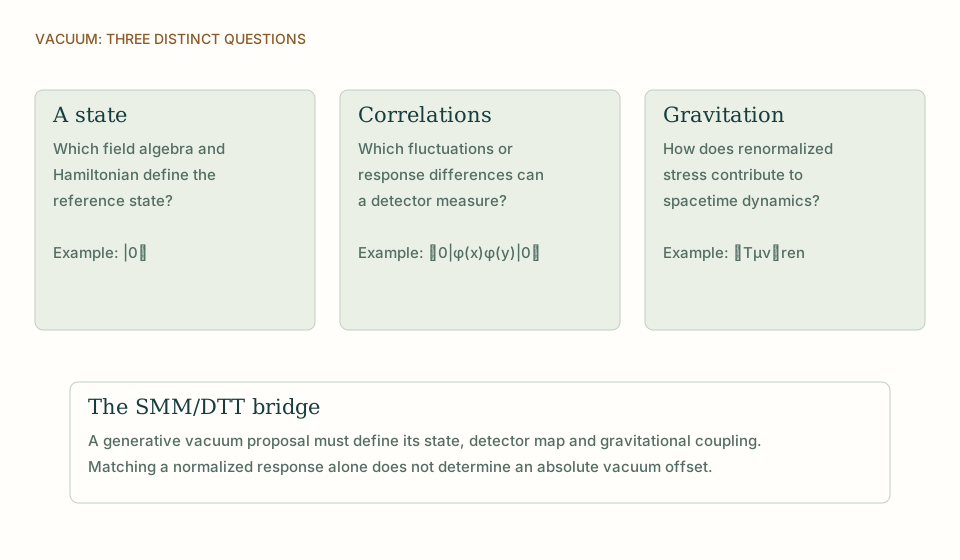
Three distinct questions about the vacuum. A quantum state, its measurable correlations, and its gravitational stress are different objects. A proposed generative source needs an explicit map to each. View full size ↗
03What BAO contributes
A baryon acoustic scale acts as a statistical standard ruler in the clustering of matter tracers. Its observed angular and redshift dependence constrains combinations of distances, the expansion rate and the sound-horizon scale. Combining it with other observations extends the temporal range and helps constrain cosmological parameters, while also making the inference depend on the consistency of datasets and the chosen model.
For a DTT comparison, the immediate task is therefore a physical distance–redshift prediction. A source tick count or a qualitative statement that the vacuum evolves is not the quantity the survey fits. The model must relate its source dynamics to material clocks, photon propagation, the scale factor and the primordial ruler, or explicitly inherit a conventional early-universe calibration. [2][4]
04Worked equation of state and density
A common phenomenological choice is w(a)=w₀+wa(1−a), with a=1 today. Integrating separate energy conservation gives uDE(a)/uDE,0=a^{−3(1+w₀+wa)} exp[−3wa(1−a)]. The constant-vacuum case is w₀=−1 and wa=0.
Choose illustrative values w₀=−0.8 and wa=−0.6; these are not quoted DESI best-fit parameters. Then w(a)=−1.4+0.6a, crossing w=−1 at a=2/3, or redshift z=0.5. At a=1/2 the energy-density ratio is 0.5^{1.2}e^{0.9}≈1.071. A substantial change in w can therefore correspond to a comparatively modest integrated density difference over part of the observed range. Distance observables integrate the expansion further, which helps explain why precise combined inference is needed. [2][5]
Separately conserved effective dark-energy component. The worked parameter values are illustrative and are not a new data fit.
05A fit is not yet a stable field model
The w₀wa expression describes a background history; it does not specify a complete microscopic action. A canonical scalar with positive kinetic energy and positive total density obeys w≥−1, so the illustrative crossing cannot be produced by that simplest scalar alone. Other constructions may realize different histories, but their stability, perturbations and interactions have to be calculated.
DTT should use this as a constructive restriction. A source law needs to identify the histories it permits before looking at the preferred region of a fit. If its effective variable is canonical, the associated bound matters. If it introduces energy exchange or modified gravity, the equations for matter and perturbations must change consistently. Calling a fitted crossing an interchange of temporal roles does not supply those equations. [5][2]
06What a source prediction would look like
An informative DTT cosmology would derive a function w(a), or a constrained relation between its parameters, from one calibrated source mechanism. The same solution would predict expansion and growth. If the source also changes the early sound horizon or photon propagation, those effects must enter the analysis rather than be absorbed into the standard-ruler calibration unnoticed.
The model should be compared with the full allowed family of conventional alternatives, using the same datasets and treatment of nuisance parameters. Fixing one source scale from the observed expansion is a calibration; a subsequent linked observable is the prediction. This distinction protects the programme from claiming success merely because a flexible description can follow the preferred cosmological curve. [2][4]
07Why the result still matters for DTT
The possibility of evolving dark energy is well suited to a programme interested in the physical role of temporal organization. It motivates a concrete question about whether source retention and completion can generate a conserved, slowly evolving effective stress. That question can lead to a useful theoretical paper even before a unique cosmological model is selected.
The strongest contribution would remove an independent freedom: for example, derive a relation between the background evolution and a perturbation property rather than tune them separately. The DESI benchmark then becomes a test of the resulting model. Its statistical preference should remain attached to its stated dataset combination and parameterization, while the source’s distinctive mechanism is judged by the additional relationships it actually derives. [2][5]
THE SAME QUESTION, DIFFERENT STARTING POINTS
The comparison at a glance
Question
SMM/DTT
DESI DR2 cosmological constraints
Meaning of the evidence
DTT needs its own constrained distance and growth predictions before claiming observational support.
The named DR2 result prefers an evolving parameterization at a dataset-dependent significance.
Physical law
The source must supply conserved energy, pressure and perturbation dynamics.
w₀wa is a phenomenological background parameterization, not a unique microscopic theory.
Chronology
The comparison explicitly uses the published 2025 analysis reviewed on 17 October 2026.
The reported combinations range from 2.8σ to 4.2σ; they are not independent detections to combine naively.
KEEP THE CONNECTION
Key ideas
DTT needs its own constrained distance and growth predictions before claiming observational support.
The source must supply conserved energy, pressure and perturbation dynamics.
The source interpretation becomes additional physics when it constrains an independently measurable process.
Connects the comparison to the programme’s current statement of results and assumptions.
Sources and further reading
References support the comparator and the specific mathematical or interpretive claims indicated. SMM/DTT connections are developed in the analysis above.