Quantum Darwinism: how one record becomes a shared world
Quantum Darwinism studies how selected information spreads into many environmental records that different observers can read. This guide calculates an exact redundancy example, distinguishes shared classical information from copied quantum states, and develops a concrete comparison with DTT’s outer completion and its single-source account of an accessible world.
A stable object is normally observed indirectly through light, sound or other environmental traces. Quantum Darwinism studies how a system’s selected properties become redundantly recorded in such fragments. Multiple observers can then obtain similar information without controlling the whole system or directly disturbing it in the same way.
This is especially relevant to SMM/DTT. An outer completed world is more than one observer obtaining one outcome: it should explain how many receivers can agree about durable records. The source programme can use environmental redundancy as a concrete mechanism for that agreement. It remains distinct from the additional question of whether one outcome is globally selected or all relative components remain in a unitary state. [2]
02The source and its two temporal roles
The Single Monad Model begins with one nonspatial generative source. The Duality of Time Theory distinguishes the source’s inner production from the outer order in which completed records become accessible. Its six inner levels are nested functional roles of one process: a higher role organizes lower-level work. The seventh is the completion or observation interface. They are neither six independent clocks nor six additional time coordinates.
This distinction supplies a useful research question: which features of an observed world can follow from the way a source produces, retains and releases information? A concrete answer needs a state space, an autonomous update, retained memory and a rule connecting completion to an accessible measurement. In the constructions discussed here, those mathematical ingredients are stated explicitly. A successful finite example establishes what its specified mechanism can do; further arguments connect it to physical particles, spacetime or universal laws. [1]
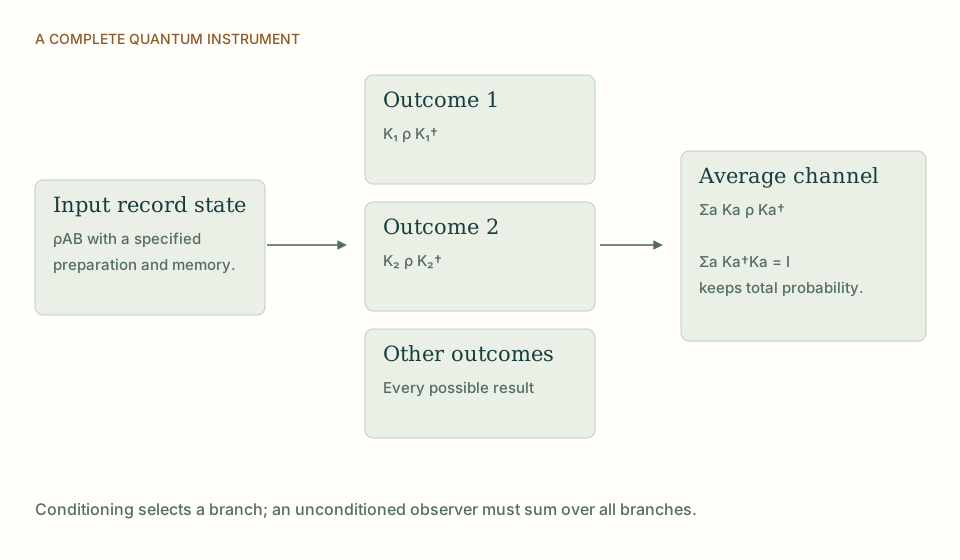
From a source process to a complete record instrument. Outcome probabilities, retained conditional states, and the outcome-averaged channel belong to the same instrument. Keeping every outcome prevents postselection from being mistaken for a signal. View full size ↗
03Worked exact redundancy model
Consider |Ψ⟩=√p|0⟩S|0⟩E₁…|0⟩EN+√(1−p)|1⟩S|1⟩E₁…|1⟩EN, with at least two environmental qubits. For any nonempty fragment containing fewer than all N qubits, tracing out the rest removes the off-diagonal term. The fragment and system then share a classical label with probabilities p and 1−p.
Using entropy in bits, HS=HF=HSF=H₂(p), where H₂ is binary entropy. Their mutual information is I(S:F)=HS+HF−HSF=H₂(p). At p=1/2, each individual environment qubit carries one bit about the system’s selected Z label. If the entire environment is controlled, the joint state is pure and I(S:E)=2H₂(p). The extra global correlation is not available in an arbitrary small fragment. [2]
I(S:F)=H₂(p) for 1≤|F|<N; I(S:E)=2H₂(p)
Ideal pure branching state with orthogonal environmental records. H₂(p)=−p log₂p−(1−p)log₂(1−p).
04The same model respects no cloning
The environment has copied an orthogonal record label, not made N independent copies of an arbitrary unknown qubit. If the initial system has a coherent superposition, the controlled interactions produce an entangled state. No observer holding one environmental qubit possesses a complete independent copy of that unknown input.
This distinction is essential for a cosmic archive. DTT can distribute stable completed labels widely while retaining quantum coherence in larger correlations. It cannot assume unlimited backups of unknown quantum information while also keeping ordinary quantum kinematics. The environmental model illustrates how agreement among observers and nonclassical global information coexist without violating that restriction. [2][3]
05Imperfect records expose a physical resource cost
Real environmental records need not be perfectly orthogonal. Suppose each fragment constituent has conditional states with overlap magnitude |γ|. A fragment of m independent constituents then has overlap |γ|^m. For equal prior probabilities, the optimal binary discrimination error for the two pure fragment states is [1−√(1−|γ|^{2m})]/2.
For an illustrative |γ|=0.8 and m=5, this error is about 0.0276. A larger fragment contains a more reliable record, but consumes more of the environmental resource. Thus redundancy, accuracy and accessibility can be calculated rather than asserted. The example does not say every real environment has independent identical fragments; correlations and uncontrolled interactions can change the result. [2]
Perror=[1−√(1−|γ|^{2m})]/2
Equal-prior discrimination of two pure fragment states under the stated product-record assumption. The numerical overlap is illustrative.
06The DTT mechanism worth developing
A source model could derive which record variable is stable, how it is imprinted on multiple receivers and how the completion flag relates to the required redundancy. The six nested functions can organize coherent preparation, interaction, checking and publication, but the physical rule must select those operations rather than be programmed separately for every desired outcome.
This makes quantum Darwinism a particularly useful partner for DTT: it provides a measurable notion of shared access. A source law that predicts a tradeoff between completion delay, record redundancy and error would add a concrete restriction. It would also explain why the observer’s accessible world is much smaller than the full inner quantum state. A count of observer-independent records alone, without the copying dynamics and the allowed tests, would leave that mechanism incomplete. [2][4]
07What this does and does not settle
Redundant records explain why selected information is robust and available to many observers under the model’s assumptions. They do not by themselves prove the Single Monad ontology, derive the Born rule without additional premises or decide every interpretation of measurement. A branching state still raises the question of how definite observed outcomes are understood.
DTT can make progress by separating these tasks and deriving at least one more link among them. An exact source model of stable redundant records would be valuable even before a full account of geometry or universal measurement. The scientific result should identify the state, interactions, memory budget and observable tests. The philosophical interpretation can then explain why the model is viewed as an instance of inner generation and outer completion, without treating the interpretation as evidence that the mechanism is unique. [2][5]
THE SAME QUESTION, DIFFERENT STARTING POINTS
The comparison at a glance
Question
SMM/DTT
Quantum Darwinism
Shared world
A source can distribute an orthogonal completed label to many physical receivers.
Quantum Darwinism studies redundant environmental information about selected observables.
Quantum information
The archive must distinguish classical redundancy from cloning an unknown state.
The branching state preserves global correlations beyond what a small fragment reveals.
Predictive opportunity
DTT can seek a derived completion–redundancy–accuracy relation.
Record distinguishability and fragment size already supply calculable information benchmarks.
KEEP THE CONNECTION
Key ideas
A source can distribute an orthogonal completed label to many physical receivers.
The archive must distinguish classical redundancy from cloning an unknown state.
The source interpretation becomes additional physics when it constrains an independently measurable process.
Connects the comparison to the programme’s current statement of results and assumptions.
Sources and further reading
References support the comparator and the specific mathematical or interpretive claims indicated. SMM/DTT connections are developed in the analysis above.