Harvesting vacuum entanglement: a detector-level comparison
Two local probes can become entangled by coupling to correlations already present in a quantum field vacuum. This guide explains the detector mechanism and its noise threshold, distinguishes harvesting from signalling or free-energy extraction, and identifies the correlation functions a DTT generative vacuum would need to predict.
Entanglement harvesting studies how initially separate probes acquire correlations by interacting locally with a quantum field. In appropriate models they can become entangled even when the relevant interaction regions are spacelike separated. The effect relies on correlations of the field state and the details of detector switching, separation and coupling.
This is a useful new comparator for SMM/DTT because it asks a sharper question than whether the vacuum is active. A proposed generative vacuum must predict what actual probes register. A common source could explain why its completed field state has nonseparable correlations, but it must reproduce the detector response and the limits imposed by causal access. [2][3]
02The source and its two temporal roles
The Single Monad Model begins with one nonspatial generative source. The Duality of Time Theory distinguishes the source’s inner production from the outer order in which completed records become accessible. Its six inner levels are nested functional roles of one process: a higher role organizes lower-level work. The seventh is the completion or observation interface. They are neither six independent clocks nor six additional time coordinates.
This distinction supplies a useful research question: which features of an observed world can follow from the way a source produces, retains and releases information? A concrete answer needs a state space, an autonomous update, retained memory and a rule connecting completion to an accessible measurement. In the constructions discussed here, those mathematical ingredients are stated explicitly. A successful finite example establishes what its specified mechanism can do; further arguments connect it to physical particles, spacetime or universal laws. [1]
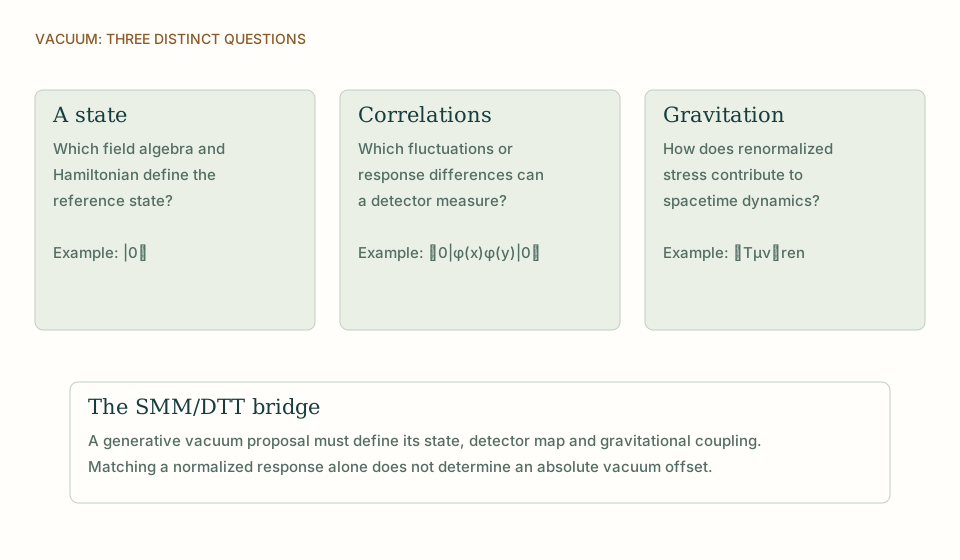
Three distinct questions about the vacuum. A quantum state, its measurable correlations, and its gravitational stress are different objects. A proposed generative source needs an explicit map to each. View full size ↗
03The detector model makes the proposal concrete
A standard idealization couples a two-level detector’s monopole operator to the field along a prescribed trajectory, with a switching function that determines when the interaction acts. Spatial smearing can describe a finite detector size. Perturbation theory then expresses local excitation probabilities and joint correlation terms through the field’s two-point function.
The switching is a physical part of the protocol, not a harmless label. Abrupt pointlike idealizations can introduce ultraviolet difficulties, and the accessible entanglement can depend strongly on smoothness, geometry and detector energy gaps. A DTT source comparison should therefore hold those apparatus choices fixed before attributing any difference to inner temporal structure. Otherwise an altered detector model can imitate a supposed new vacuum effect. [2]
04Worked entanglement threshold
In a common weak-coupling two-detector calculation, write the local excitation probabilities as PA and PB and the relevant joint coherence as M. At leading order, the negativity has the form N≈max(0,|M|−√(PAPB)). The coherence must exceed the local noise scale for this witness to be positive.
For illustrative dimensionless coefficients PA=PB=0.010 and |M|=0.015, the leading expression gives N≈0.005. If the same noise accompanies |M|=0.008, the expression gives zero. These numbers are an algebraic illustration of the threshold, not results of a simulated detector trajectory. A physical prediction requires calculating PA, PB and M from one field state, switching profile and perturbatively controlled interaction. They cannot be fitted independently to make the inequality positive. [2]
Nleading=max(0,|M|−√(PAPB))
Weak-coupling detector model at the stated leading order. Probabilities and negativity are dimensionless; higher-order corrections must be controlled near a threshold.
05Spacelike entanglement is not a message
For spacelike-separated local couplings in a microcausal field theory, detector entanglement does not permit one party to choose a signal that appears instantly in the other party’s marginal. The probes can extract correlations already present in the shared field while the commutator structure protects causal influence. Verifying spacelike separation requires considering the supports of the actual interaction regions, not just the nominal locations of the detector centres.
If the interactions overlap causally, direct exchange can contribute to the correlations as well. A comparison that claims pure vacuum harvesting must keep that distinction explicit. DTT likewise cannot use a common nonspatial origin to excuse arbitrary signalling; the source-to-detector map must calculate both the joint entanglement and the unchanged local causal response. [2][4]
06The DTT correlation function is the key object
A generative source could be mapped to an effective Wightman two-point function W(x,x′), from which the detector integrals are computed. Positivity, the field equation in the applicable regime and causal commutator properties constrain that function. Matching one vacuum energy number would not establish those properties.
The source programme becomes more informative if its nested memory predicts a restricted deformation of W with a scale fixed independently of the detector experiment. The same deformation should affect the local probabilities and joint coherence consistently. It may alter the entanglement window, but it must also remain compatible with other field measurements. A freely chosen correction for each detector separation would explain little. The useful target is one source-derived state whose correlation structure can be tested across several protocols. [2][3][4]
07Energy and interpretation
Harvesting does not mean extracting unlimited energy from nothing. Preparing, switching and reading the detectors are physical operations with resources, and entanglement is not identical to a net energy gain. A source theory that treats vacuum activity as a supply of free work would need a separate energetic calculation and would not follow from the entanglement result.
The conceptual gain for DTT is substantial but specific: it can connect a nonspatial generative ontology to an operationally defined vacuum correlation test. The formalism already predicts the benchmark effect, so observing it would not uniquely establish the Single Monad. A new contribution would be a independently fixed relation among detector responses derived from the source’s dynamics and retained memory, with the ordinary field-theory limit recovered when its additional structure becomes inaccessible. [2][3]
THE SAME QUESTION, DIFFERENT STARTING POINTS
The comparison at a glance
Question
SMM/DTT
Entanglement harvesting
Generative vacuum
A DTT vacuum model should output a consistent detector-level correlation function.
Harvesting calculations use the field two-point function and local detector couplings.
Coherence and noise
One source law must determine local noise and joint coherence together.
Leading entanglement requires |M|>√(PAPB).
Causal meaning
Source unity must preserve the causal limits of local detector access.
Vacuum entanglement harvesting does not provide controllable spacelike signalling.
KEEP THE CONNECTION
Key ideas
A DTT vacuum model should output a consistent detector-level correlation function.
One source law must determine local noise and joint coherence together.
The source interpretation becomes additional physics when it constrains an independently measurable process.
Connects the comparison to the programme’s current statement of results and assumptions.
Sources and further reading
References support the comparator and the specific mathematical or interpretive claims indicated. SMM/DTT connections are developed in the analysis above.