Lorentz invariance and hyperbolic geometry: SMM/DTT and Loop quantum gravity
When does a hyperbolic algebra describe physical changes of inertial observer, rather than a convenient coordinate identity? This article compares the source-based construction with Loop quantum gravity, identifies their strongest point of contact, and works through a concrete example that separates a valid mathematical result from the further physical relation needed to explain observations.
Lorentz transformations preserve the interval between events and relate the readings of moving rods and clocks. In one spatial dimension they can be written using hyperbolic functions of a rapidity. That elegant mathematical form is necessary for the usual boost group, but its physical interpretation also needs a common signal cone and transformation laws for material measuring devices.
A split-complex number uses a unit j with j²=+1, whereas ordinary quantum phase uses i²=−1. The two algebras have different norms and different exponential maps. Neither notation, by itself, creates a second measured time or proves a Wick rotation is a physical event. A precise comparison keeps algebra, coordinate change and dynamical observer transformation separate. [1][2]
02The SMM/DTT contribution
DTT's inner/outer distinction invites a hyperbolic description because generation and accessible completion are not interchangeable roles. A split-complex construction can encode an invariant quadratic relation between selected variables. Its value is that the invariant can be stated and checked explicitly, rather than inferred from a picture of perpendicular axes.
The decisive next identification is operational: the variables must be generated clock and distance observables, and the proposed transformations must act on actual histories and interactions. Six nested inner levels do not add six boost directions. If the same update supports a single outer causal cone and three spatial readout directions, the construction can be assessed against 3+1-dimensional Lorentz symmetry without reinterpreting functional nesting as a higher-dimensional spacetime.
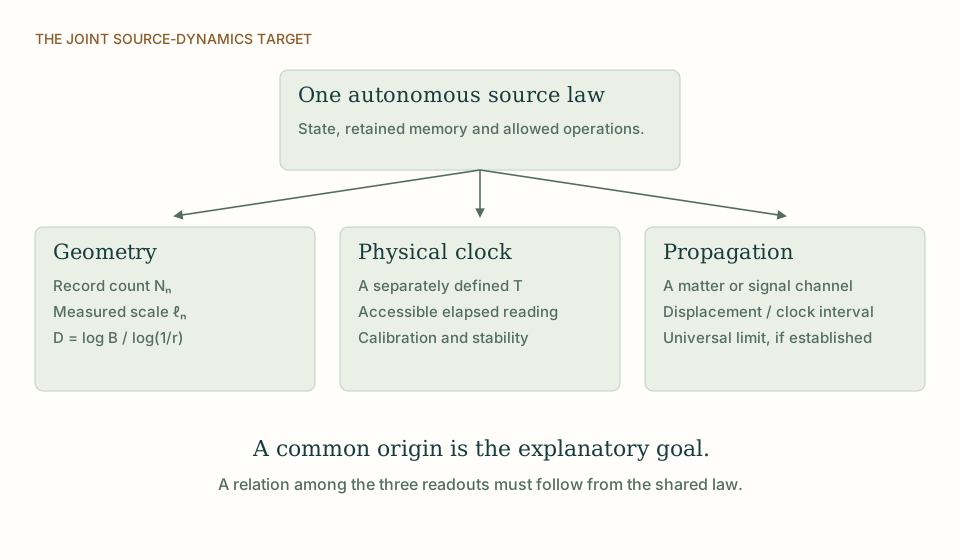
Geometry, clocks and propagation as independent readouts. A single source model should explain the relation between separately defined measurements. Sharing a diagram does not impose that relation. View full size ↗
03How Loop quantum gravity frames the problem
Loop quantum gravity quantizes geometric variables without fixing a background metric. Spin-network labels organize states, and geometric operators can have discrete spectra. Constraint dynamics and semiclassical states determine how those kinematical structures acquire physical meaning. The programme contains substantial mathematical results, but its candidate microscopic description is not experimentally established.
The useful comparison with DTT concerns the passage from algebraic carriers to physical geometry. Discrete eigenvalues alone do not determine a classical spacetime, just as a nested completion rule alone does not. The models can be compared through the construction of observables, the role of constraints and the emergence of semiclassical correlations, without equating loop labels with inner-time levels. [3][4]
04Where the mechanisms agree and differ
The discrete spectra of loop quantum geometry do not logically imply a preferred inertial frame. A spectrum belongs to an operator, and different observers may associate different measurement arrangements or quantum states with a geometric quantity. This is a helpful comparison for DTT, because it prevents the inference that a discrete inner process must visibly violate Lorentz symmetry.
The converse inference is also invalid: a discrete model is not Lorentz invariant merely because its variables can be placed in a hyperbolic algebra. The source must define how observers act on states, constraints and material clocks. Loop quantum gravity makes these questions part of a background-independent quantum construction; DTT proposes a prior generative organization that would need a compatible action on accessible records. A useful bridge would map the temporal completion observables to relational geometric measurements and show that a change of inertial frame does not reveal the hidden production order. The boost calculation below supplies the simplest algebraic test, but a complete result requires the same symmetry for dynamics. This focuses the comparison on the transformation of physical observables, where discreteness and covariance can actually be assessed together. [3][4]
05Worked example: assumptions, calculation and result
Write z=ct+jx and apply z′=e^(−jη)z, with e^(−jη)=coshη−j sinhη. The real components become ct′=ct coshη−x sinhη and x′=x coshη−ct sinhη. Multiplication gives (ct′)²−(x′)²=(ct)²−x², so the interval is preserved algebraically.
If tanhη=v/c=0.6, then coshη=1.25 and sinhη=0.75. A clock moving with x=vt has t′=t/1.25. This reproduces the standard time-dilation factor after identifying the coordinates with physical inertial measurements. Without that identification, it is only a norm-preserving transformation. The example isolates exactly what a temporal-source derivation has supplied and what its matter-and-clock dynamics must still establish. [1][2]
c has velocity units, η is dimensionless, and j²=+1. The quantum phase unit i is a different algebraic object.
06An independent operational check
The group property provides another independent check. Two collinear boosts with rapidities η₁ and η₂ compose by adding rapidities, so their physical velocities combine as (v₁+v₂)/(1+v₁v₂/c²). At v₁=v₂=0.6c the result is about 0.882c, not 1.2c. A temporal model whose measured velocities instead add linearly would fail the operational identification even if a hyperbolic norm were available somewhere in its algebra. The example makes the distinction testable within the mathematics: the same variables used to prove interval invariance must also govern the composition of actual observer transformations and matter propagation.
07What follows from the comparison
A discrete update need not imply observable Lorentz violation; the answer depends on how its states and observables transform. Conversely, an invariant equation written on paper does not guarantee every species shares the same limiting speed. A useful SMM/DTT result links the invariant quadratic form to propagation and clock universality, then identifies any symmetry-breaking operator explicitly enough to compare with published bounds.
THE SAME QUESTION, DIFFERENT STARTING POINTS
The comparison at a glance
Question
SMM/DTT
Loop quantum gravity
Starting physical structure
One nonspatial source; six nested inner functional levels produce records accessible through outer completion.
Quantum geometric states described through holonomies, fluxes and constraints.
The central mechanism in this topic
The source ordering must be unobservable under the physical observer transformations.
Quantum geometric discreteness is distinct from a fixed background lattice or preferred frame.
How the claim is made operational
A source-to-record map must define geometry, material response and physical clocks with shared inputs.
Geometric operators, physical-state conditions and semiclassical reconstruction.
Meaning of agreement
Agreement is a compatibility result; a source-selected relation or fixed residual would add explanatory content.
The stated framework provides a benchmark within its own assumptions and established domain.
KEEP THE CONNECTION
Key ideas
A covariant observable map is the relevant bridge between discreteness and Lorentz symmetry.
The worked example establishes only the result stated under its explicit assumptions.
Six nested inner levels describe one generative organization; outer time orders accessible completion.
Develops the source construction or operational distinction used in this comparison.
Sources and further reading
References support the comparator and the specific mathematical or interpretive claims indicated. SMM/DTT connections are developed in the analysis above.