Spacetime discreteness and continuum limits: SMM/DTT and String theory and AdS/CFT
How can discrete production yield continuous motion, and which microscopic details remain visible after refinement? This article compares the source-based construction with String theory and AdS/CFT, identifies their strongest point of contact, and works through a concrete example that separates a valid mathematical result from the further physical relation needed to explain observations.
A continuum limit is a relationship among a family of models, not a visual impression that the cells look small. The lattice spacing or update interval changes while specified physical quantities remain fixed. Correlation functions, distances and propagation laws must converge in an identified regime. A large but fixed network may approximate a continuum for some experiments while failing badly for others.
This matters because different ways of shrinking the same grid produce different physics. Holding the jump probability fixed while changing the waiting time can lead to diffusion, ballistic propagation or a frozen system. The microscopic update and the unit conversion jointly determine the limit. Merely declaring the inner tick very short leaves that relationship unspecified. [1][2][3]
02The SMM/DTT contribution
DTT gives continuity a natural explanatory setting: outer observation reads an accumulated sequence of completed inner processes. The six inner levels are nested operations in this production, not separate continuous axes. A coarse outer observer may be insensitive to individual internal operations and respond only to stable collective correlations.
That interpretation becomes constructive when the source update supplies a refinement rule and a physical resource budget. A faster update cannot be obtained at zero cost merely by relabeling the step number. Clock resolution, interaction strength and retained memory determine which limit is physically meaningful. This is also why a mathematical continuum limit and a realizable infinite-speed computational process must remain distinct.
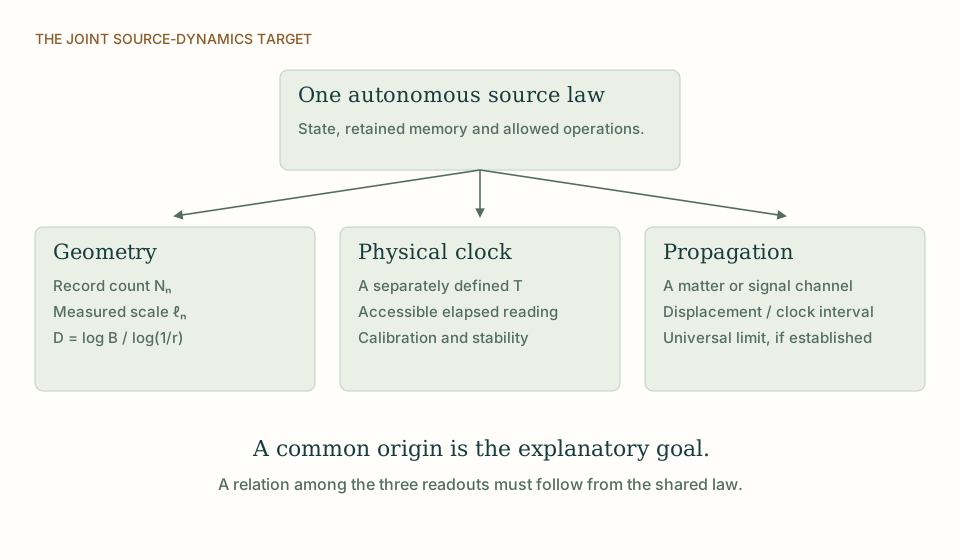
Geometry, clocks and propagation as independent readouts. A single source model should explain the relation between separately defined measurements. Sharing a diagram does not impose that relation. View full size ↗
03How String theory and AdS/CFT frames the problem
String theory replaces pointlike elementary excitations with extended quantum objects and contains gravitational modes in appropriate constructions. AdS/CFT gives a more specific connection: certain gravitational bulk descriptions correspond to nongravitational boundary quantum theories in defined limits. The correspondence is powerful in its domain, but it does not identify every holographic idea with a realized cosmology.
DTT can be compared with this framework through reconstruction: which accessible data determine geometry, and which microscopic distinctions are redundant or hidden? The comparison must preserve differences between a boundary/bulk dictionary and an inner/outer production distinction. The terms dual and completion acquire physical content only through explicit maps of states, observables and dynamics. [4][5]
04Where the mechanisms agree and differ
String theory provides several ways in which a smooth spacetime description can be effective rather than fundamental. A continuum world-sheet formulation, a target-space geometry and a boundary quantum description are different layers of the theory; none should be equated casually with DTT inner and outer time. The useful comparison is how one description loses microscopic detail while retaining the observables of another.
A source model could define a coarse-graining map from completed histories to effective fields, much as an explicit duality or low-energy limit supplies a map between descriptions. It would then be possible to ask which corrections are suppressed and whether locality emerges only in a particular sector. The six nested levels would describe the organization of that source map, not a set of compact string dimensions. The scaling exercise below illustrates that convergence of a transport law requires more than a dense collection of events. DTT's distinctive opportunity is to tie the clock used in the limit to the same production process that generates the geometry. Without that link, a smooth limit can be imposed by rescaling variables while leaving the physical explanation of duration untouched. [4][5]
05Worked example: assumptions, calculation and result
For a symmetric one-dimensional random walk, each step changes position by ±a with equal probability. After n steps, ⟨x⟩=0 and ⟨x²⟩=na². Setting physical time t=nδt gives ⟨x²⟩=(a²/δt)t. A nontrivial diffusive limit keeps D=a²/(2δt) fixed as a and δt shrink.
If a is halved and δt is quartered, D is unchanged. If both are halved, D is halved and the limiting transport law changes. For a strictly causal ballistic update, a/δt is the relevant speed instead. These are different scalings. A universal light cone cannot be inferred from the random-walk relation alone, although the example illustrates exactly how microscopic timing can affect an observed dimensional or transport probe. [1][2][3]
⟨x²⟩=na²=2Dt; D=a²/(2δt). Ballistic speed instead scales as a/δt.
D has units m² s⁻¹, a is a step length and δt a physical waiting time. The walk is a classical illustrative model.
06An independent operational check
A useful diagnostic is to hold a macroscopic experiment fixed while refining the microscopic description. The source-to-record map should identify the same preparation, the same detector and the same physical duration at every refinement. If the experiment itself changes with the regulator, apparent convergence can be misleading. This is particularly important for finite-memory models: increasing resolution may require increasing memory or interaction energy. A valid limiting theorem can state those costs explicitly without claiming that an infinite physical resource exists. The result then describes a controlled approximation and identifies which quantities remain finite and which are only mathematical regulators.
07What follows from the comparison
Universality is helpful to the SMM/DTT programme: different internal details may lead to the same robust long-distance laws. It also limits what can be inferred from agreement. Reproducing a diffusion equation does not reveal the unique microscopic ontology. Distinctive evidence lies in constrained corrections, protected relations between observables, or a reduction in independent input parameters that survives changes of regulator.
THE SAME QUESTION, DIFFERENT STARTING POINTS
The comparison at a glance
Question
SMM/DTT
String theory and AdS/CFT
Starting physical structure
One nonspatial source; six nested inner functional levels produce records accessible through outer completion.
Quantum strings and, in specific settings, a boundary/bulk dual description.
The central mechanism in this topic
The coarse-graining map should jointly generate effective fields and their physical clock.
Low-energy and duality maps connect different descriptions with defined observable dictionaries.
How the claim is made operational
A source-to-record map must define geometry, material response and physical clocks with shared inputs.
World-sheet or boundary-field dynamics with a defined reconstruction dictionary.
Meaning of agreement
Agreement is a compatibility result; a source-selected relation or fixed residual would add explanatory content.
The stated framework provides a benchmark within its own assumptions and established domain.
KEEP THE CONNECTION
Key ideas
A continuum description is physically explanatory only when its clock and transport scaling are fixed.
The worked example establishes only the result stated under its explicit assumptions.
Six nested inner levels describe one generative organization; outer time orders accessible completion.
Develops the source construction or operational distinction used in this comparison.
Sources and further reading
References support the comparator and the specific mathematical or interpretive claims indicated. SMM/DTT connections are developed in the analysis above.