Causal order and local propagation: SMM/DTT and General relativity
Can a source without spatial position generate a stable notion of neighborhood and a finite speed of influence between completed records? This article compares the source-based construction with General relativity, identifies their strongest point of contact, and works through a concrete example that separates a valid mathematical result from the further physical relation needed to explain observations.
Causal order and spatial proximity encode different information. A causal relation states which events can influence which others. A spatial distance compares records on an appropriate common slice or through a relational protocol. A graph can have a finite propagation speed relative to its edges while still being physically nonlocal if those edges join arbitrarily distant readouts.
Locality therefore has two stages: the interaction structure must be generated, and the dynamics must respect that structure. An inequality bounding propagation on an already chosen graph addresses the second stage. It does not explain why that graph resembles three-dimensional space. This separation makes the challenge sharper and gives partial achievements a clear place in the overall reconstruction. [1][2]
02The SMM/DTT contribution
The Single Monad is nonspatial, so its alleged unity cannot be represented as a point that sends ordinary signals from a hidden location. In DTT, locality would belong to the relations among completed records. The six inner levels could produce and retain a neighborhood structure; outer time would order observable influence through that structure.
A single controller is not enough to explain locality if it is allowed to update any record pair independently. A stronger rule lets the same retained relations restrict both record formation and later transport. Then memory is physically important: it preserves which comparisons count as nearby, rather than being an inert log appended after spatial interactions have already been assumed.
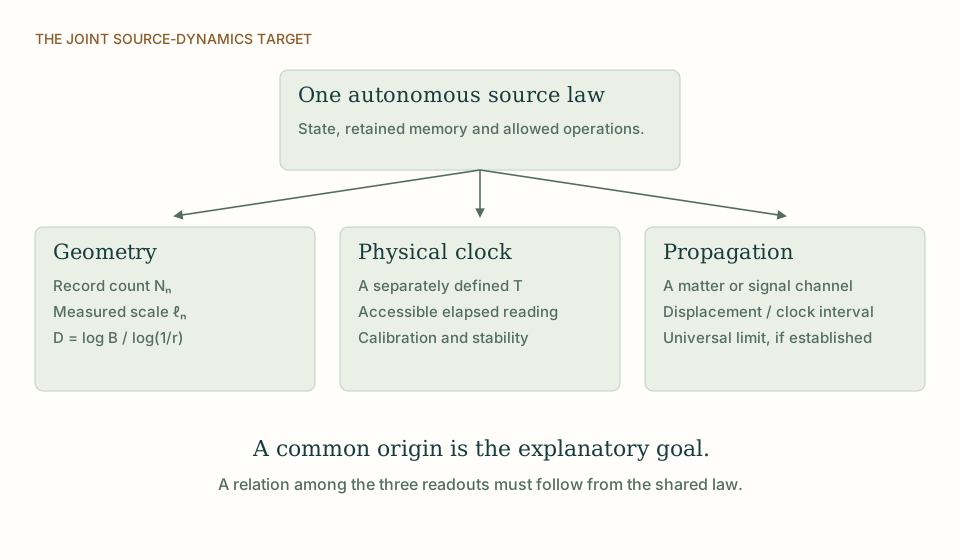
Geometry, clocks and propagation as independent readouts. A single source model should explain the relation between separately defined measurements. Sharing a diagram does not impose that relation. View full size ↗
03How General relativity frames the problem
General relativity describes gravitation through a dynamical Lorentzian metric coupled to stress-energy. Its coordinate freedom is a redundancy of description, while proper times, causal relations and appropriately specified observables have physical meaning. The framework supplies a demanding macroscopic benchmark and an extensive experimental record. It does not, in its classical formulation, derive a microscopic ontology of spacetime.
For this comparison, the relevant question is whether a source-generated description reproduces the metric theory in its tested domain and clarifies one of its microscopic inputs. Agreement with an Einstein equation or a boost formula is a compatibility result. A distinct physical prediction additionally requires a defined departure, with the same matter and clock observables on both sides. [3][4]
04Where the mechanisms agree and differ
General relativity ties causal propagation to the metric light cone. A DTT model that generates spatial neighborhoods must recover this connection between geometry and matter dynamics, rather than defining distance from one rule and propagation speed from another. This is the main content of a joint geometry–clock–cone problem.
A local circuit on a chosen graph can have a finite speed, as the example below shows, but that graph may already contain the spatial information the source was meant to explain. The stronger construction generates the adjacency and ensures that the same retained relations constrain subsequent influence. Six nested inner levels could organize this dependency, with outer completion making only the resulting causal order accessible. The nonspatial source should not be interpreted as a hidden physical point broadcasting instantaneous signals, because that would reintroduce a background space and potentially a preferred frame. The positive DTT contribution would be a relational locality mechanism whose metric and causal cone agree for all generated matter. General relativity supplies the consistency target; it does not itself explain why a nonspatial source would choose that particular local organization. [3][4]
05Worked example: assumptions, calculation and result
On a chain with nearest-neighbor updates, suppose a disturbance can cross at most one edge of length a during each completed interval δτ. A record N edges away cannot respond before Nδτ, giving an exact circuit cone with v=a/δτ. This uses a bounded-depth update with strictly local gates.
Continuous-time Hamiltonians generally give a different result: a Lieb–Robinson estimate bounds a distant commutator by a constant times exp[−μ(d−vt)]. The tail is small rather than exactly zero outside the effective cone. If d−vt=10/μ, the exponential factor is about 4.54×10⁻⁵. Neither result determines a physical speed until the edge length and the clock interval are independently identified. Nor does either prove that the source generated the chain. [1][2]
Tₘᵢₙ=Nδτ; d=Na; v=a/δτ. A Hamiltonian bound has the form ‖[A(t),B]‖≤C e^(−μ(d−vt)).
d and a are physical distances only after readout calibration; μ has inverse-distance units. C depends on observables and interaction assumptions.
06An independent operational check
A neighborhood rule can also fail through rare long links. Suppose almost all edges connect nearby records but a small fraction join distant regions. A short graph path may then connect points that appear far apart in the geometric readout. The propagation bound remains valid in graph distance while failing to express the intended physical locality. A source law must therefore constrain the relation between graph distance and measured distance, not merely the number of edges crossed per update. This gives a precise role to retained memory: it can preserve compatible neighborhood relations and prevent later operations from introducing unaccounted shortcuts.
07What follows from the comparison
This comparison suggests a strong attainable result: a joint theorem for neighborhood retention and propagation under one autonomous update. It would explain why a spatially organized record persists and why perturbations remain confined to its effective cone. That is more informative than postulating all-to-all generation followed by a local outer description, because it identifies the actual mechanism suppressing observable nonlocal shortcuts.
THE SAME QUESTION, DIFFERENT STARTING POINTS
The comparison at a glance
Question
SMM/DTT
General relativity
Starting physical structure
One nonspatial source; six nested inner functional levels produce records accessible through outer completion.
A dynamical Lorentzian metric and covariant matter fields.
The central mechanism in this topic
Generated adjacency and clock response should jointly determine the observable causal cone.
The metric determines causal cones and matter propagation in its applicable regime.
How the claim is made operational
A source-to-record map must define geometry, material response and physical clocks with shared inputs.
Metric field equations, proper-time observables and their controlled approximations.
Meaning of agreement
Agreement is a compatibility result; a source-selected relation or fixed residual would add explanatory content.
The stated framework provides a benchmark within its own assumptions and established domain.
KEEP THE CONNECTION
Key ideas
A finite speed on an assumed graph is a partial result; generated locality is the deeper target.
The worked example establishes only the result stated under its explicit assumptions.
Six nested inner levels describe one generative organization; outer time orders accessible completion.
Develops the source construction or operational distinction used in this comparison.
Sources and further reading
References support the comparator and the specific mathematical or interpretive claims indicated. SMM/DTT connections are developed in the analysis above.