Singularity resolution and geodesic completeness: SMM/DTT and String theory and AdS/CFT
Does discrete re-creation remove physical singularities, or merely replace divergent variables by a bounded description? This article compares the source-based construction with String theory and AdS/CFT, identifies their strongest point of contact, and works through a concrete example that separates a valid mathematical result from the further physical relation needed to explain observations.
A spacetime singularity is not simply a place where a selected density becomes large. In general relativity, geodesic incompleteness means that a freely falling trajectory can end after a finite proper time without extension inside the spacetime. Curvature may diverge, but finite curvature alone does not guarantee that all physical trajectories continue uniquely.
A quantum model can address this problem in several ways: a bounce may replace a classical collapse, a wave function may remain regular, or geometry may cease to be an appropriate description. Each possibility requires a criterion for continuing physical observables. The word resolution is therefore meaningful only when the model states what replaces the classical trajectory and whether its evolution remains well defined. [1][2]
02The SMM/DTT contribution
DTT offers the idea that apparent spatial breakdown could reflect a change in the completion of inner generative processes. If no completed record corresponds to a classical singular geometry, the classical divergence may be outside the domain of the readout. That is a potentially coherent interpretation, but exclusion from the output catalogue is not yet a dynamical account of what an infalling system experiences.
The six nested inner levels may continue to operate even when the outer geometric description fails. To turn that suggestion into physics, the model needs a well-defined state across the transition, conserved probabilities or a specified open-system evolution, and a rule connecting records before and after it. The Single Monad's ontological continuity cannot substitute for mathematical existence and uniqueness.
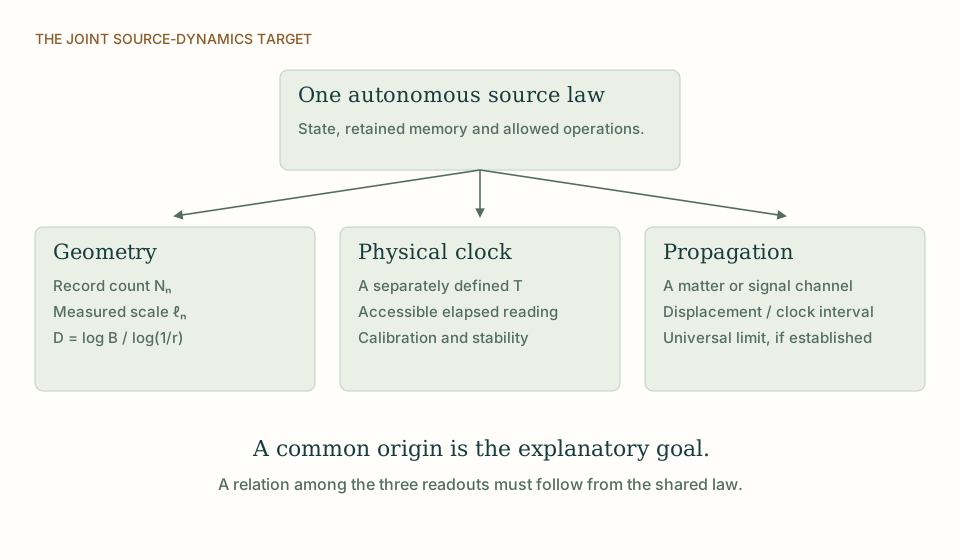
Geometry, clocks and propagation as independent readouts. A single source model should explain the relation between separately defined measurements. Sharing a diagram does not impose that relation. View full size ↗
03How String theory and AdS/CFT frames the problem
String theory replaces pointlike elementary excitations with extended quantum objects and contains gravitational modes in appropriate constructions. AdS/CFT gives a more specific connection: certain gravitational bulk descriptions correspond to nongravitational boundary quantum theories in defined limits. The correspondence is powerful in its domain, but it does not identify every holographic idea with a realized cosmology.
DTT can be compared with this framework through reconstruction: which accessible data determine geometry, and which microscopic distinctions are redundant or hidden? The comparison must preserve differences between a boundary/bulk dictionary and an inner/outer production distinction. The terms dual and completion acquire physical content only through explicit maps of states, observables and dynamics. [3][4]
04Where the mechanisms agree and differ
String theory can alter classical singularities through extended degrees of freedom or a dual description in which the apparent geometric failure is not fundamental. AdS/CFT gives especially clear examples of a quantum description that may remain meaningful when a simple bulk picture becomes difficult. DTT shares the general idea that observable geometry need not be the deepest layer.
The difference is the level of specification. A boundary Hamiltonian or an explicit string background defines what continues; a Single Monad's ongoing production must be supplemented by an equally precise law for states and records. The six nested inner levels describe the proposed organization of this continuation, not a proof of unitarity or geodesic completeness. The bounce calculation below illustrates one possible effective behavior, but a source model could instead produce a nongeometric regime with no classical trajectory. Either result can be physically meaningful if its observable map is defined. DTT's strongest contribution would explain how information and material probes pass between geometric regimes using one autonomous completion law. That would make its temporal origin claim comparable to an actual dual description rather than a broad analogy about hidden reality. [3][4]
05Worked example: assumptions, calculation and result
A common illustrative bounce equation is H²=(8πG/3)ρ(1−ρ/ρc), with ρ treated as mass density and ρc a positive critical density. It gives H=0 at ρ=ρc. For a fluid with w=p/(ρc²), energy conservation gives ρ̇=−3Hρ(1+w). Away from H=0, differentiating and continuing smoothly yields Ḣ=−4πGρ(1+w)(1−2ρ/ρc).
At ρ=ρc and w>−1, Ḣ=4πGρc(1+w)>0: contraction turns to expansion. The algebra identifies a bounce within this effective homogeneous model. It does not derive the equation from DTT, establish inhomogeneous stability, or prove geodesic completeness in the full theory. Those distinctions prevent a useful worked mechanism from becoming an overstated universal conclusion. [1][2]
H²=(8πG/3)ρ(1−ρ/ρc); at ρ=ρc, H=0 and Ḣ=4πGρc(1+w)>0 for w>−1.
ρ and ρc are mass densities, H has units s⁻¹, and w is dimensionless. This is an illustrative effective bounce law.
06An independent operational check
A bounce of the average scale factor need not bound fluctuations or tidal observables. Two states can share the same mean volume while one has a broad distribution extending into a problematic regime. A physical resolution therefore concerns the state and its observables, not just a plotted mean trajectory. The source-to-record map can make this precise by identifying what an internal clock and a matter probe would read across the transition. A well-defined continuation may exist even when no smooth metric does, but the model must state its replacement measurements rather than relying on the continued existence of an unobserved source alone.
07What follows from the comparison
A strong source-based result would specify which observables remain finite and how their evolution passes through a region where classical geometry fails. A bounded operator spectrum can help, but its dynamics and physical interpretation still matter. Comparison with published bounce models is most useful when it exposes these separate tasks and identifies a smaller theorem that can actually be proved.
THE SAME QUESTION, DIFFERENT STARTING POINTS
The comparison at a glance
Question
SMM/DTT
String theory and AdS/CFT
Starting physical structure
One nonspatial source; six nested inner functional levels produce records accessible through outer completion.
Quantum strings and, in specific settings, a boundary/bulk dual description.
The central mechanism in this topic
Autonomous source evolution must specify what survives and how records reconnect.
Extended or dual quantum descriptions can replace particular classical geometric singularities.
How the claim is made operational
A source-to-record map must define geometry, material response and physical clocks with shared inputs.
World-sheet or boundary-field dynamics with a defined reconstruction dictionary.
Meaning of agreement
Agreement is a compatibility result; a source-selected relation or fixed residual would add explanatory content.
The stated framework provides a benchmark within its own assumptions and established domain.
KEEP THE CONNECTION
Key ideas
A precise state evolution and observable map define what singularity resolution means in each model.
The worked example establishes only the result stated under its explicit assumptions.
Six nested inner levels describe one generative organization; outer time orders accessible completion.
Develops the source construction or operational distinction used in this comparison.
Sources and further reading
References support the comparator and the specific mathematical or interpretive claims indicated. SMM/DTT connections are developed in the analysis above.