Ultimate symmetry and symmetry breaking: SMM/DTT and Grand unified theories
How can one source support differentiated particles and interactions while retaining a mathematically meaningful unity? This article compares the source-based construction with Grand unified theories, identifies their strongest point of contact, and works through a concrete example that separates a valid mathematical result from the further physical relation needed to explain observations.
A symmetry is a transformation that preserves specified structure: an action, a state, an observable relation or a probability law. These are different statements. An equation can have a symmetry that its lowest-energy state does not share. A gauge redundancy can identify alternative descriptions without creating additional physical states. A classification of philosophical levels becomes a physical symmetry theory only when its transformations and invariants are supplied.
This distinction is particularly useful for the idea of ultimate symmetry. A completely undifferentiated source need not carry the largest familiar Lie group. It may instead precede the availability of the observables on which such groups act. The emergence of a physical symmetry can then concern the algebra of retained records, while symmetry breaking concerns the dynamics that favors one class of records. [1][2][3]
02The SMM/DTT contribution
SMM places unity at the generative origin and multiplicity in the produced world. DTT gives this relation a temporal structure: six nested inner levels organize possible distinctions, and outer completion determines which distinctions become accessible. This suggests separating source invariance, carrier symmetry, completion symmetry and the symmetry of the observed state.
That separation has explanatory value because the same source can support states with different observable symmetries. It avoids the unsupported step from metaphysical oneness to a particular gauge group. A model becomes stronger when it derives a specific stabilizer or representation from a stated completion rule, then shows how the dynamics selects a vacuum and why the associated excitations have the required physical interactions.
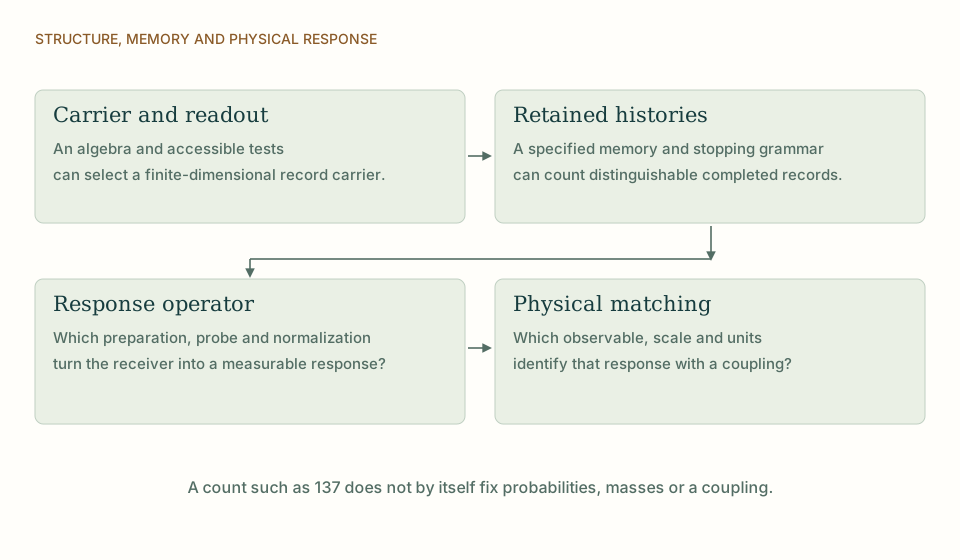
From carrier structure to a measurable response. Representation dimension, a chosen retention grammar, a response operator and physical calibration are separate stages of the constants programme. View full size ↗
03How Grand unified theories frames the problem
Grand unified theories embed the Standard Model gauge structure in a larger group and organize particles into unified representations. Their physical content includes symmetry-breaking patterns, coupling matching, heavy states and possible number-changing processes such as proton decay. The choice of unified group and matter content is substantial model input, not a consequence of the word unity.
This makes GUTs a useful comparison for the Single Monad programme. Both seek a common origin of differentiated interactions, but they operate at different levels: GUTs provide explicit field representations, while SMM/DTT aims to explain why such carriers arise. A meaningful bridge must reproduce branching rules and observables, or derive a different constrained alternative. [4]
04Where the mechanisms agree and differ
Grand unification means embedding several interaction symmetries into one larger gauge group. SMM's unity is more primitive: a nonspatial source is intended to generate the distinctions on which any such group acts. These are related ambitions, but they are not the same claim. A unique source can support many different representation structures unless its dynamics selects one.
The most useful comparison is the branching of a unified carrier into observed sectors. A GUT supplies explicit representation decompositions and symmetry-breaking fields; DTT would need an equally explicit completion map whose invariant subspaces reproduce those sectors or predict a different constrained pattern. The six nested levels are not six generators of a unified Lie algebra. The worked symmetry-breaking example below shows how a state can reduce a law's symmetry, but it leaves the choice of law open. A strong temporal result would remove one of those choices through source constraints. It would also preserve anomaly consistency and the observed low-energy gauge structure. Unity then becomes explanatory because it limits allowed physics, rather than because a common name is assigned to independently chosen interactions. [4]
05Worked example: assumptions, calculation and result
Consider a real two-component field φ=(φ₁,φ₂) with V(φ)=λ(φ₁²+φ₂²−v²)²/4 and λ>0. The potential is invariant under planar rotations, but its minima lie on the circle |φ|=v. Choosing the vacuum (v,0) makes one direction radial and one tangent to the circle. Expanding φ₁=v+h and φ₂=π gives V=λv²h² plus higher-order terms; the radial mode has m²=2λv² for canonically normalized fields, while the tangent mode has zero quadratic mass in the global-symmetry model.
Thus symmetric laws can produce asymmetric states without asymmetric fundamental equations. If the symmetry is gauged, the degrees-of-freedom accounting changes through the Higgs mechanism. This calculation is an explanatory benchmark, not a derivation of the Standard Model or a claim that all source distinctions must follow this potential. [1][2][3]
V=λ(|φ|²−v²)²/4; m²radial=2λv²; m²tangent=0 for a global O(2) example.
Natural units ħ=c=1; canonically normalized scalar fields have mass dimension 1 and λ is dimensionless in four spacetime dimensions.
06An independent operational check
The stabilizer of a record gives a useful intermediate object. It is the set of transformations that leave that particular record unchanged. Different records can have different stabilizers even when they arise from the same source law. A source-derived classification of these stabilizers would explain which observable symmetry patterns are possible without assuming that every pattern occurs dynamically. A separate energy or probability law selects which records are favored. This separation keeps the programme constructive: first determine the allowed symmetry types, then calculate their physical realization. Neither step needs to be advertised as complete particle unification before the other is established.
07What follows from the comparison
The strongest temporal approach would restrict the allowed potential, representation and completion map simultaneously. A group label by itself leaves these choices free. Comparing symmetry levels with standard symmetry breaking therefore helps identify the positive contribution: a generative rule could explain which symmetries are physically available before explaining why a particular state fails to display all of them.
THE SAME QUESTION, DIFFERENT STARTING POINTS
The comparison at a glance
Question
SMM/DTT
Grand unified theories
Starting physical structure
One nonspatial source; six nested inner functional levels produce records accessible through outer completion.
A larger gauge group containing the observed interaction symmetries.
The central mechanism in this topic
One source should select which carrier decompositions and invariants are physically available.
A larger gauge group and its breaking fields determine representation branching.
How the claim is made operational
A source-to-record map must define geometry, material response and physical clocks with shared inputs.
Representation branching, symmetry breaking, coupling matching and heavy-particle phenomenology.
Meaning of agreement
Agreement is a compatibility result; a source-selected relation or fixed residual would add explanatory content.
The stated framework provides a benchmark within its own assumptions and established domain.
KEEP THE CONNECTION
Key ideas
Ontological unity becomes a physical unification principle when it restricts representations and interactions.
The worked example establishes only the result stated under its explicit assumptions.
Six nested inner levels describe one generative organization; outer time orders accessible completion.
Develops the source construction or operational distinction used in this comparison.
Sources and further reading
References support the comparator and the specific mathematical or interpretive claims indicated. SMM/DTT connections are developed in the analysis above.