Fine-structure constant and 137: SMM/DTT and Standard Model quantum field theory
What would connect an exact structural count of 137 to the measured electromagnetic interaction strength? This article compares the source-based construction with Standard Model quantum field theory, identifies their strongest point of contact, and works through a concrete example that separates a valid mathematical result from the further physical relation needed to explain observations.
The electromagnetic fine-structure constant is dimensionless: α=e²/(4πε₀ħc) in SI notation. Its measured low-energy inverse is approximately 137.035999, and effective electromagnetic couplings depend on the momentum scale and the renormalization convention. An exact integer arising in a vacuum construction is therefore not automatically the measured coupling.
The proposed SMM/DTT use of 137 is strongest when it is stated as a structural result about a specified completed vacuum or retained-record space. The missing physical bridge is a response calculation: how do those records normalize an electromagnetic kinetic term, a charge, or a scattering amplitude? Numerical proximity motivates that question but does not answer it. [1][2][3]
02The SMM/DTT contribution
Within the intended DTT interpretation, exact 137 and 128 characterize structural vacuum organizations associated with different readouts; they are not assigned here to low- and high-energy electromagnetic running. Six nested inner levels generate distinctions that outer completion retains. A count of those distinctions could constrain a response if the theory supplies a physical map from completion cost to a measurable interaction.
The binary-to-decimal construction is mathematically transparent once its ingredients are fixed: the nonempty subset counts 1,3,7 are weighted by 100,10,1. The scientific issue is why those weights and that additive response are selected by the source. A noncircular derivation must determine the counting rule and the response normalization without choosing them because they yield a familiar integer.
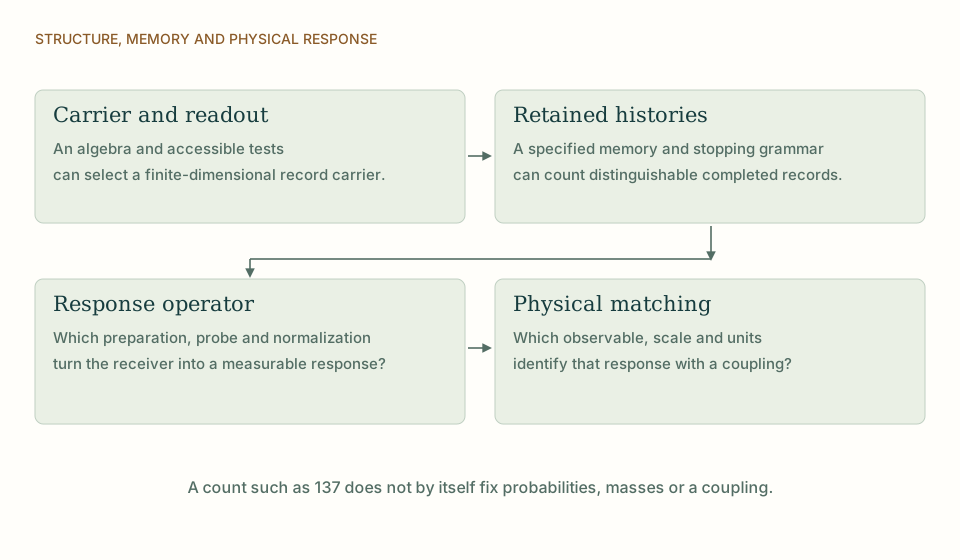
From carrier structure to a measurable response. Representation dimension, a chosen retention grammar, a response operator and physical calibration are separate stages of the constants programme. View full size ↗
03How Standard Model quantum field theory frames the problem
The Standard Model describes matter and nongravitational interactions with quantum fields, internal gauge symmetry and a Higgs sector. Particle representations, coupling constants and several mass parameters are inputs constrained by experiment. Its success makes it the immediate low-energy benchmark for any proposed source theory of matter, while leaving important questions about the origin of those inputs open.
A DTT comparison should therefore distinguish explanation of a parameter from reproduction of a formula that already contains it. A source-derived carrier or completion law would be useful if it restricts representations, couplings or relations among observables. It must still reproduce the field-theoretic meaning of charge, spin, locality and radiative corrections. [2][1]
04Where the mechanisms agree and differ
In Standard Model quantum field theory, electromagnetic strength is defined through a normalized gauge interaction and extracted from specified observables. The exact integer 137 in a DTT vacuum count has a different initial meaning. The comparison is therefore a matching problem: can the structural response of completed records fix the coefficient that a scattering or atomic experiment measures?
The arithmetic below establishes the count once binary multiplicities and decimal weights are supplied. It also exposes the missing selection of the radix and the additive response rule. Six nested inner levels may constrain those choices, but a statement that they should produce a familiar constant is not a derivation. The intended structural 128 should likewise remain a vacuum label rather than a stand-in for a high-energy electromagnetic coupling. A strong DTT result would derive an effective gauge kinetic term and a charge normalization from the same completion dynamics, then calculate any mass or holonomy correction without fitting the measured fractional remainder. This is a promising route because it connects a combinatorial theorem to a conventional observable. Until that bridge is calculated, the proximity of 137 to the inverse low-energy coupling is motivation for research, not an established prediction of QED. [2][1]
05Worked example: assumptions, calculation and result
For d=0,1,2,3, compute 2ᵈ−1 to obtain 0,1,3,7. Then Σ(2ᵈ−1)10^(3−d)=0+100+30+7=137. The arithmetic is exact. Replacing the radix by a general b gives b²+3b+7, so b=9 gives 115 and b=11 gives 161. The choice of base therefore has physical importance if the result is intended as an invariant response rather than a notation.
Using the rounded measured inverse α⁻¹≈137.035999, the difference from 137 is about 0.035999. Relative to 137 this is approximately 2.63×10⁻⁴. This is the size of a matching correction, not its derivation. Calling it holonomy or mass dressing becomes explanatory only after an independently fixed model calculates its sign and magnitude. [1][2][3]
All quantities in this counting exercise are dimensionless. The measured inverse is rounded; the calculation does not equate a structural label with α⁻¹.
06An independent operational check
A response can be insensitive to an enlarged auxiliary space. If extra states never couple to the charged carrier and are traced out with unit normalization, multiplying their number need not change any scattering probability. Consequently, a raw dimension cannot determine α unless the completion dynamics makes that dimension enter a physical coefficient. This is a stringent but useful test of the retained-record proposal. It distinguishes an observable normalization from bookkeeping and asks whether the proposed 137 survives removal of inaccessible or redundant sectors. A count that passes this test would be a much stronger candidate for physical matching than an integer obtained from an unconstrained state catalogue.
07What follows from the comparison
The productive comparison is between response mechanisms. A structural theorem can reduce the available vacuum organization; field theory then tells us what matching and radiative corrections mean. A strong SMM/DTT result would fix the electromagnetic response in one declared scheme and derive an additional observable using the same inputs. That would turn an intriguing number into a constrained physical proposal.
THE SAME QUESTION, DIFFERENT STARTING POINTS
The comparison at a glance
Question
SMM/DTT
Standard Model quantum field theory
Starting physical structure
One nonspatial source; six nested inner functional levels produce records accessible through outer completion.
Complex quantum fields in gauge representations, with a Higgs sector and measured parameters.
The central mechanism in this topic
An exact vacuum record count needs an independently derived electromagnetic response map.
The coupling is defined by normalized interactions and renormalized observables.
How the claim is made operational
A source-to-record map must define geometry, material response and physical clocks with shared inputs.
A local action, quantum amplitudes, renormalization and comparison with measured observables.
Meaning of agreement
Agreement is a compatibility result; a source-selected relation or fixed residual would add explanatory content.
The stated framework provides a benchmark within its own assumptions and established domain.
KEEP THE CONNECTION
Key ideas
The central missing result is physical matching from structural count to charge and gauge-field normalization.
The worked example establishes only the result stated under its explicit assumptions.
Six nested inner levels describe one generative organization; outer time orders accessible completion.
Develops the source construction or operational distinction used in this comparison.
Sources and further reading
References support the comparator and the specific mathematical or interpretive claims indicated. SMM/DTT connections are developed in the analysis above.
NIST, CODATA value: fine-structure constant ↗Official metrology reference for the measured fine-structure constant; consulted 17 October 2026, values below are deliberately rounded.