Electron mass and scale selection: SMM/DTT and Spectral geometry and Kaluza–Klein models
Can a temporal spectral mode explain the electron mass without importing the mass through a chosen inner period? This article compares the source-based construction with Spectral geometry and Kaluza–Klein models, identifies their strongest point of contact, and works through a concrete example that separates a valid mathematical result from the further physical relation needed to explain observations.
A mass spectrum requires both dimensionless structure and a physical scale. Integer eigenvalues can organize ratios, but converting an eigenvalue into kilograms or electron-volts needs a normalization. A relation such as E=ħω becomes a prediction of electron mass only if the relevant frequency and its coupling to an electron state are fixed independently.
This is the difference between explaining quantization and selecting a measured value. Many systems have equally spaced modes but radically different frequency scales. The electron also has spin, charge and chiral couplings, so assigning its mass to the first mode of a circle does not identify the electron unless the same model supplies those properties. [1][2][3]
02The SMM/DTT contribution
DTT offers an intuitive interpretation of rest energy as persistent inner production associated with an outer matter record. The six nested inner levels may organize a mode whose completion is stable enough to appear as a particle. That view becomes mathematically useful when a source Hamiltonian or spectral operator defines the mode and its observable energy.
An internal circle must be dimensionally specified. If its radius is a length R, a relativistic Kaluza–Klein-like spectrum has a mass scale ħ/(Rc). If the parameter is an inner time T, the corresponding scale is ħ/(Tc²). Confusing these units can hide a fitted scale. The source dynamics must select the radius or period, and show why the electron occupies the indicated mode.
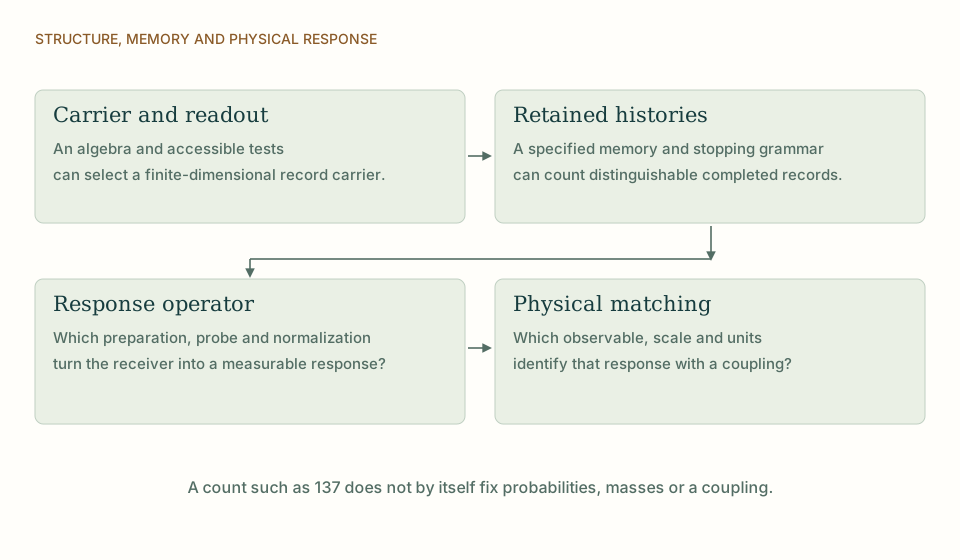
From carrier structure to a measurable response. Representation dimension, a chosen retention grammar, a response operator and physical calibration are separate stages of the constants programme. View full size ↗
03How Spectral geometry and Kaluza–Klein models frames the problem
Kaluza–Klein models relate lower-dimensional fields to a higher-dimensional geometry, often with compact internal directions. Fourier or spectral modes on the compact factor generate towers of effective excitations. Spectral geometry similarly relates operators and their spectra to geometric information, though it need not use a literal extra coordinate.
For DTT the useful comparison is the interpretation of an inner compact cycle. A compact time parameter is not automatically a harmless spatial extra dimension: its signature, operator domain and physical evolution must be stated. Six nested functional levels are not six compact coordinates. The shared mathematics of modes becomes a physical correspondence only when energy, charge and geometry are mapped consistently. [2][4]
04Where the mechanisms agree and differ
Kaluza–Klein compactification is the closest conventional comparison to a mass tower generated by an inner cycle. A mode number contributes momentum in the compact direction, which appears as mass in the effective lower-dimensional theory. DTT can reproduce the same spectral arithmetic, but its interpretation of the compact parameter must be explicit.
If the parameter is a time scale T, the mass conversion is ħ/(Tc²); if it is a length R, it is ħ/(Rc). Six nested functional levels are not six hidden spatial circles, so the standard Kaluza–Klein derivation does not automatically apply to them. The worked spectrum below also shows that periodic and antiperiodic domains yield different ladders. A source theory could improve on an arbitrary compactification by selecting the domain and scale through its own dynamics. It would then need to explain why the electron is a particular mode and why unwanted nearby modes are absent or otherwise consistent with observations. This is a useful comparison because it identifies both the positive quantization mechanism and the remaining scale problem. Merely exchanging a free electron mass for a free compactification radius does not reduce the model's physical freedom. [2][4]
05Worked example: assumptions, calculation and result
Take an internal time coordinate τ with period 2πT. The operator −i∂τ has eigenvalues n/T for periodic functions exp(inτ/T). If physical energy is Eₙ=ħ|n|/T, then mₙ=ħ|n|/(Tc²). The integer spacing follows from the boundary condition, while T remains an input.
For the observed electron rest energy approximately 0.511 MeV, the reduced Compton time ħ/(mₑc²) is about 1.29×10⁻²¹ s. Choosing T equal to this value reproduces the electron mass by construction. A predictive model instead obtains T from another independently fixed quantity or predicts a dimensionless mass ratio. Antiperiodic boundary conditions would shift n to n+1/2, illustrating that the boundary condition also carries physical information. [1][2][3]
ωₙ=n/T; mₙ=ħ|n|/(Tc²). For a length radius R=cT, mₙ=ħ|n|/(Rc).
T is a time and R a length; the circle period is 2πT or circumference 2πR. Periodic versus antiperiodic domains give different spectra.
06An independent operational check
Mass definitions also depend on context. A parameter in a bare Hamiltonian, a pole in a propagator and an effective mass in a medium are related but different quantities. A source spectral eigenvalue must be matched to the mass used in the intended observable. Otherwise a small discrepancy can reflect mismatched definitions rather than a new temporal correction. The electron calculation is most informative when it fixes a free-particle mass relation and then uses that same relation in another setting, such as atomic binding. This provides an independent check that the source mode is a physical particle property and not only an adjustable clock period.
07What follows from the comparison
The useful contribution of a temporal spectral model can be a constrained pattern of masses or a protection principle for a light mode. Absolute scale selection is a separate result. A convincing electron calculation also reproduces its charge and spin and remains stable when interactions renormalize the effective mass. These requirements focus the proposal on physical content rather than a numerical substitution.
THE SAME QUESTION, DIFFERENT STARTING POINTS
The comparison at a glance
Question
SMM/DTT
Spectral geometry and Kaluza–Klein models
Starting physical structure
One nonspatial source; six nested inner functional levels produce records accessible through outer completion.
A specified internal geometry or operator whose modes appear as effective fields.
The central mechanism in this topic
The source should select the inner period, domain and electron carrier independently.
Compact momentum yields a mass tower whose scale depends on the internal radius.
How the claim is made operational
A source-to-record map must define geometry, material response and physical clocks with shared inputs.
Dimensional reduction, spectral decomposition, normalization and mode matching.
Meaning of agreement
Agreement is a compatibility result; a source-selected relation or fixed residual would add explanatory content.
The stated framework provides a benchmark within its own assumptions and established domain.
KEEP THE CONNECTION
Key ideas
Mode quantization is a valid mechanism; radius selection and particle identification remain essential.
The worked example establishes only the result stated under its explicit assumptions.
Six nested inner levels describe one generative organization; outer time orders accessible completion.
Develops the source construction or operational distinction used in this comparison.
Sources and further reading
References support the comparator and the specific mathematical or interpretive claims indicated. SMM/DTT connections are developed in the analysis above.