Hydrogen spectrum and atomic binding: SMM/DTT and Spin networks and spin foams
Can a temporal account of electron motion reproduce atomic energies and predict a residual that survives ordinary quantum-electrodynamic corrections? This article compares the source-based construction with Spin networks and spin foams, identifies their strongest point of contact, and works through a concrete example that separates a valid mathematical result from the further physical relation needed to explain observations.
Hydrogen is useful because its leading energy scale has a compact analytic form while precision spectroscopy probes many smaller effects. The simplest Coulomb model predicts gross energy levels. Relativity, radiative corrections, recoil and proton structure modify them. A new model must state which approximation it is comparing and cannot interpret every difference from the simplest formula as new physics.
The relation v/c≈α in a Bohr-style ground-state estimate is a consequence of ordinary atomic dynamics, not an independent measurement of a universal electron speed. The quantum ground state is not a small classical orbit with a uniquely defined instantaneous velocity. A temporal tick interpretation can be helpful, but its physical content must come from a Hamiltonian or an operational distribution of momentum and energy. [1][2][3]
02The SMM/DTT contribution
SMM/DTT can interpret an atom as a stable pattern of inner generation whose completed outer records reproduce stationary quantum probabilities. Six nested inner levels would organize the production of spatial and matter distinctions, while spectroscopy reads differences between accessible completion energies.
A genuine atomic prediction requires the same parameters to govern the electron's free properties and its binding response. If a tick count is chosen from α and an inner period is chosen from the electron mass, reproducing the gross hydrogen spectrum is a consistency check. The stronger target is a constrained correction or relation among transitions that cannot be removed by recalibrating already measured constants.
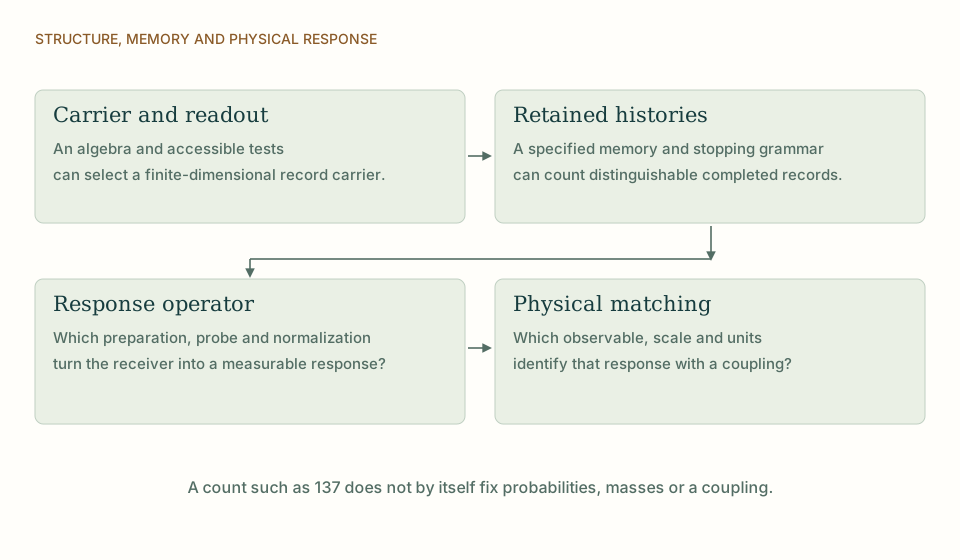
From carrier structure to a measurable response. Representation dimension, a chosen retention grammar, a response operator and physical calibration are separate stages of the constants programme. View full size ↗
03How Spin networks and spin foams frames the problem
Spin networks label quantum geometric states by representations and invariant intertwiners. Spin foams organize amplitudes for transitions between such boundary states. These structures are not automatically networks of ordinary matter particles, even when the same representation groups appear in particle physics. Constraints determine which labels encode geometric degrees of freedom.
DTT can use this comparison to clarify how local carriers are sewn into a global record. The crucial questions are which amplitudes the sewing rule assigns, which redundancies are removed, and what continuum observables emerge. A completed history resembles a boundary-to-boundary construction only after those maps have been defined; visual similarity between diagrams cannot establish equivalence. [4][5]
04Where the mechanisms agree and differ
Spin networks and spin foams primarily describe quantum geometry, so their representation labels do not directly determine hydrogen energy levels. To compare them with an atom, a model must add physical charged matter and recover the electromagnetic interaction. DTT's source-generated spatial records face the same requirement: an apparent electron–proton relation needs a Hamiltonian and calibrated clock before it defines a spectrum.
A useful bridge could derive local transport for a charged spinor on a semiclassical record network and show that its long-wavelength interaction becomes Coulombic. Six nested inner levels might generate the neighborhood and the neutral completion of a bound state, but those operations must produce the correct energy response. The calculation below gives the leading binding scale that such a construction must reproduce. A new correction would depend on how the discrete geometry or completion rule modifies the effective kinetic or interaction terms, not simply on a network's existence. DTT could contribute an explicit source mechanism tying geometry, matter and clocks together. The comparison remains a partial model until the same inputs yield both free-particle propagation and several atomic transitions, with established quantum-electrodynamic effects included in the baseline. [4][5]
05Worked example: assumptions, calculation and result
The nonrelativistic Coulomb spectrum is Eₙ=−μc²α²/(2n²), where μ is the electron–proton reduced mass. Neglecting the small reduced-mass correction and using mₑc²≈511000 eV and α≈1/137.036 gives E₁≈−13.6 eV. The n=2 level is approximately −3.4 eV, so the 2→1 transition releases about 10.2 eV.
The associated leading velocity scale is αc≈2.19×10⁶ m s⁻¹. Both numbers follow from the same supplied constants. An illustrative fractional change δα/α produces approximately 2δα/α in a gross transition energy when the mass is fixed. Real precision comparisons must also account for how the proposed mechanism changes masses, nuclear structure and higher-order terms; varying one input in isolation may not represent a consistent theory. [1][2][3]
Nonrelativistic point-Coulomb approximation. μ=mₑmₚ/(mₑ+mₚ); fine structure, Lamb shifts, finite-size effects and recoil corrections require additional terms.
06An independent operational check
Different operators leave different spectroscopic patterns. A contact interaction mainly probes the wave function near the nucleus, while a long-range potential affects extended orbital regions. A uniform rescaling of α shifts many gross transition energies together. These distinctions help make a temporal proposal falsifiable even before a full calculation is available: once the source selects an operator, its relative pattern across states is constrained. The model should use that pattern as an independent consequence, rather than assigning an unrelated correction to every line. The resulting comparison can reveal whether the new mechanism is distinguishable from mass calibration, nuclear-size uncertainty or ordinary radiative effects.
07What follows from the comparison
The informative test is a frozen-parameter comparison across several transitions or systems. A model that predicts a correction in hydrogen should also specify its effect in another isotope or a different atomic species when the same mechanism applies. This makes spectroscopy a bridge from temporal ontology to controlled theoretical consequences, while preserving the success of the established leading calculation.
THE SAME QUESTION, DIFFERENT STARTING POINTS
The comparison at a glance
Question
SMM/DTT
Spin networks and spin foams
Starting physical structure
One nonspatial source; six nested inner functional levels produce records accessible through outer completion.
Representation-labeled graphs, invariant intertwiners and transition amplitudes.
The central mechanism in this topic
Generated geometry must support charged matter transport and a derived binding interaction.
Quantum geometric networks need explicit matter coupling before atomic spectra can be calculated.
How the claim is made operational
A source-to-record map must define geometry, material response and physical clocks with shared inputs.
Gauge-invariant sewing, constraint implementation and semiclassical geometric amplitudes.
Meaning of agreement
Agreement is a compatibility result; a source-selected relation or fixed residual would add explanatory content.
The stated framework provides a benchmark within its own assumptions and established domain.
KEEP THE CONNECTION
Key ideas
The key bridge is the effective charged-particle Hamiltonian, not a resemblance between loops and atomic orbits.
The worked example establishes only the result stated under its explicit assumptions.
Six nested inner levels describe one generative organization; outer time orders accessible completion.
Develops the source construction or operational distinction used in this comparison.
Sources and further reading
References support the comparator and the specific mathematical or interpretive claims indicated. SMM/DTT connections are developed in the analysis above.
NIST, CODATA value: fine-structure constant ↗Official metrology reference for the measured fine-structure constant; consulted 17 October 2026, values below are deliberately rounded.