Outline criteria for a meaningful residual: a specified model, fixed coefficients, uncertainty control, and a pattern across observables. The skeleton draft motivates this task but does not complete it.
Let the observed frequency vector be νobs and a fixed conventional baseline be νbase(θ). A residual is r=νobs−νbase. This is a difference between two specified objects, not yet an explanation. A DTT residual would additionally require an operator or source mechanism that predicts a restricted pattern in r, survives conventional corrections and uses coefficients fixed by the declared calibration procedure. The Paper 13 skeleton proposes this research direction but provides no measured residual vector or completed calculation. Its scientific target can nevertheless be stated precisely: a restricted residual pattern with a declared operator and calibration rule.
02Predict a family of levels, not isolated line offsets
Suppose the source model produces δH=Σk ckOk. First-order shifts of nondegenerate levels are δEa=Σk ck⟨a|Ok|a⟩. In a degenerate subspace the perturbation must first be diagonalized. Each transition then inherits a difference of level matrix elements. This makes the predicted line pattern highly constrained and automatically respects energy-cycle consistency. Giving every transition an unrelated holonomy fraction would remove that constraint and can violate a common stationary Hamiltonian.
δνab = Σk ck[⟨b|Ok|b⟩−⟨a|Ok|a⟩]/h.
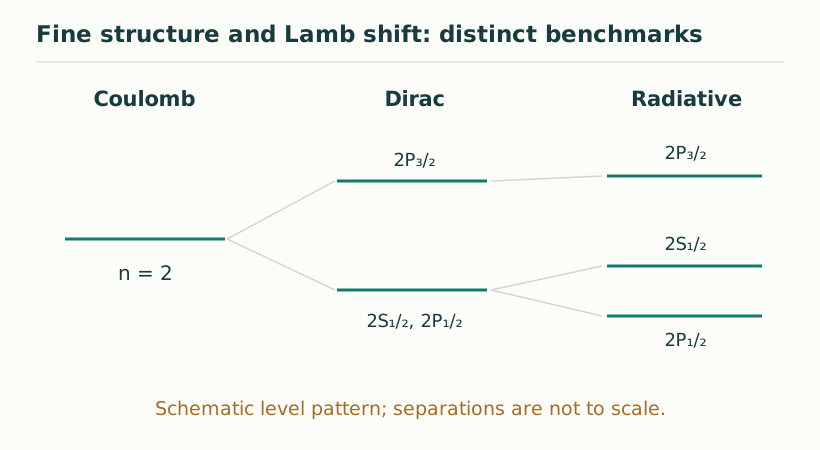
Figure 1. Fine structure and Lamb shift: distinct benchmarks. Schematic only, with deliberately exaggerated separations. For hydrogen n = 2, Dirac fine structure separates j = 1/2 from j = 3/2; radiative corrections further separate 2S₁/₂ and 2P₁/₂. No measured scale is plotted. View full size ↗
03A worked contact-pattern test
For the illustrative contact insertion, let K=λ/(πrB³) and δEnS=K/n³. The 1S→2S frequency shift is −7K/(8h), while the 2S→3S shift is −19K/(216h). Their ratio is 19/189. This ratio follows before λ is assigned and is an example of a cross-state prediction. A third transition can test the same pattern. The calculation is only first-order contact theory; it is not a claimed DTT value for λ. Nuclear finite-size effects can also have contact-like behavior, so the pattern alone does not establish a unique origin.
04Separate nuisance directions from novel ones
Let N contain baseline sensitivities to uncertain masses, radii or calibration offsets, while S contains proposed temporal shape columns. A residual component in the span of N can be absorbed by conventional nuisance changes within their allowed uncertainties. The informative part is the component of S that remains independent after those nuisance directions are accounted for. If every proposed temporal column is a linear combination of conventional ones, this data set cannot identify the new coefficient. Additional observables with different dependence are then required. This is an identifiability question, not a failure of statistical precision.
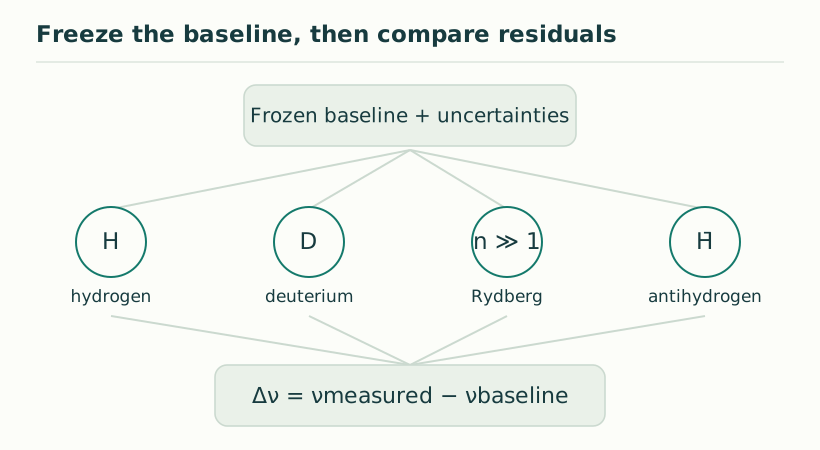
Figure 2. Freeze the baseline, then compare residuals. A differential test compares independently predicted and measured transitions across several systems. Shared nuisance effects can cancel only under a specified covariance model. The plotted markers are a design schematic, not data or DTT predictions. View full size ↗
05What would support a source interpretation
The strongest case would combine a derivation of the operator from one autonomous inner dynamics, a fixed coefficient, an independently verified QED baseline and a matching pattern across several reserved channels. Isotope, angular-momentum and field-dependence comparisons can distinguish mechanisms that agree in one line. A loop phase or structural integer should enter through an explicit energy map with correct units. The six nested stages may constrain that map, but their labels alone cannot determine the sign, magnitude or state dependence. These requirements turn SMM/DTT’s conceptual picture into falsifiable relationships.
06What a null result would teach
If the residual is consistent with zero, the experiment constrains the proposed coefficient or confirms that its effect is hidden below the sensitivity of the chosen channels. It does not refute every possible source interpretation. If the pattern fails, the specified operator or matching law is challenged; adding one new coefficient per failed line would evade the test. A good report therefore publishes the frozen prediction, covariance and goodness-of-fit criterion, including unsuccessful comparisons. The proposed residual shape and the conventional nuisance directions specify the comparison geometry; locating a measured uncertainty region within it requires actual observations and a completed calculation.
KEEP THE CONNECTION
Key ideas
A residual becomes a DTT claim only through a restricted source-derived pattern.
Nuisance degeneracy must be resolved before assigning a novel origin.
Scope of the argument. The contact example is an illustrative conditional calculation. No experimental DTT residual or derived contact coefficient is claimed.
Sources & further reading
Temporal Reconstruction of Hydrogen III, skeleton research outlinepaper13_hydrogen_fine_structure_lamb_shift.pdf, §§2–7, pp.3–9
Minimal hydrogen note: transition consistency and contact correctionsmm_dtt_minimal_hydrogen.pdf, §8.1, p.7
Working manuscript. Article-level references identify the consulted sections and the scope of the interpretation. No public URL was supplied for this exact manuscript version.