
In this article
- What must be assigned to an atomic state
- Holonomy and its gauge-invariant content
- The branch convention cannot be hidden
- From a phase to an energy
- A worked three-state consistency check
- The SMM/DTT construction task
Introduce the skeleton draft’s proposal to extend a ground-state holonomy description to different atomic states. Focus on the definitions needed before state-dependent predictions can be evaluated.
Paper 14 proposes that distinct atomic states can correspond to distinct completed record cycles. A state label such as a=(n,ℓ,j,F) summarizes radial excitation, orbital angular momentum, total electronic angular momentum and, where included, hyperfine angular momentum. The proposal becomes calculable only when each label selects a definite cycle Ca and a definite transport operator along it. A drawing of a longer loop for an excited state is not enough. The cycle must follow from the same source rule used for all states, with the relevant band and observation interface specified.
Given a connection and a closed cycle, holonomy is the ordered transport around that cycle. Changing the local frame at the base point conjugates the holonomy, so conjugacy invariants such as trace, eigenvalues and determinant are candidate observable quantities. The skeleton uses the phase of the determinant in a selected physical low-band sector. This choice requires a specification of the band projector and a demonstration that transport respects it, or a controlled rule for leakage. A determinant computed on a convenient algebraic subspace is not automatically the phase measured by an atom.
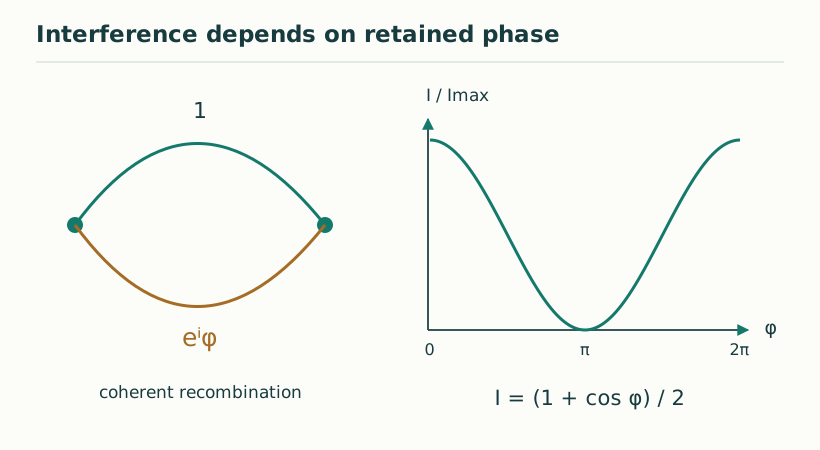
A phase is defined modulo a full turn. Comparing two values of Arg requires a common branch or a continuous lift along a specified parameter path. The ground reference ηa=Ha−H1S is therefore meaningful only after those conventions are fixed. If a phase crosses a branch cut, a numerical jump may reflect representation rather than a physical discontinuity. A source theorem can select a lift through continuity, winding or a completion rule, but that selection must be stated. The same branch prescription must work for all states and isotopes admitted to the comparison.
A dimensionless holonomy fraction does not yet have energy units. The model needs an energy map or a perturbation operator connecting phase information to stationary levels. For example, an illustrative law δEa=Kηa with one fixed energy scale K gives δνab=K(ηb−ηa)/h. It automatically satisfies the sum rule for transitions around a three-level cycle. A different map may be justified by the source dynamics, but multiplying each transition by an independently chosen sensitivity generally does not preserve a common level structure.
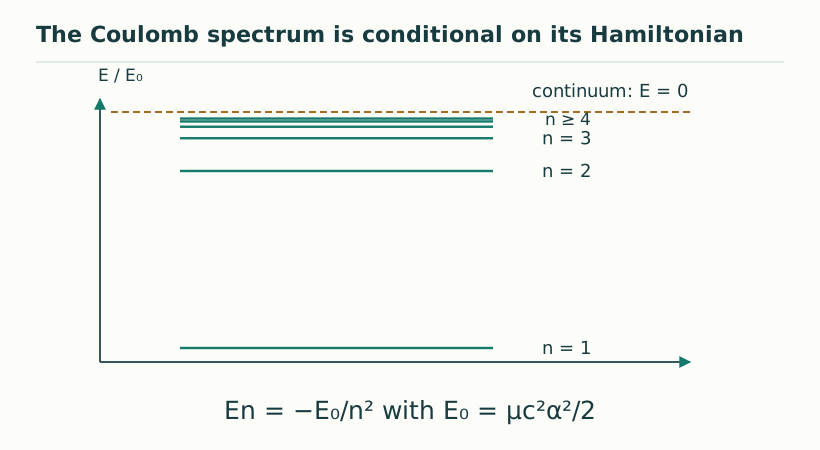
Let η1=0, η2=ε and η3=0. Under the shared energy map, the 1→2 shift is Kε/h, the 2→3 shift is −Kε/h and the 1→3 shift vanishes. The cycle closes exactly. A rule that instead multiplies each holonomy difference by its own unperturbed transition frequency will generally fail because those frequencies differ. The minimal hydrogen note explicitly identifies this problem in an older transition-wise ansatz. The correction does not rule out holonomy effects; it shows that they must enter through compatible level energies or a more explicitly time-dependent measurement model.
In the intended architecture, inner histories generate a state and outer completion retains the record that identifies it. Six nested stages should determine the admissible cycles, not be reinterpreted as six independent phase knobs that can fit each line. A completed paper would construct Ca, its transport, the physical band and the energy map from a common update. It would prove branch consistency and derive shared state dependence before using data. The present skeleton supplies the organizing question. This article adds the mathematical contract a state-dependent holonomy proposal must satisfy to become an atomic prediction.
KEEP THE CONNECTION
Scope of the argument. A precise expansion of a skeleton proposal; no state cycles or physical holonomy coefficients have yet been derived in the supplied short draft.
Draft file: paper14_hydrogen_differential_holonomy_tests.pdf
Working manuscript. Article-level references identify the consulted sections and the scope of the interpretation. No public URL was supplied for this exact manuscript version.
Source register →