Outline how highly excited states could extend the proposed state-dependent test program. Explain which scaling law the temporal model must provide before measurements can discriminate it.
Rydberg states sample larger distances and have smaller neighboring energy spacings than low-lying states. This makes them a useful complement to near-nucleus probes. Paper 14 suggests that state-dependent record cycles might become distinguishable in such states. That proposal should be framed as a question about a derived scaling law: how does the source’s effective operator depend on n and angular momentum? A longer-looking temporal cycle is not yet a prediction of a longer lifetime or a larger correction. The link must be calculated through wavefunctions, level energies or a specified time-dependent measurement process.
02What the Coulomb model already predicts
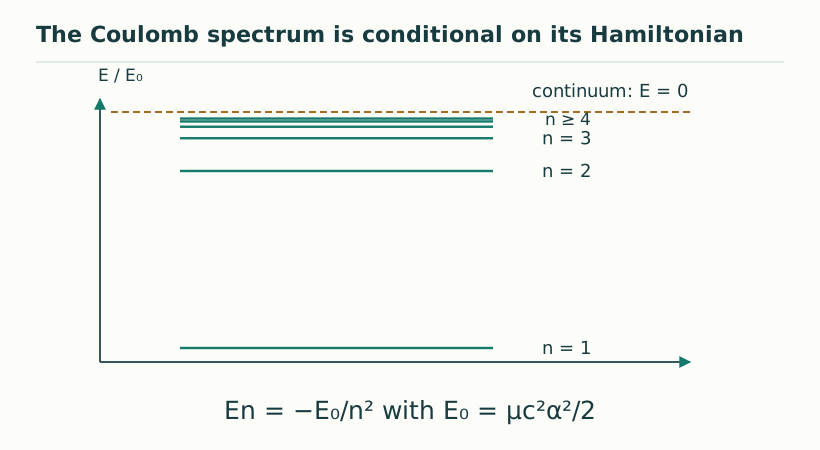
For En=−B/n² with B>0, the spacing to the next principal level is B[(1/n²)−1/(n+1)²], which approaches 2B/n³ for large n. The characteristic orbital size grows as n²rB in the semiclassical scaling sense, though exact expectation values also depend on angular momentum. These relations are existing consequences of the Coulomb operator. Recovering them would be an important consistency check for a source model, but they should not be counted as distinctive DTT predictions merely because the states are described as long completion cycles.
En+1−En = B(2n+1)/[n²(n+1)²] ∼ 2B/n³.
Figure 1. The Coulomb spectrum is conditional on its Hamiltonian. For the nonrelativistic Coulomb Hamiltonian, bound levels follow En = −E₀/n² and approach the continuum threshold. The diagram uses dimensionless E/E₀ and does not derive the coupling or supply radiative corrections. View full size ↗
03Different operators behave very differently
A contact insertion probes the wavefunction at the nucleus. At leading order its nS shift scales as 1/n³, while states with ℓ>0 have zero contact density at the origin. A long-range perturbation instead samples the extended wavefunction and can have a different n and ℓ dependence. A spin-sensitive perturbation adds further angular structure. This is why high-angular-momentum states can complement S states: they suppress some short-distance contributions without automatically suppressing all possible new physics. The predicted operator, rather than the word “Rydberg,” determines the useful observable.
04An example of an informative null channel
Suppose a candidate source correction is exclusively the first-order contact term. Then a high-ℓ transition has no correction from that term at this order, while an nS transition can have one. A nonzero high-ℓ residual would challenge the contact-only model or indicate omitted baseline/environmental effects. This is a useful discriminating prediction even though it predicts zero in one channel. Conversely, giving the model a new long-range operator after observing that residual requires a revised hypothesis and fresh testing. Null channels make a shared source mechanism more constrained.
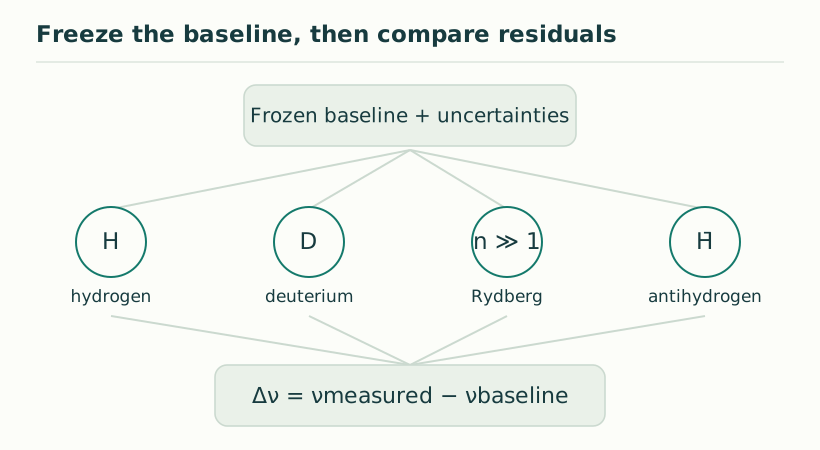
Figure 2. Freeze the baseline, then compare residuals. A differential test compares independently predicted and measured transitions across several systems. Shared nuisance effects can cancel only under a specified covariance model. The plotted markers are a design schematic, not data or DTT predictions. View full size ↗
05The environment becomes part of the test
Highly excited states can be sensitive to external electric and magnetic fields, thermal radiation, collisions and line-shape effects. State preparation and finite lifetime also affect accessible precision. A theoretical comparison must specify the actual state labels and measurement environment rather than compare a field-free formula with an arbitrary measured line. These considerations do not make Rydberg tests unsuitable; they define which uncertainties and controls are needed. A cancellation that removes a nuclear term may still leave a large environmental sensitivity, and the covariance model should reflect that tradeoff.
06How to formulate the DTT target
Construct the state cycle Ca from the same nested inner hierarchy used for the ground state, then derive its observable operator and its large-n behavior. Demonstrate how the completion rule preserves or changes the spatially extended state. If a characteristic memory scale enters, derive how it appears in levels or linewidths and identify whether it can be represented by ordinary auxiliary dynamics. A strong result would be one fixed asymptotic law across low-lying S states and high-ℓ Rydberg states. In SMM, the same source must support both kinds of completed state; this makes a shared operator and coefficient a concrete consistency requirement across their very different spatial scales.
KEEP THE CONNECTION
Key ideas
Rydberg scaling is already constrained by the Coulomb baseline.
Operator matrix elements decide whether a state enhances or suppresses a correction.
High-angular-momentum channels can provide valuable null tests.
Scope of the argument. A test strategy based on standard Coulomb scaling; no source-derived long-cycle correction is supplied by the skeleton.
Sources & further reading
Hydrogen as a Differential Test of the Holonomy Fraction, skeleton outlinepaper14_hydrogen_differential_holonomy_tests.pdf, §§2–7, pp.3–9
Minimal hydrogen note: state and transition consistencysmm_dtt_minimal_hydrogen.pdf, §8.1, pp.6–7
Source editions and catalogue entries
Skeleton draft
Hydrogen as a Differential Test of the Holonomy Fraction
Working manuscript. Article-level references identify the consulted sections and the scope of the interpretation. No public URL was supplied for this exact manuscript version.