Examine antihydrogen as a comparison of matter and antimatter spectra. Explicit symmetry assumptions, a shared baseline, and correlated observables determine what a temporal model would need to predict and how either equality or a difference could constrain it.
Antihydrogen contains an antiproton and a positron. Comparing corresponding transitions with hydrogen tests the symmetry relations between matter and antimatter under controlled conditions. The ALPHA collaboration has experimentally observed the antihydrogen 1S–2S transition; that establishes a concrete spectroscopy channel, not a DTT anomaly. Paper 14 proposes an orientation-sensitive comparison but leaves its dynamics as a skeleton. The central theoretical question is therefore precise: does the source model preserve the ordinary symmetry relation, or does it introduce a specified operator that changes sign or magnitude between the two systems?
02What the ordinary reference assumes
A conventional comparison matches corresponding state labels and accounts for the different experimental environments, including trapping fields. Under the usual CPT-symmetric relativistic quantum-field framework, particle and antiparticle properties are related so that corresponding isolated spectra agree. If a source construction reproduces that framework, agreement is expected. A discrepancy claim requires more than an “opposite time direction” interpretation: it must state which standard assumption or effective symmetry is modified and show how that modification enters an observable. Many internal orientation conventions can reverse without changing any physical transition.
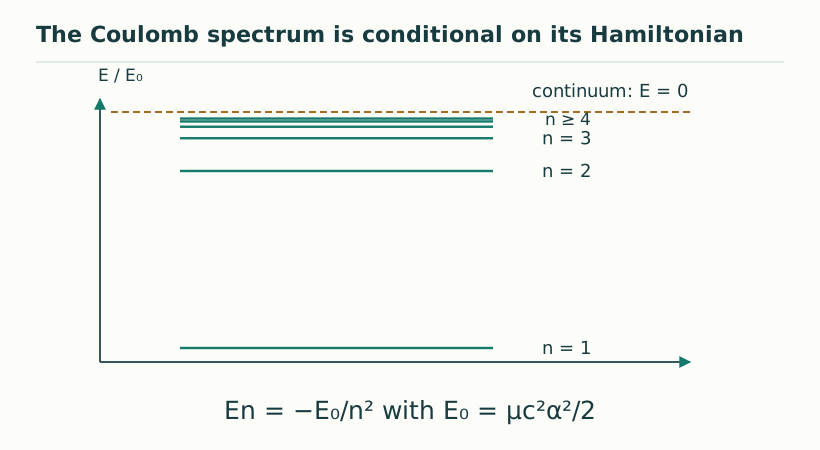
Figure 1. The Coulomb spectrum is conditional on its Hamiltonian. For the nonrelativistic Coulomb Hamiltonian, bound levels follow En = −E₀/n² and approach the continuum threshold. The diagram uses dimensionless E/E₀ and does not derive the coupling or supply radiative corrections. View full size ↗
03Separate a convention from a symmetry-odd operator
Suppose an effective Hamiltonian contains a term cOodd whose transformation under the specified matter–antimatter map is odd. Then its level contribution can have opposite signs in the two systems. The difference of corresponding transition shifts becomes twice the appropriate level-difference matrix element if all other assumptions match. This is a transparent illustrative mechanism. It does not assert that such an operator is present or permitted by the completed SMM/DTT model. A mere reversal of the phase coordinate, accompanied by the corresponding transformation of states and observables, may instead leave the entire spectrum unchanged.
If δEa(anti)=−δEa(H), then δνab(H)−δνab(anti)=2[δEb(H)−δEa(H)]/h.
04Define the comparison at the level of states
The hydrogen and antihydrogen measurements must refer to corresponding hyperfine and magnetic sublevels or to consistently defined field-free centroids. Magnetic trapping can select particular states, and line-shape modeling can shift an extracted resonance. The same mathematical convention for n, ℓ, j and nuclear spin coupling must be used on both sides. Uncertainties associated with environment and extrapolation belong in the comparison. The skeleton’s orientation idea becomes a useful target only after these state and measurement definitions are fixed.
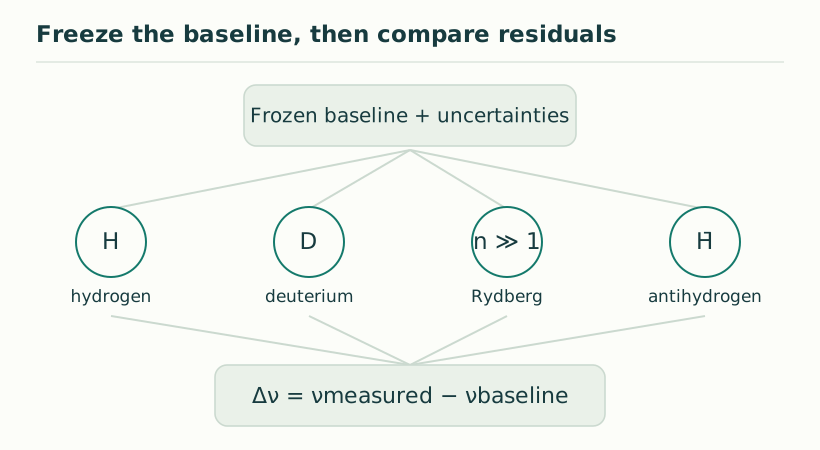
Figure 2. Freeze the baseline, then compare residuals. A differential test compares independently predicted and measured transitions across several systems. Shared nuisance effects can cancel only under a specified covariance model. The plotted markers are a design schematic, not data or DTT predictions. View full size ↗
05The SMM/DTT interpretation that needs proof
Inner generative orientation and outer completion orientation are distinct roles. Reversing one is not automatically charge conjugation, time reversal or their product. A source model must define how its orientation map acts on the matter carrier, mediator, clock and completed observables. It must then show whether the resulting operation is a symmetry of the full update and energy map. The six nested stages should transform consistently as a hierarchy, not be independently flipped to fit a chosen sign. This is an opportunity to clarify the proposed connection between temporal duality and antimatter at the operator level.
06A useful research outcome even with exact agreement
A rigorous result that the source construction enforces equality of corresponding spectra would be meaningful if it follows from nontrivial common dynamics. It would identify a symmetry constraint that every completion-compatible matter sector must obey. Alternatively, a small independently fixed symmetry-odd term would predict a specific pattern across optical and spin-sensitive channels. Either result is stronger than an unrestricted expectation of “some difference.” Both outcomes have a clear decision criterion, but numerical predictions require the operator, coefficient and experimental comparison to be calculated.
KEEP THE CONNECTION
Key ideas
An antihydrogen transition is an established test channel, not evidence of a temporal anomaly.
Orientation reversal must be translated into a defined symmetry action.
Equality or a restricted difference can both be informative source predictions.
Scope of the argument. A proposed symmetry test. No CPT violation, antimatter spectral anomaly or calculated DTT difference is asserted.
Sources & further reading
Hydrogen as a Differential Test of the Holonomy Fraction, skeleton outlinepaper14_hydrogen_differential_holonomy_tests.pdf, §§2–7, pp.3–9
Minimal hydrogen note: state and transition consistencysmm_dtt_minimal_hydrogen.pdf, §8.1, pp.6–7
Working manuscript. Article-level references identify the consulted sections and the scope of the interpretation. No public URL was supplied for this exact manuscript version.