Explain why differences between transitions can test a shared model more strongly than a single fitted line. Develop the proposed holonomy comparison as an overconstrained protocol.
01Why differences can be more informative than one line
A single measured transition can often be reproduced by changing one energy scale. Several transitions constrain not just a scale but the pattern of state dependence. Differential spectroscopy uses suitable combinations to cancel common contributions or emphasize different operators. Paper 14 proposes this as an overconstraint layer for SMM/DTT. The idea is especially suitable when a common source is claimed: one source law should organize many states with a small number of shared parameters. The test should expose those relationships rather than allocate a new adjustable quantity to every observed line.
02Start from a residual vector
For each transition i, define ri=νobs,i−νbase,i using one fixed baseline and its input covariance. A candidate effective operator produces a column of predicted sensitivities across the transitions. Several operators give a matrix S and a coefficient vector c, so r≈Sc plus experimental and theoretical error. The matrix entries must come from level differences and the declared operator basis. This representation makes the empirical question explicit: does one small coefficient vector explain the full residual pattern?
r = Sc + ε; Si,k = [⟨bi|Ok|bi⟩−⟨ai|Ok|ai⟩]/h.
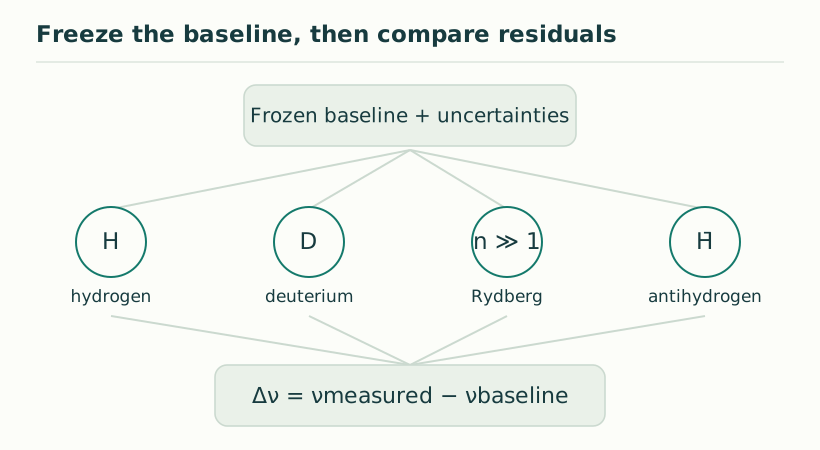
Figure 1. Freeze the baseline, then compare residuals. A differential test compares independently predicted and measured transitions across several systems. Shared nuisance effects can cancel only under a specified covariance model. The plotted markers are a design schematic, not data or DTT predictions. View full size ↗
03A two-line contact illustration
For a first-order contact insertion, S-state shifts scale as 1/n³. The 1S→2S and 2S→3S residuals therefore have a fixed ratio 19/189 if that insertion is the only extra effect and the same scale applies. A linear combination r23−(19/189)r12 must vanish in this simple model. This is a genuine differential prediction even before the unknown amplitude is fixed. It is not a unique signature of temporal physics: ordinary short-distance nuclear contributions can share similar leading behavior. Extra channels are needed to separate competing mechanisms.
04Cancellation has an uncertainty cost
If w is a vector of weights defining a differential observable D=wᵀr, its variance is wᵀΣw. A combination that cancels a large common systematic may amplify independent noise or another theoretical uncertainty. Therefore a visually appealing subtraction is not automatically a better test. Choose weights using a stated objective and covariance model, and freeze them before examining the reserved data. When uncertainties are correlated, using only their separate error bars can either overestimate or underestimate the information gained by taking differences.
D = wᵀr; Var(D) = wᵀΣw.
05Count independent directions rather than raw lines
Measuring ten transitions does not necessarily provide ten independent tests. Some are algebraically linked by shared levels, and some depend on parameters in nearly the same way. The useful count is the rank of the sensitivity matrix after nuisance directions and exact transition identities are handled. A nearly singular matrix may make coefficients poorly identifiable even when the nominal number of lines exceeds the number of unknowns. The source program should therefore select channels for complementary state dependence, such as different angular momenta, isotopes or spin response, rather than merely accumulate similar measurements.
06Transition networks contain exact dependencies
Represent each level as a vertex and each signed transition as an edge. If B is the incidence matrix of this transition graph and E the level-energy vector, then hν=BE. For a connected graph with q levels, the incidence rank is q−1. Measuring more than q−1 edges can provide valuable consistency checks and reduce noise, but it does not create more independent stationary level differences. Closed cycles give exact signed sum rules. A differential design should therefore distinguish new level information from redundant measurements of the same information. A claimed state-dependent temporal correction must satisfy these cycle rules unless the model explicitly abandons stationary shared levels and supplies a different time-dependent measurement theory.
07Connection to a common generative mechanism
DTT’s inner/outer distinction motivates the possibility that hidden phase structure leaves a small pattern in completed atomic records. Differential testing asks whether that pattern is constrained by one mechanism across states. A successful derivation should predict the columns of S, including signs and scaling, from the same six-stage hierarchy and completion rule. If the observed pattern contradicts those columns, the specified mechanism is challenged. If it agrees, conventional alternatives must still be evaluated. The value lies in an independently derived relation that could have failed, not in the fact that temporal language can be attached to a fitted line.
KEEP THE CONNECTION
Key ideas
Differential combinations test shared state dependence.
Use full covariance when choosing cancellations.
Independent sensitivity directions matter more than the number of lines.
Scope of the argument. A proposed protocol with an illustrative operator pattern, not an analysis of measured residuals.
Sources & further reading
Hydrogen as a Differential Test of the Holonomy Fraction, skeleton outlinepaper14_hydrogen_differential_holonomy_tests.pdf, §§2–7, pp.3–9
Minimal hydrogen note: state and transition consistencysmm_dtt_minimal_hydrogen.pdf, §8.1, pp.6–7
Source editions and catalogue entries
Skeleton draft
Hydrogen as a Differential Test of the Holonomy Fraction
Working manuscript. Article-level references identify the consulted sections and the scope of the interpretation. No public URL was supplied for this exact manuscript version.