A proposed isotope-comparison article within the differential-test program. Identify which effects are shared and which require separate mass and nuclear inputs before interpreting a residual.
Hydrogen and deuterium have the same electronic charge structure but different nuclei. Comparing them tests whether a model correctly separates electronic dynamics from mass and nuclear effects. This is useful for SMM/DTT because a common source mechanism might predict a universal electronic operator while allowing different nuclear states. Universality does not mean identical numerical shifts: the wavefunctions and reduced masses change. Paper 14 lists isotope comparisons as a research channel, but does not calculate their holonomies or residuals. The comparison must begin with the conventional isotope dependence before any new temporal interpretation is assigned.
02The leading reduced-mass effect
For an electron of mass me and a nucleus of mass M, the relative coordinate uses μ=meM/(me+M). In the leading Coulomb model, energy scales are proportional to μ and the radius is inversely proportional to μ. A heavier nucleus makes μ closer to me. This changes every gross-structure level even when the electronic coupling is identical. Therefore an isotope shift is not by itself evidence for new interactions. The measured nuclear masses and their uncertainties must be supplied or independently derived and kept separate from the coefficient being tested.
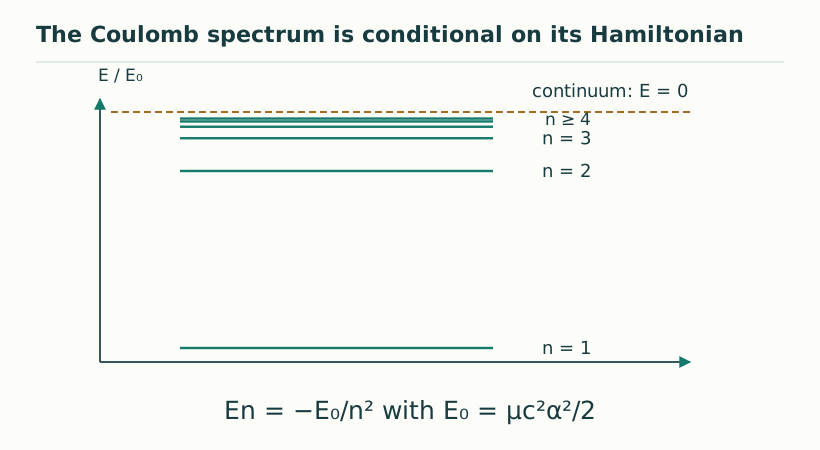
μ = meM/(me+M); En = −μc²α²/(2n²); rB = ħ/(μcα).
Figure 1. The Coulomb spectrum is conditional on its Hamiltonian. For the nonrelativistic Coulomb Hamiltonian, bound levels follow En = −E₀/n² and approach the continuum threshold. The diagram uses dimensionless E/E₀ and does not derive the coupling or supply radiative corrections. View full size ↗
03A universal contact coefficient still produces isotope dependence
Consider the same first-order contact coefficient λ for both isotopes. Since an nS wavefunction at the origin scales as rB⁻³, its contact shift scales as μ³α³λ/ħ³. If α and λ are held fixed, the ratio of contact shifts between deuterium and hydrogen is (μD/μH)³. This provides a clear example of universal dynamics with nonidentical observable effects. It also shows why simply subtracting equal numerical shifts would be wrong. The formula applies to the stipulated electronic contact insertion; it does not assume nuclear contact terms are universal.
δEnS(D)/δEnS(H) = (μD/μH)³ for a shared λ.
04Nuclear structure is a separate source of uncertainty
The proton and deuteron differ in charge distribution, spin and internal response. Finite-size and polarizability terms therefore cannot be removed by a naive reduced-mass substitution. Hyperfine structures require different spin couplings and a clearly defined centroid if those splittings are averaged out. Recoil effects beyond the simplest reduced-mass treatment also remain. A proposed temporal residual should be compared against this expanded baseline, with nuclear inputs and their correlations declared. Otherwise the new parameter may merely absorb a missing or inconsistently handled nuclear correction.
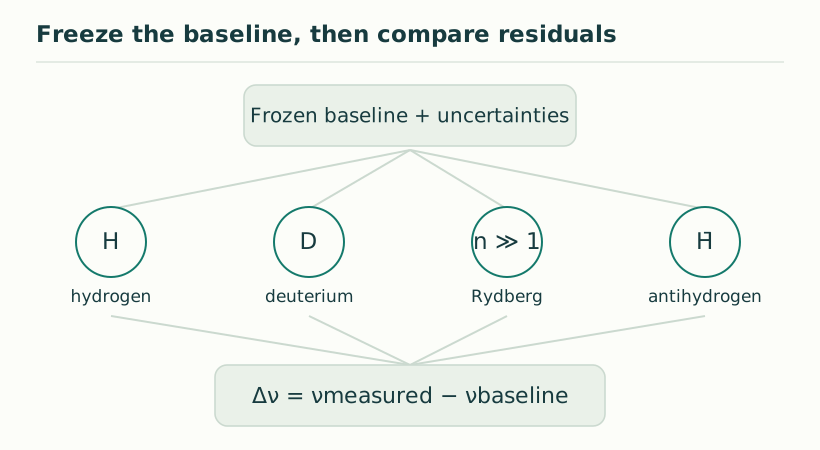
Figure 2. Freeze the baseline, then compare residuals. A differential test compares independently predicted and measured transitions across several systems. Shared nuisance effects can cancel only under a specified covariance model. The plotted markers are a design schematic, not data or DTT predictions. View full size ↗
05What should be common in the source model
The same rule for constructing the electronic record cycle, selecting the physical band and lifting its phase should be used in both isotopes. Nuclear changes should enter through specified source states or interaction terms, not a new arbitrary branch convention for each atom. A DTT claim becomes informative if it predicts which part of the phase response is universal and which scales with μ, nuclear spin or charge radius. That relationship must then be translated through a shared energy map. A phase difference without such a map cannot be compared directly with a frequency difference.
06An effective comparison design
Choose several transitions with different sensitivity to short-distance nuclear physics and electronic operators. Build the isotope-dependent baseline first, then calculate the candidate response matrix and its covariance. A useful table would list each parameter, whether it is shared, how it changes between isotopes and which data fixed it. If two effects have nearly the same isotope and n dependence, the selected data cannot separate them; angular or spin channels may be needed. The goal is a controlled cross-check of one source law, not the assumption that every isotope difference should disappear in a dual-time theory.
KEEP THE CONNECTION
Key ideas
Reduced mass changes ordinary atomic scales between isotopes.
Universal operators can have different isotope matrix elements.
Nuclear structure and hyperfine conventions must be included explicitly.
Scope of the argument. Standard reduced-mass scaling plus a conditional contact example; no DTT isotope residual is calculated.
Sources & further reading
Hydrogen as a Differential Test of the Holonomy Fraction, skeleton outlinepaper14_hydrogen_differential_holonomy_tests.pdf, §§2–7, pp.3–9
Minimal hydrogen note: state and transition consistencysmm_dtt_minimal_hydrogen.pdf, §8.1, pp.6–7
Source editions and catalogue entries
Skeleton draft
Hydrogen as a Differential Test of the Holonomy Fraction
Working manuscript. Article-level references identify the consulted sections and the scope of the interpretation. No public URL was supplied for this exact manuscript version.