
In this article
- The question behind the comparison
- The single-source and nested-time proposal
- The comparator’s explanatory structure
- The precise agreement and difference
- Worked example: what follows and what does not
- What this comparison contributes


Presentism and a growing block differ about the existence of the past, but neither position by itself determines whether microscopic equations have inverse solutions. The comparison develops this distinction through a worked example and explains its implications for SMM/DTT’s nested generation, completed records and account of the observable world.
Reversing time in a physical theory means more than replacing a displayed t by −t. One must transform quantities such as velocities, momenta and angular momenta appropriately, and specify how the dynamics and boundary conditions behave. A process can obey a reversible law while occurring in an asymmetric state. DTT’s passage from inner generation to outer completion could represent a fundamental asymmetry, an effective loss of access, or a boundary-conditioned orientation. These are alternatives with different consequences, so a useful comparison does not treat the word irreversible as sufficient explanation.
A completed record is typically stable because many microscopic degrees of freedom support it. That stability need not make the total evolution noninvertible. If a system becomes correlated with an environment and the environment is ignored, the reduced description can lose visible coherence even when the joint dynamics preserves information. Reversing the reduced evolution is then difficult because the discarded correlations are needed. This offers a natural language for a completion interface, provided its environment and resource budget are included rather than absorbed into a metaphysical label.
The six nested levels can distinguish different forms of reversibility. An inner operation may be mathematically invertible, while an observer cannot access its inverse after completion. A higher level may retain enough information to reverse a lower operation, while the outer record omits that information. This hierarchy would support a precise account of apparent irreversibility. It would differ from a fundamental destructive update, which changes the theory’s allowed trajectories themselves. Both are intelligible, but only a specified model determines which description applies.
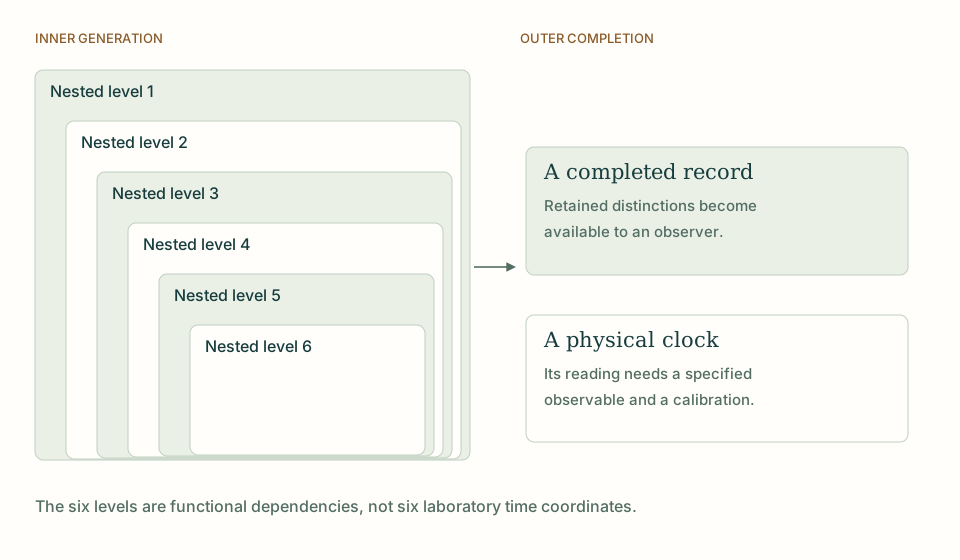
SMM begins with one nonspatial generative source. DTT distinguishes its inner production from the outer order in which completed results become accessible. The six inner levels are nested functional dependencies within that production; the seventh denotes outer completion. They are not six independent clocks, six spatial directions, or six simultaneously occupied temporal axes. This distinction makes the framework more specific than a general claim that everything changes: it asks how a world of persistent relations can be generated before its spatial representation is taken for granted. [2]
Presentism restricts concrete temporal existence to the present; the growing-block view includes the past and present while excluding the future. The distinction is decisive for a record-based ontology. A present record of yesterday and yesterday’s continuing existence are different claims. Broad’s treatment of becoming supplies the historical growing-block comparator; the presentist alternative sharpens what an archive does and does not establish.
Suppose a stone bears an inscription describing a vanished ceremony. A presentist can treat the inscription as a current object with a history. A growing-block theorist can additionally include the ceremony itself in reality. Both can agree about what the inscription says. The disagreement therefore cannot be settled by pointing to a stored record alone. SMM/DTT gains precision by stating whether renewal preserves past events, preserves only present traces, or uses another form of persistence. Relativity adds the separate question of how a privileged present, if proposed, relates to spatially separated events. [1]
Presentism and a growing block differ about the existence of the past, but neither position by itself determines whether microscopic equations have inverse solutions. A presentist can describe a reversible pendulum, and a growing-block theorist can regard its reversed motion as another possible history. DTT’s renewed completion therefore should not be equated automatically with a dynamical prohibition on reversal.
The sharper issue is whether a completed event can lose its ontological status. In a growing block, genuine subtraction of an existing past would conflict with the usual growth picture. In a renewal account, recreating a previous pattern can produce a new event rather than restore the old event’s identity. This distinction parallels the physical difference between reversing an entire correlated state and merely reproducing a visible configuration. DTT can use it to clarify why recurrence is not historical undoing. Its source law must still explain which transformations are physically allowed. The comparison separates ontological irreversibility from mathematical noninvertibility and from the practical inability of an observer to retrieve discarded information. [1]
Start with a qubit in (|0⟩ + |1⟩)/√2 and an environment in |e⟩. Let an interaction produce (|0⟩|e₀⟩ + |1⟩|e₁⟩)/√2, where the environment states are orthogonal. The qubit alone is then described by a diagonal density matrix with probabilities one half, because tracing over the environment removes the off-diagonal terms. The joint state remains pure. An inverse joint unitary can in principle restore the original superposition, whereas operations on the qubit alone generally cannot. This is an example of lost local access, not a proof that the universe has erased information. A physical DTT completion law can be compared with this explicit distinction.
An account of temporal asymmetry is strongest when it identifies the operation whose inverse fails, the information needed for reversal, and the observer for whom that information is unavailable. These questions also keep metaphysical becoming distinct from laboratory reversibility. A theory may affirm genuinely new actual events while retaining reversible equations for measurable correlations; whether that combination is coherent depends on its ontology and its rule for records, not on an isolated slogan about quantum mechanics.
THE SAME QUESTION, DIFFERENT STARTING POINTS
| Question | SMM/DTT | Presentism and the growing-block universe |
|---|---|---|
| Explanatory starting point | Completion marks a change in accessible records, whose reversibility depends on the retained source and environmental information. | Presentism and the growing block disagree over whether past events themselves remain real. |
| Key distinction | Recovering a locally decohered state can require joint control of the environment even when the underlying evolution remains unitary. | Presentism and a growing block differ about the existence of the past, but neither position by itself determines whether microscopic equations have inverse solutions. |
KEEP THE CONNECTION
Connects this comparison with the author’s discussion of reversal.
Connects this comparison with the author’s discussion of reversal.
Connects this comparison with the author’s discussion of reversal.
Connects this comparison with the author’s discussion of reversal.
Connects this comparison with the author’s discussion of reversal.
References support the comparator and the specific mathematical or interpretive claims indicated. SMM/DTT connections are developed in the analysis above.
How these comparisons distinguish premises, results and physical claims