
In this article
- The question behind the comparison
- The single-source and nested-time proposal
- The comparator’s explanatory structure
- The precise agreement and difference
- Worked example: what follows and what does not
- What this comparison contributes


A privileged present does not tell a clock how fast to run. Presentism and growing-block theories therefore need ordinary physical clock laws unless they add a mechanism of their own. The comparison develops this distinction through a worked example and explains its implications for SMM/DTT’s nested generation, completed records and account of the observable world.
A clock is a physical system whose changes provide a reproducible comparison with other changes. Its readings are not created by writing t in an equation. Oscillations, transitions and accumulated phases become clocks when a preparation, readout and calibration connect them with a measurable interval. SMM/DTT’s distinction between generative and observed time is therefore tested conceptually by asking what an embedded clock actually counts. If an outer clock is independent of the proposed inner dynamics, their ratio remains an additional assumption.
Operational time has several layers. A counter counts events. A phase tracks periodic evolution. A calibrated clock assigns units such as seconds. A relativistic clock measures proper time along its path. These descriptions can agree in a suitable regime while responding differently to noise, acceleration or changes in the underlying state. A generative theory must recover their agreement where established physics requires it. It should also explain why different clock technologies share the same spacetime dependence, rather than assigning each species its own completion rate.
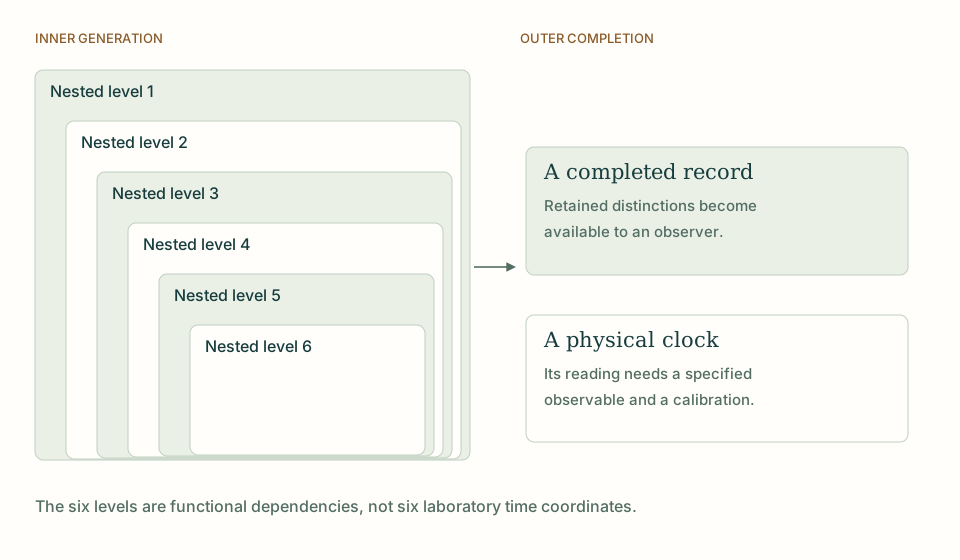
The six nested levels are not six separate clocks that can be adjusted until a desired ratio appears. Their proposed role is to organize how a completed state becomes available. A successful clock law would derive a phase or counter response from that same source trajectory. Changing a refinement or branching parameter would then change geometry and timing in a linked way. If the oscillator frequency is retuned whenever the geometry changes, a numerical agreement demonstrates calibration freedom rather than a necessary physical relation. This is the decisive distinction between a constructive explanation and a convenient parametrization.
SMM begins with one nonspatial generative source. DTT distinguishes its inner production from the outer order in which completed results become accessible. The six inner levels are nested functional dependencies within that production; the seventh denotes outer completion. They are not six independent clocks, six spatial directions, or six simultaneously occupied temporal axes. This distinction makes the framework more specific than a general claim that everything changes: it asks how a world of persistent relations can be generated before its spatial representation is taken for granted. [2]
Presentism restricts concrete temporal existence to the present; the growing-block view includes the past and present while excluding the future. The distinction is decisive for a record-based ontology. A present record of yesterday and yesterday’s continuing existence are different claims. Broad’s treatment of becoming supplies the historical growing-block comparator; the presentist alternative sharpens what an archive does and does not establish.
Suppose a stone bears an inscription describing a vanished ceremony. A presentist can treat the inscription as a current object with a history. A growing-block theorist can additionally include the ceremony itself in reality. Both can agree about what the inscription says. The disagreement therefore cannot be settled by pointing to a stored record alone. SMM/DTT gains precision by stating whether renewal preserves past events, preserves only present traces, or uses another form of persistence. Relativity adds the separate question of how a privileged present, if proposed, relates to spatially separated events. [1]
A privileged present does not tell a clock how fast to run. Presentism and growing-block theories therefore need ordinary physical clock laws unless they add a mechanism of their own. DTT’s distinctive possibility is to derive the timing of completed records from source activity. This could complement either ontology, provided the clock is defined independently of the completion count.
A growing block also faces a distinction between the amount of history that exists and the duration measured by a local observer. A longer archive may contain more events without representing more proper time along every path. A presentist can similarly distinguish a current memory’s depth from an elapsed clock interval. DTT should preserve these distinctions rather than interpret six inner roles as six equal units of time. The useful comparison asks whether a source law constrains the phase or counter of an embedded clock without retuning it. If so, DTT offers a physical contribution that an existence-only account of the present does not supply; the ontology of the past remains a separate commitment. [1]
An oscillator with angular frequency ω accumulates phase φ = ωτ. Its inferred interval is τ = φ/ω, once ω is independently calibrated. Suppose a source completes n records and a proposed inner counter reports u = 3n. An observed ratio u/n = 3 is exact, but it contains no seconds and says nothing about the oscillator phase. To conclude that a clock ratio is three, the source dynamics must establish how φ changes with n. Two models with φ = n and φ = 2n have the same record counts and different physical timing. This counterexample shows exactly why an additional transducer law matters.
A promising DTT explanation therefore uses clocks as outputs of the same theory that produces spatial relations. The result should be robust under changing the way a calculation is labelled and should state its domain of approximation. This operational standard does not diminish the philosophical distinction between production and observation; it gives that distinction a concrete route into physics. The most informative comparison asks which theory supplies the clock, which merely orders events, and which leaves the conversion from order to duration open.
THE SAME QUESTION, DIFFERENT STARTING POINTS
| Question | SMM/DTT | Presentism and the growing-block universe |
|---|---|---|
| Explanatory starting point | DTT distinguishes internal stage counts, completed-record counts and the oscillator readings through which physical duration is measured. | Presentism and the growing block disagree over whether past events themselves remain real. |
| Key distinction | A fixed ratio of source counters predicts a clock ratio only after a law connects those counters with a calibrated physical phase. | A privileged present does not tell a clock how fast to run. |
KEEP THE CONNECTION
Connects this comparison with the author’s discussion of clocks.
Connects this comparison with the author’s discussion of clocks.
Connects this comparison with the author’s discussion of clocks.
Connects this comparison with the author’s discussion of clocks.
Connects this comparison with the author’s discussion of clocks.
References support the comparator and the specific mathematical or interpretive claims indicated. SMM/DTT connections are developed in the analysis above.
How these comparisons distinguish premises, results and physical claims