
In this article
- The question behind the comparison
- The single-source and nested-time proposal
- The comparator’s explanatory structure
- The precise agreement and difference
- Worked example: what follows and what does not
- What this comparison contributes


McTaggart’s B-series assumes an earlier/later ordering of events, while relativistic record networks can contain events with no invariant earlier/later relation because they are spacelike separated. The comparison develops this distinction through a worked example and explains its implications for SMM/DTT’s nested generation, completed records and account of the observable world.
Two events being available in one record does not imply that they happened simultaneously. A photograph can combine light emitted at different times; an archive can collect reports made in different places; a later observer can compare events that were never in causal contact. DTT’s outer completion is most naturally understood first as availability of a record. Identifying it with a universal simultaneous present would be a further physical claim, requiring a synchronization rule and an account of its relation to relativity.
Relativistic simultaneity is defined relative to a chosen inertial frame for spatially separated events. Local coincidence is different: two clocks meeting at one event can compare readings without convention about distant simultaneity. A source-based theory may contain a deeper ordering, but if that order selects an observable preferred frame it has physical consequences. If it never affects any observable, it functions as underlying explanatory structure. Keeping these alternatives distinct prevents a metaphysical unity of source from silently becoming an absolute laboratory time.
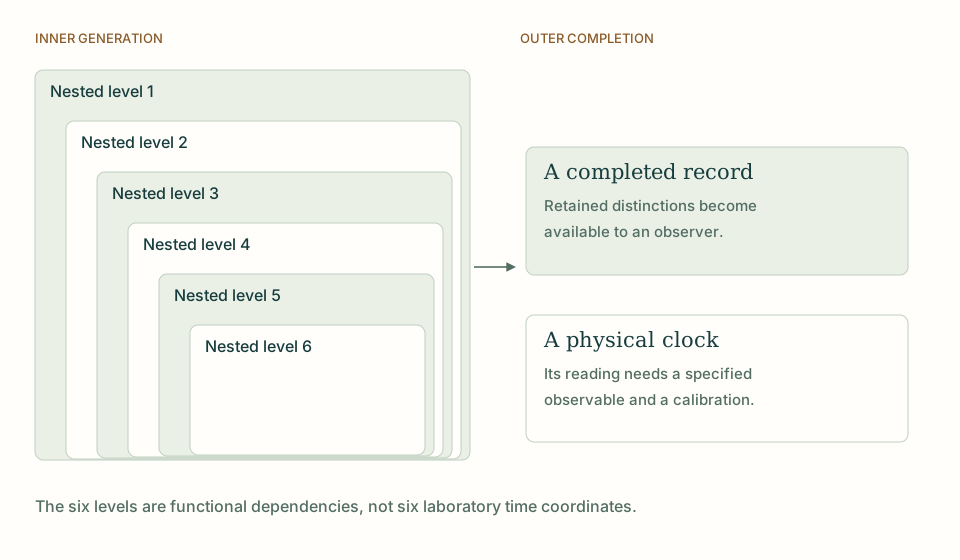
The six nested inner levels concern the formation of accessible relations and do not automatically supply six hypersurfaces or a seventh global slice. Nesting is a dependency structure. A completion relation might instead form a partial order, allowing some records to be incomparable until a later interaction combines them. Such a construction could preserve the difference between local causal precedence and frame-dependent order at a distance. The positive DTT question is then how a common source produces a consistent network of local records without requiring every observer to share one instantaneous world-picture.
SMM begins with one nonspatial generative source. DTT distinguishes its inner production from the outer order in which completed results become accessible. The six inner levels are nested functional dependencies within that production; the seventh denotes outer completion. They are not six independent clocks, six spatial directions, or six simultaneously occupied temporal axes. This distinction makes the framework more specific than a general claim that everything changes: it asks how a world of persistent relations can be generated before its spatial representation is taken for granted. [2]
McTaggart distinguished tensed positions—past, present and future—from the relations earlier than and later than. His argument challenges the coherence of taking passage as a changing possession of incompatible temporal properties. For the comparison here, the distinction is a tool for asking what DTT’s completion adds to an ordered history. A sequence can be fully ordered without specifying which member is now present.
Consider a list of event labels A, B and C. The facts A precedes B and B precedes C do not change when a reader moves down the list. What changes is the reader’s relation to a particular entry. If a completion theory adds an objective change in actuality, it needs to say whether that change is another event, an irreducible feature of events, or a change in a meta-time. These alternatives expose the regress question without assuming that McTaggart’s conclusion is correct. His analysis is philosophical; it supplies no Hamiltonian, physical clock or information-processing mechanism. [1]
McTaggart’s B-series assumes an earlier/later ordering of events, while relativistic record networks can contain events with no invariant earlier/later relation because they are spacelike separated. DTT’s completion should therefore not be identified uncritically with one total B-series. A local observer can order received records even when the originating events do not possess a frame-independent global order.
The A-series adds a present, but that does not resolve the physical synchronization problem. If DTT claims one universal completed present, it must say how distant events belong to it and whether the distinction affects observations. A weaker and more flexible construction uses local completion and a partial order of record dependence. McTaggart’s distinction remains useful for interpreting those records, yet the relational structure is richer than a single line of event labels. The comparison highlights DTT’s opportunity to explain shared accessibility without assuming universal simultaneity. It also clarifies why a later common archive is evidence of comparable records, not of one cosmic instant at which all its entries occurred. [1]
In an inertial frame, let two events be simultaneous and separated by distance L along x: Δt = 0 and Δx = L. A second frame moving at speed v assigns Δt′ = −γvL/c², with γ = 1/√(1−v²/c²). Unless v or L vanishes, the events are not simultaneous in that frame. Their eventual inclusion in the same notebook does not change this result. For timelike-related events, however, all inertial frames preserve their causal order. A DTT record relation should therefore distinguish causal ancestry from the order imposed by a particular display or coordinate system.
This yields a useful design principle for comparisons: shared source, shared information and shared simultaneity are three different claims. The first concerns ontology, the second communication or correlated access, and the third spacetime conventions or structure. A rigorous completion theory could explain why local observers agree when their records overlap while legitimately disagreeing about distant simultaneity. That would connect unity with the observed plurality of perspectives in a mathematically meaningful way.
THE SAME QUESTION, DIFFERENT STARTING POINTS
| Question | SMM/DTT | McTaggart’s A-series and B-series |
|---|---|---|
| Explanatory starting point | Outer completion supplies accessible records whose causal ancestry must be distinguished from a chosen coordinate synchronization. | Tensed positions and fixed earlier/later relations classify events without specifying their physical production. |
| Key distinction | Records assembled together need not describe simultaneous distant events; a physical model must recover relativistic transformations between observers. | McTaggart’s B-series assumes an earlier/later ordering of events, while relativistic record networks can contain events with no invariant earlier/later relation because they are spacelike separated. |
KEEP THE CONNECTION
Connects this comparison with the author’s discussion of simultaneity.
Connects this comparison with the author’s discussion of simultaneity.
Connects this comparison with the author’s discussion of simultaneity.
Connects this comparison with the author’s discussion of simultaneity.
Connects this comparison with the author’s discussion of simultaneity.
References support the comparator and the specific mathematical or interpretive claims indicated. SMM/DTT connections are developed in the analysis above.
How these comparisons distinguish premises, results and physical claims
SMONAD
Share this page, or keep a clear reference to the work you are reading.
Use this reference for the explanation on this page. “n.d.” means its first publication date is not specified; the update date is recorded separately.