
In this article
- The question behind the comparison
- The single-source and nested-time proposal
- The comparator’s explanatory structure
- The precise agreement and difference
- Worked example: what follows and what does not
- What this comparison contributes


Whitehead’s process philosophy explains temporal order through relations among occasions, but it does not by itself fix the calibrated rate of a laboratory clock. The comparison develops this distinction through a worked example and explains its implications for SMM/DTT’s nested generation, completed records and account of the observable world.
A clock is a physical system whose changes provide a reproducible comparison with other changes. Its readings are not created by writing t in an equation. Oscillations, transitions and accumulated phases become clocks when a preparation, readout and calibration connect them with a measurable interval. SMM/DTT’s distinction between generative and observed time is therefore tested conceptually by asking what an embedded clock actually counts. If an outer clock is independent of the proposed inner dynamics, their ratio remains an additional assumption.
Operational time has several layers. A counter counts events. A phase tracks periodic evolution. A calibrated clock assigns units such as seconds. A relativistic clock measures proper time along its path. These descriptions can agree in a suitable regime while responding differently to noise, acceleration or changes in the underlying state. A generative theory must recover their agreement where established physics requires it. It should also explain why different clock technologies share the same spacetime dependence, rather than assigning each species its own completion rate.
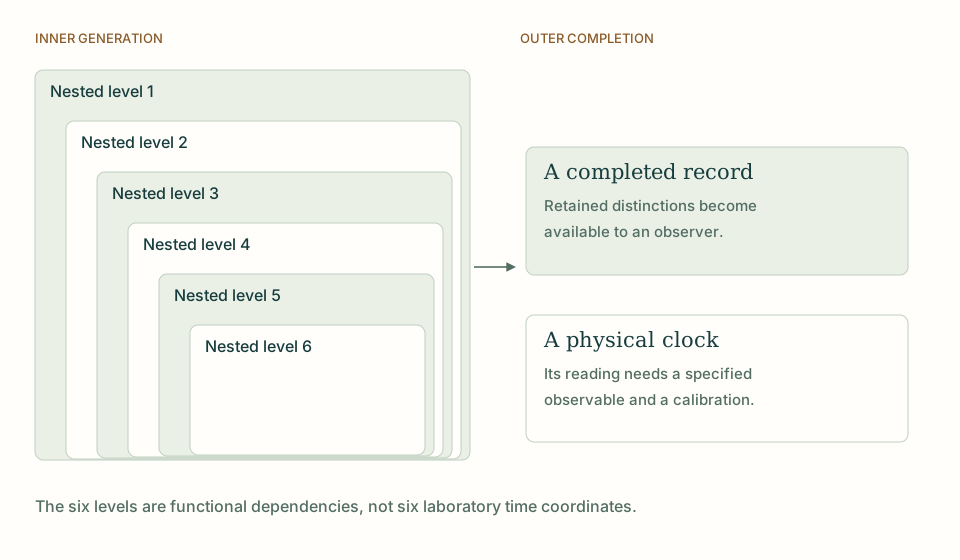
The six nested levels are not six separate clocks that can be adjusted until a desired ratio appears. Their proposed role is to organize how a completed state becomes available. A successful clock law would derive a phase or counter response from that same source trajectory. Changing a refinement or branching parameter would then change geometry and timing in a linked way. If the oscillator frequency is retuned whenever the geometry changes, a numerical agreement demonstrates calibration freedom rather than a necessary physical relation. This is the decisive distinction between a constructive explanation and a convenient parametrization.
SMM begins with one nonspatial generative source. DTT distinguishes its inner production from the outer order in which completed results become accessible. The six inner levels are nested functional dependencies within that production; the seventh denotes outer completion. They are not six independent clocks, six spatial directions, or six simultaneously occupied temporal axes. This distinction makes the framework more specific than a general claim that everything changes: it asks how a world of persistent relations can be generated before its spatial representation is taken for granted. [2]
Whitehead treats actuality through a plurality of occasions whose becoming culminates in determinate completion. His vocabulary of concrescence and satisfaction provides a close philosophical comparison with inner production and outer completion. The comparison is not an identity: Whitehead’s many actual occasions have an explanatory status different from the Single Monad’s one generative source.
A melody illustrates the process-oriented question without reducing it to acoustics. The significance of the final note depends on the pattern already realized, and the completed phrase becomes a condition for what follows. The whole is neither an unrelated collection of notes nor a timeless object unaffected by its realization. SMM/DTT can use a similar logic of inherited determination while assigning the production of multiplicity to one source. Whitehead’s metaphysical categories do not supply the specific six-level architecture, a quantum probability rule or a numerical clock calibration. Their value here is a disciplined account of becoming, relation and completed actuality. [1]
Whitehead’s process philosophy explains temporal order through relations among occasions, but it does not by itself fix the calibrated rate of a laboratory clock. DTT’s nested generation likewise needs more than ordered stages to obtain seconds. Their common emphasis on becoming can clarify why clocks are processes within the world rather than neutral observers outside it. The quantitative timing law remains a separate achievement.
This difference suggests a constructive extension of the process viewpoint. A clock can be modelled as a stable recurring pattern of completed events, with memory distinguishing successive cycles. DTT would then need to derive the relation between that recurring pattern and other generated motions. The six nested levels cannot be assigned independent periods until their physical meanings are specified. If a shared source law forces different clock patterns to agree on one effective temporal metric, it would add mathematical substance to the philosophical idea of a relational world. Whitehead provides a close conceptual motivation, while DTT’s success would be judged by the explicit clock mechanism and its robustness. [1]
An oscillator with angular frequency ω accumulates phase φ = ωτ. Its inferred interval is τ = φ/ω, once ω is independently calibrated. Suppose a source completes n records and a proposed inner counter reports u = 3n. An observed ratio u/n = 3 is exact, but it contains no seconds and says nothing about the oscillator phase. To conclude that a clock ratio is three, the source dynamics must establish how φ changes with n. Two models with φ = n and φ = 2n have the same record counts and different physical timing. This counterexample shows exactly why an additional transducer law matters.
A promising DTT explanation therefore uses clocks as outputs of the same theory that produces spatial relations. The result should be robust under changing the way a calculation is labelled and should state its domain of approximation. This operational standard does not diminish the philosophical distinction between production and observation; it gives that distinction a concrete route into physics. The most informative comparison asks which theory supplies the clock, which merely orders events, and which leaves the conversion from order to duration open.
THE SAME QUESTION, DIFFERENT STARTING POINTS
| Question | SMM/DTT | Whitehead’s process philosophy |
|---|---|---|
| Explanatory starting point | DTT distinguishes internal stage counts, completed-record counts and the oscillator readings through which physical duration is measured. | Many occasions undergo becoming and achieve determinate actuality that conditions later occasions. |
| Key distinction | A fixed ratio of source counters predicts a clock ratio only after a law connects those counters with a calibrated physical phase. | Whitehead’s process philosophy explains temporal order through relations among occasions, but it does not by itself fix the calibrated rate of a laboratory clock. |
KEEP THE CONNECTION
Connects this comparison with the author’s discussion of clocks.
Connects this comparison with the author’s discussion of clocks.
Connects this comparison with the author’s discussion of clocks.
Connects this comparison with the author’s discussion of clocks.
Connects this comparison with the author’s discussion of clocks.
References support the comparator and the specific mathematical or interpretive claims indicated. SMM/DTT connections are developed in the analysis above.
How these comparisons distinguish premises, results and physical claims