
In this article
- The question behind the comparison
- The single-source and nested-time proposal
- The comparator’s explanatory structure
- The precise agreement and difference
- Worked example: what follows and what does not
- What this comparison contributes


Presentism can describe a succession of recurring presents, while a growing block can contain many distinct repetitions of a similar event. Neither position requires the entire universe to return to an earlier state. The comparison develops this distinction through a worked example and explains its implications for SMM/DTT’s nested generation, completed records and account of the observable world.
A cycle repeats a configuration or operation; recurrence returns a system sufficiently close to an earlier state. Neither necessarily repeats the entire history. A clock hand can complete a turn while its counter advances. A biological rhythm can recur while the organism changes. SMM/DTT’s inner cycles can therefore coexist with an outer history that does not close. The key is to specify what cycles and what retains information from one completion to the next. Without that distinction, a circle in a diagram can misleadingly imply that all events recur exactly.
A compact inner variable may represent a periodic phase rather than a closed timelike curve in spacetime. Identifying phase values separated by a period is an algebraic or topological statement. It does not mean that a traveller returns to a past physical event. If a retained state changes after each traversal, the full state space includes both phase and memory. A projection onto phase alone then hides the accumulating history. This is especially useful for a theory that interprets stable matter as organized repetition: persistence can depend on a repeatable pattern without reducing the pattern’s biography to one closed orbit.
The six nested levels suggest cycles within cycles, but their periods need not be independent observables. A slower completion may require the successful closure of a lower operation. This structure can produce a hierarchy of effective timescales, although the values and ratios of those timescales still require dynamics. Counting six roles does not determine a frequency spectrum. A physical model would specify the recurrence condition, the stability of the cycle and the rule that carries memory between completions. These ingredients let cyclic generation support novelty rather than merely oppose it.
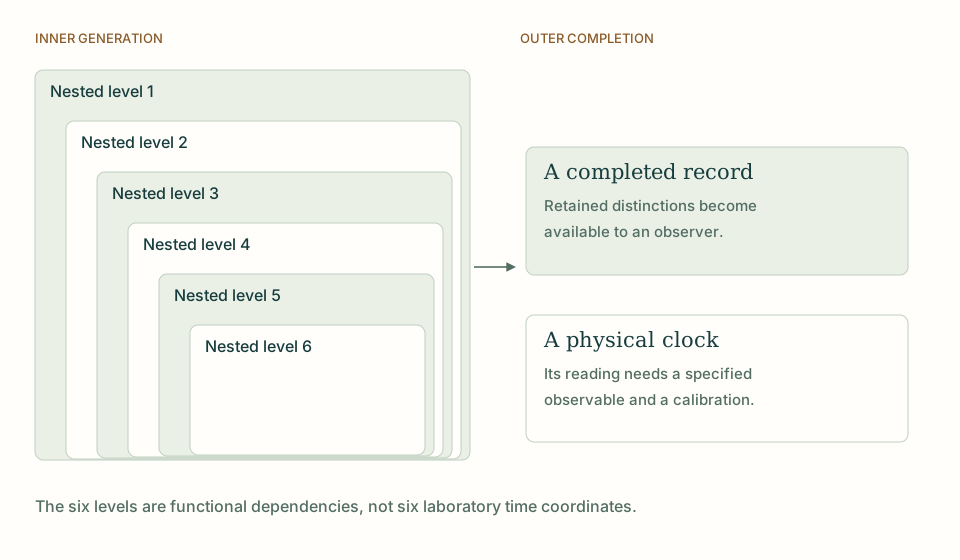
SMM begins with one nonspatial generative source. DTT distinguishes its inner production from the outer order in which completed results become accessible. The six inner levels are nested functional dependencies within that production; the seventh denotes outer completion. They are not six independent clocks, six spatial directions, or six simultaneously occupied temporal axes. This distinction makes the framework more specific than a general claim that everything changes: it asks how a world of persistent relations can be generated before its spatial representation is taken for granted. [2]
Presentism restricts concrete temporal existence to the present; the growing-block view includes the past and present while excluding the future. The distinction is decisive for a record-based ontology. A present record of yesterday and yesterday’s continuing existence are different claims. Broad’s treatment of becoming supplies the historical growing-block comparator; the presentist alternative sharpens what an archive does and does not establish.
Suppose a stone bears an inscription describing a vanished ceremony. A presentist can treat the inscription as a current object with a history. A growing-block theorist can additionally include the ceremony itself in reality. Both can agree about what the inscription says. The disagreement therefore cannot be settled by pointing to a stored record alone. SMM/DTT gains precision by stating whether renewal preserves past events, preserves only present traces, or uses another form of persistence. Relativity adds the separate question of how a privileged present, if proposed, relates to spatially separated events. [1]
Presentism can describe a succession of recurring presents, while a growing block can contain many distinct repetitions of a similar event. Neither position requires the entire universe to return to an earlier state. DTT’s cyclic inner generation fits both if successive closures leave distinguishable records. The ontology of the past remains a separate matter from the periodicity of the mechanism.
A growing block gives an especially clear distinction between repeating a pattern and deleting accumulated history: a new cycle adds another occurrence rather than replacing the earlier one. A renewal-based presentism instead needs current memory to preserve the difference between cycles. DTT’s source-memory rule should state which interpretation it supports. The six nested levels may organize cycles of different functional depth, but their number does not determine equal periods or the duration of a cosmic week. The useful comparison asks what persists across a turn and what counts as a new completion. That gives cyclic language explanatory content without making an unsupported claim that all events recur exactly. [1]
Consider a state (θ,m), with θ an angle and m an integer record count. One update advances θ by π/2; after four updates θ returns to its original value and m increases by one. The phase is periodic, but the full state is not. If an observer reads only cos θ, the display repeats every four steps. If the observer can also read m, successive cycles are distinguishable. This elementary model explains how circular inner organization and ordered outer history can coexist. It does not fix the physical duration of a cycle: assigning four milliseconds requires an additional clock relation, whereas four updates is only a count.
The strongest comparison focuses on identity across recurrences. Is a repeated form the same event, a new event with the same structure, or merely an observationally indistinguishable event? DTT’s language of renewed creation favors a new completion carrying inherited relations, but a particular model must state what is preserved. This perspective avoids treating recurrence as evidence for an eternal return of every experience while retaining the explanatory value of periodic organization.
THE SAME QUESTION, DIFFERENT STARTING POINTS
| Question | SMM/DTT | Presentism and the growing-block universe |
|---|---|---|
| Explanatory starting point | A recurring inner phase can accompany an outer history that remains ordered because successive cycles leave distinguishable records. | Presentism and the growing block disagree over whether past events themselves remain real. |
| Key distinction | Returning a phase variable to its starting value does not return the full state when its retained record count has changed. | Presentism can describe a succession of recurring presents, while a growing block can contain many distinct repetitions of a similar event. |
KEEP THE CONNECTION
Connects this comparison with the author’s discussion of cycles.
Connects this comparison with the author’s discussion of cycles.
Connects this comparison with the author’s discussion of cycles.
Connects this comparison with the author’s discussion of cycles.
Connects this comparison with the author’s discussion of cycles.
References support the comparator and the specific mathematical or interpretive claims indicated. SMM/DTT connections are developed in the analysis above.
How these comparisons distinguish premises, results and physical claims
SMONAD
Share this page, or keep a clear reference to the work you are reading.
Use this reference for the explanation on this page. “n.d.” means its first publication date is not specified; the update date is recorded separately.