


The answer in brief
Local phase structures leave genuine freedom in composition. A successful source model must derive which joint distinctions are observable and show that their quotient is preserved by all allowed operations.
Go to the research challengeTwo successful local models do not yet specify their joint system
A source can generate two local carriers, each with a positive norm and a selected ordinary complex phase. To describe their joint preparation, one must still decide which combinations are states, which operations are independently controllable and which joint tests are possible. Those choices determine entanglement, information capacity and whether local statistics suffice to reconstruct a complete record.
This is a particularly sharp question for the Single Monad Model. A common generative origin may organize the two subsystems, but the origin alone does not identify their tensor product or remove every hidden joint degree of freedom. The composition guide presents one explicit phase-compatible interface. The research task is to explain why the source's observable histories implement that interface.
Composition should also respect the distinction between nested generation and multiple independent times. Six nested inner roles can cooperate in forming one joint record. Treating each role as an extra independent subsystem would change the state space and its parameter count; it requires a separate physical argument.
What the complex balancing relation does
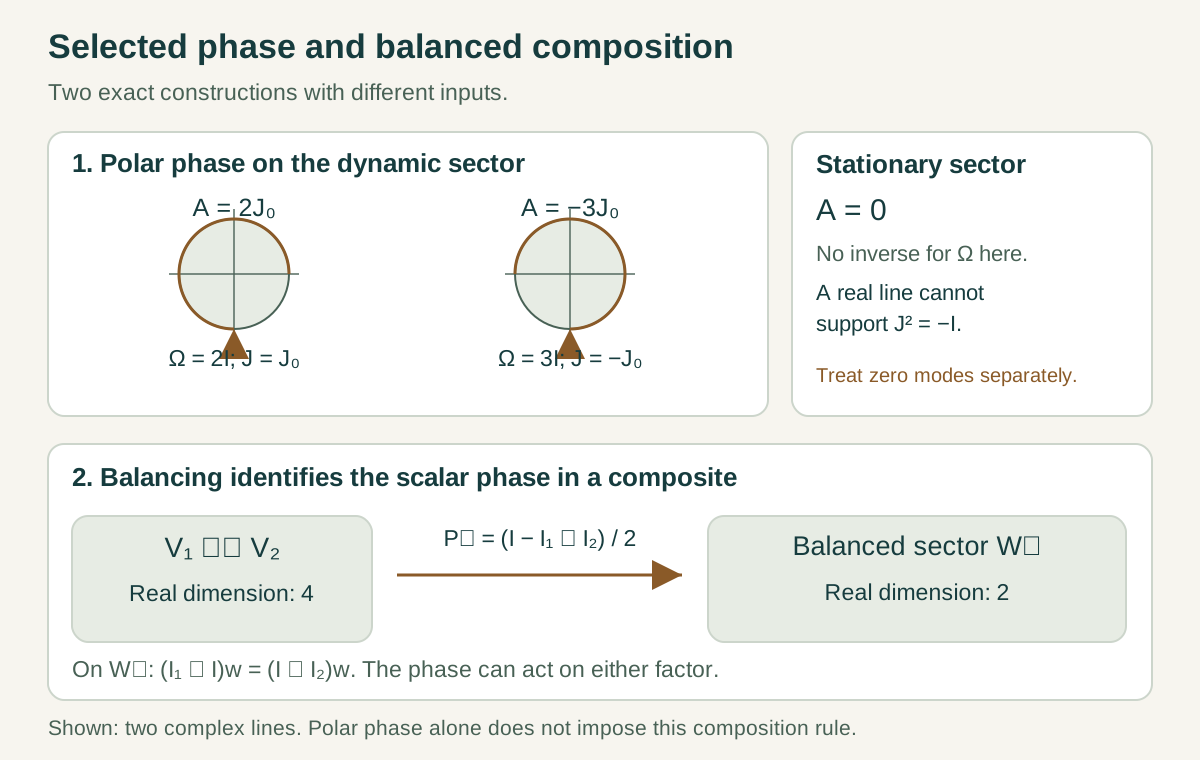
Let V₁ and V₂ be real vector spaces with operators J₁²=−I and J₂²=−I. Their real tensor product initially treats J₁x⊗y and x⊗J₂y as independent expressions. The ordinary complex tensor product identifies them: moving a common imaginary scalar from one factor to the other should not change the joint vector.
For two real planes regarded as complex lines, the real tensor product has dimension four, while the balanced quotient has real dimension two. For two complex two-level carriers, each underlying real space has dimension four; the real tensor product has dimension sixteen and the balanced space has dimension eight, as required for a four-dimensional complex composite.
The quotient is mathematically exact once the relation is declared. Physically, it says that the differences removed by balancing cannot be detected by any admitted preparation, transformation or completed test. Checking only an immediate output is too weak: a later joint operation could convert an apparently hidden difference into an observable label. The proposed equivalence must remain valid under every allowed continuation.
What should count as a complete joint record?
Local tomography means that the statistics of independently chosen local tests, including their correlations, determine the composite state. It does not mean the global state is a product, or that marginal statistics alone determine entanglement. The correlations are essential. In a complex two-qubit model, the sixteen products of I, X, Y and Z form an operator basis; after fixing trace, their statistics determine fifteen independent real parameters.
Requiring such completeness excludes the real two-level comparison just described when only its real local tests are admitted. It does not, by itself, prove all of complex quantum theory. A reconstruction still needs admissible state cones, transformations, independent preparation, probability rules and consistency for more than two systems.
A source record can also be intentionally incomplete. If the operational task permits only Z labels, preserving a full density matrix may be unnecessary. The issue then becomes whether that reduced record predicts every permitted later test. The record and memory guide supplies the right criterion: retained information is sufficient relative to a stated future test family.
Operations must respect the quotient too
Suppose a proposed source identifies a real tensor difference as zero but later permits an operation that maps that difference to a visible vector. The quotient has no well-defined evolution: two representatives of the same state acquire different successors. A necessary condition is that every allowed operation preserve the subspace of identified differences. This is a concrete algebraic test on each operation matrix.
For three carriers, the result should also be independent of whether one first composes the first two or the last two. The balancing rules must give a consistent common phase orientation, and independently controlled local transformations must embed consistently in the triple. A pairwise construction that works in isolation can fail this associativity check when incompatible identifications are chosen on different pairs.
Time reversal illustrates the care needed. Reversing all phase orientations together can be represented consistently by conjugation. Reversing only one factor changes how its scalar action is identified with the other factor. Whether that operation is available as a physical local control, an antilinear symmetry or an external comparison of conventions must be stated. Treating these as interchangeable can conceal an inconsistent composite rule.
What would constitute a source-based selection?
A useful construction starts with real source histories and a declared set of local preparation and completion operations. Define two histories to be equivalent only when every allowed future test gives the same statistics. Then prove that the resulting joint equivalence is precisely the phase-balanced quotient, or identify the additional sectors it retains.
A finite proof should exhibit enough tests to distinguish every retained parameter and demonstrate that the quotient is preserved by the work update. Repeat the construction for three systems. A numerical example can help locate the candidate subspace, but the central deliverable is the algebraic relation between source operations, observational equivalence and the resulting state space.
If an extra joint parameter survives, it creates a clear research direction: find an admissible joint experiment that detects it, or justify a source restriction that makes it permanently inaccessible. Either result strengthens the theory by explaining the scope of its composite records rather than presuming a familiar tensor product at the outset.
Develop the argument
Questions to take further
- Do all allowed continuations preserve the proposed phase-balancing relation?
- Can local product tests reconstruct every retained joint parameter, and does the answer remain consistent for three systems?
A concrete next step
Derive the observable composite
Specify local source preparations, joint updates and future tests for two and then three phase-bearing carriers. Define equivalence using those tests rather than assuming the complex tensor product.
What to share
The quotient state space, a distinguishing test basis, and proofs of operation compatibility and associativity.
I welcome collaboration with experts in physics, mathematics and philosophy. Get in touch with a question or proposal.