
Observational equivalence depends on the full family of allowed tests. Reduced dynamics closes only when hidden differences cannot change a later retained output.
What you will learn
- Construct a future test separating equal present observations.
- Check the finite linear condition for an autonomous retained update.
- Explain why discarded information can reappear as memory.
Before you begin: Lessons 01–02. The lesson introduces the needed two-coordinate matrix notation.
Ask the same future question of both preparations
Equality of present display values is easy to test: compare the displays. Equality as predictive states asks more. Apply the same allowed processing to each preparation, then compare the resulting observations. If any admitted procedure separates them, the preparations cannot share one predictive label for that experiment.
This is an operational definition, not a demand to retain every imaginable hidden detail. A difference that no allowed preparation, operation or measurement can reveal need not become a public distinction. The family of tests sets the resolution of the description. Expanding that family can split an old equivalence class, so a model must say which controls belong to its experimental interface.
Worked example: a hidden control bit
Let the full state be (b,m), with visible bit b and memory bit m. The current detector reports b. Compare (0,0) and (0,1): both display zero. Allow an update U that replaces b by b XOR m while retaining m. XOR means addition modulo two, so equal input bits produce zero and unequal bits produce one.
After U, the first state remains (0,0) and the second becomes (1,1). The same detector now reports different values. Therefore b alone cannot determine the next display under U. Retaining both bits repairs the prediction. Alternatively, remove U from the admitted controls; that changes the problem. Simply continuing to call the initial displays equivalent while using m later would leave the reduced update ambiguous.
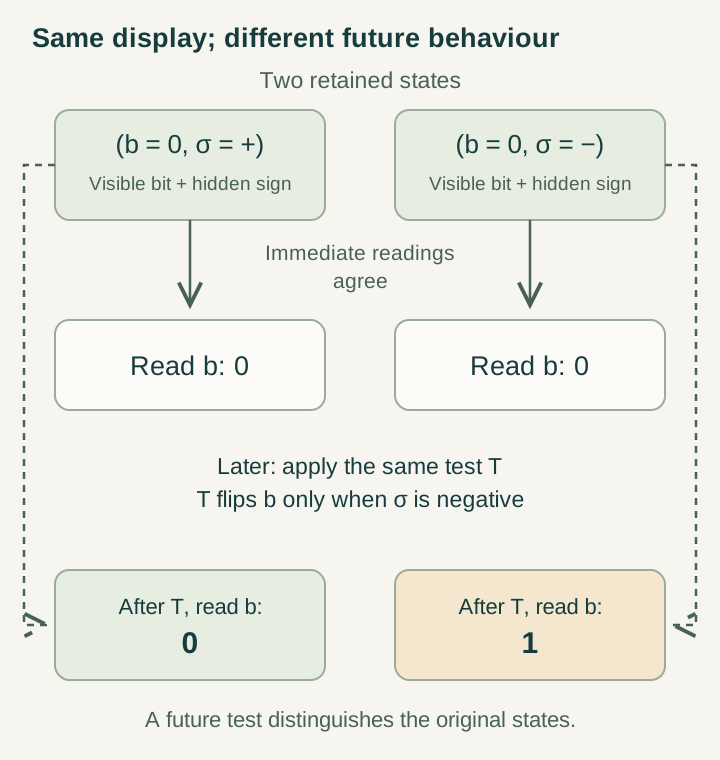
Open the full-size diagram →
When a reduced update is well defined
Let Π map a full state to its record. We seek an update V using only records, with V(Π(z))=Π(U(z)). This is possible precisely when any two full states with the same record still have the same record after U. The necessity is immediate: a function V cannot assign two outputs to one input.
For sufficiency, choose any representative z of a record r and define V(r)=Π(U(z)). The condition ensures that another representative gives the same result. This is the whole content of a well-defined update on equivalence classes. If many controls are admitted, the condition must hold for the relevant completed sequences, not merely for one conveniently chosen operation.
An exact two-coordinate check
Write a linear update as M(x,y)=(ax+by,cx+dy), where x is retained and y is hidden. The next visible coordinate is ax+by. Two states (x,y) and (x,y′) therefore differ next by b(y−y′). Autonomy for every hidden input holds exactly when b=0.
Here P keeps the retained component, Q keeps its complement, and I is the identity operation. Multiplying PM=TP by Q gives PMQ=0. Conversely that condition implies PM=PMP, so the visible part of M provides T. This is an information projection on vectors; a physical quantum measurement will need the different instrument construction in Lesson 07.
The chosen boundary can restore autonomy
Rotate a real plane through an angle θ while retaining only its first coordinate. The visible intermediate value generally depends on the hidden second coordinate. Now follow the rotation by its inverse before exposing a completed record. Their product is the identity, so the final retained value equals its initial value regardless of hidden input.
This example shows why inner leakage and completed leakage are different tests. Completion can be a boundary at which a reduced update closes, even when intermediate stages do not. It does not show that every source undoes its work. The actual source law must determine the sequence, and the completion flag must certify that the boundary has been reached before the simplified record rule is used.
What to do when a record is too small
There are three constructive responses to failed autonomy: retain more state, restrict the operation language, or let predictions depend on a recorded history. The last option gives memory equations. Eliminating a relaxing hidden variable can produce an exponentially weighted integral of earlier visible values together with a term depending on hidden initial preparation.
That memory is meaningful, but a model with one ordinary time parameter and an auxiliary variable can already produce it. To establish a distinctive DTT restriction, derive the permitted memory and its relation to independently measured source responses. The records and memory guide supplies the full elimination. Carry this lesson into the binary spatial demo: an accurate current coordinate need not be a sufficient predictive state.
Try the exercises
Work through each question, then open the answer to compare the steps.
Exercise 1
For M(x,y)=(3x+2y,y), compare initial states (1,0) and (1,4). Can a rule for x alone predict the next observation?
Show the worked answer
Both preparations display x=1. The first next display is 3×1+2×0=3; the second is 3×1+2×4=11. A function of the common input one cannot give both three and eleven. The difference eight equals bΔy=2×4. Retaining y, or forbidding this coupling, is necessary for an exact first-order reduced prediction.
Exercise 2
A quarter-turn sends (x,y) to (−y,x). Show what two quarter-turns do, and decide whether x alone predicts that completed result.
Show the worked answer
Apply the rule twice: (x,y) becomes (−y,x), then (−x,−y). The first component after one step depends on hidden y. After two steps it is −x, which depends only on retained x. Thus the two-step completed update closes as V(x)=−x even though the individual step does not. Its use requires that both steps have actually completed.
Continue with the articles
- When two histories count as the same observation
Introduce completion and observational equivalence as distinct ways of identifying histories. Explain why the tests available to an observer determine which differences survive.
- Test languages and observable quotients
Explore how richer tests alter the distinctions retained by a record model. Introduce the draft’s correspondence between test languages and observational congruences.
- Retained observations versus predictive states
Ask when retained information is sufficient to predict future outputs autonomously. Explain the completion criterion and why keeping observations need not keep every dynamically relevant distinction.