


What does complexification need to explain?
Counting successive configurations does not by itself explain quantum interference. In the two-path experiment, alternatives must be combined in a way that retains a relative phase. The question is therefore not simply how to attach the letter i to a description, but what structure makes that phase meaningful and compatible with the system's transformations. [B19]
The published phase-selection programme starts with a real Hilbert space and an orthogonal symmetry representation. It asks which real-linear operators can serve as imaginary units and how an oriented flow can select one. The order of construction matters: compatible structure first, dynamical orientation second, then a complex description under the relevant additional rules. [P03]
For the first experiment, use the real plane with coordinates (x,y), ordinary addition, and squared length x²+y². Those are supplied mathematical inputs. A quarter turn is the real map J₀(x,y)=(−y,x). There is no need to assume complex scalar multiplication in order to calculate its action.
Turn a real vector
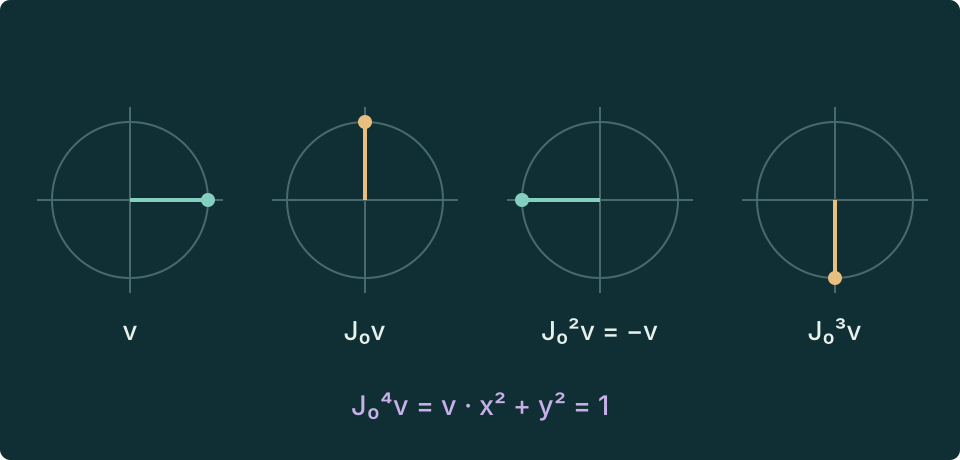
Drag the angle or press Play. The vector begins at (1,0), follows a unit circle, and retains squared length one. Step adds a quarter turn; Reset restores zero degrees. The animation parameter is an illustrative angle, not a calibrated second clock.
Explore · Exact finite illustration
Change the inputs and compare the numerical readout. Playback begins only when you press Play.
The interactive values require JavaScript. The diagram and worked equations provide the same mathematical construction.
At 90° the vector is (0,1); at 180° it is (−1,0); at 270° it is (0,−1). The live numerical readout gives the same information as the drawing. A complete rotation supplies a useful visual model of recurrent phase.
Build the algebra from the operator
Applying J₀ twice gives (−x,−y), so its square is minus the identity. Its transpose is its negative, and J₀ᵀJ₀=I. These properties make the quarter turn compatible with the Euclidean inner product.
Even powers of J₀ alternate between I and −I; odd powers alternate between J₀ and −J₀. Grouping the exponential series gives the cosine and sine terms. Multiplication of these matrices yields R(α)R(β)=R(α+β), while R(θ)ᵀR(θ)=I proves norm preservation.
This definition turns the real plane into a complex line. The algebra works because J₀²=−I. Writing z=x+iy is now a concise representation of the chosen quarter-turn structure, rather than the source of that structure.
The input behind the plane
In the larger reconstruction, the real inner product also needs a justification. The book describes a route from a supplied positive comparison kernel on histories: form formal linear combinations, remove null vectors, and complete in the induced norm. Positivity and compatibility with the intended tests are substantive assumptions in that route. [B21]
The plane is an exact finite example, not a derivation of the entire physical state space from a picture of the Monad. The SMM/DTT connection is the proposed role of oriented inner generation in selecting phase after an appropriate carrier is available. Outer records and their probabilities require further ingredients. [P02] [B02]
Continue to phase selection to see why a circle alone cannot choose between J₀ and −J₀. For the earlier distinction between generation and completion, see Duality and Emergence.