


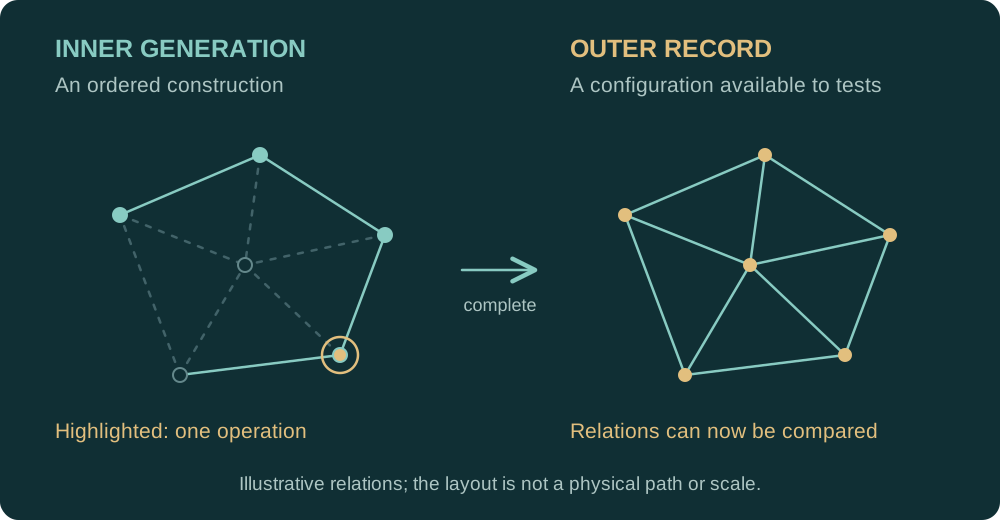
One process, two temporal roles
What if time does more than order changes in an already existing world? The Single Monad Model (SMM) proposes a common source for the distinctions that make up the world. Duality of Time Theory (DTT) asks how the activity of that source forms a configuration, and how the completed configuration becomes available to observation. These are the roles called inner-time generation and outer-time observation. [B01] [B02]
Inner time
The order of generative operations: forming relations, assembling a state, and satisfying the conditions for completion. An internal change need not create a new observable event.
Outer time
The succession of completed, accessible records. An observer compares these records to describe persistence, motion, and the passage measured by a physical clock.
The distinction is between constitution and availability. It is not merely the difference between a fast clock and a slow clock. Nor does it require a person to look before a record exists: a detector, an apparatus, or another physical system can retain the relevant correlation. A later human reading is a further event within this account.
See generation and observation separately
From inner steps to an outer record
Watch the working configuration grow. The observer’s panel changes only when a whole frame is completed. Playback speed and the drawn network are illustrative choices.
In the left panel, individual operations prepare a network. The right panel holds the last completed record while the next configuration is still under construction. At completion, the finished configuration is transferred to that panel and the outer record counter advances. Change the write order to see different preparations reach the same target.
The example uses independent writes to a predetermined configuration. That choice makes the final record independent of the schedule. In an interacting model, changing the order can change the result; independence must be established for the actual operations. The display illustrates the distinction between working state and available record without selecting a physical microscopic rule. [B09] [A06]
Follow the idea from intuition to mathematics
How a world is generated
The Single Monad, renewal, nested roles, and the difference between source order and spatial motion.
↗02 / EXPLOREWhen a result becomes observable
Completion, memory, predictive records, and why seeing the same display need not mean having the same state.
↗03 / EXPLOREFrom relations to spatial structure
Six paired roles, three readout directions, locality, and the distinct meanings of dimension.
↗04 / EXPLORETwo geometries of phase
Circular complex phase, hyperbolic temporal pairing, and the structures that connect them.
↗05 / EXPLOREInterference and records
Phase-sensitive alternatives, measurement interactions, finite capture, and retained information.
↗06 / EXPLOREFrom counts to clocks
Operational calibration, finite propagation, Lorentz cones, and the comparison of proper times.
↗07 / EXPLOREThe mathematical bridge
Completion maps, predictive closure, quaternionic readout, receiver ranks, and hidden-state memory.
↗08 / EXPLOREWhat a physical explanation must establish
Published results, model assumptions, observations, and the next testable questions.
↗Read the proposal at three levels
| Level | The question | What counts as support? |
|---|---|---|
| Conceptual / ontological | Can multiplicity and persistence be understood through one continuing source? | A coherent account of generation, renewal, and completed relations; historical and philosophical interpretation. |
| Mathematical | Which structures follow from explicitly stated rules? | Definitions, constructions, proofs, and counterexamples that reveal the role of each hypothesis. |
| Physical | Does a specified source model describe nature? | Calibrated observables, recovered established limits, and predictions tested independently of fitted inputs. |
The books develop the first level and its motivation. The published papers supply increasingly specific constructions at the second. The third requires identifying those constructions with physical systems and testing their consequences. Moving between these levels is the work of the programme; a compelling animation helps explain a construction but does not replace its physical test. [B16] [P01]
Choose a reading route
First encounter
Begin with inner generation, continue to outer observation, then explore space and dimensions. The glossary explains unfamiliar terms.
Technical reader
Start with the mathematical bridge, use the claim and evidence guide, and follow the four published papers in sources and reading.
All diagrams can be opened or downloaded individually. The visual atlas collects the illustrations and eight interactive explorations. Animations provide explicit controls and respect reduced-motion preferences.